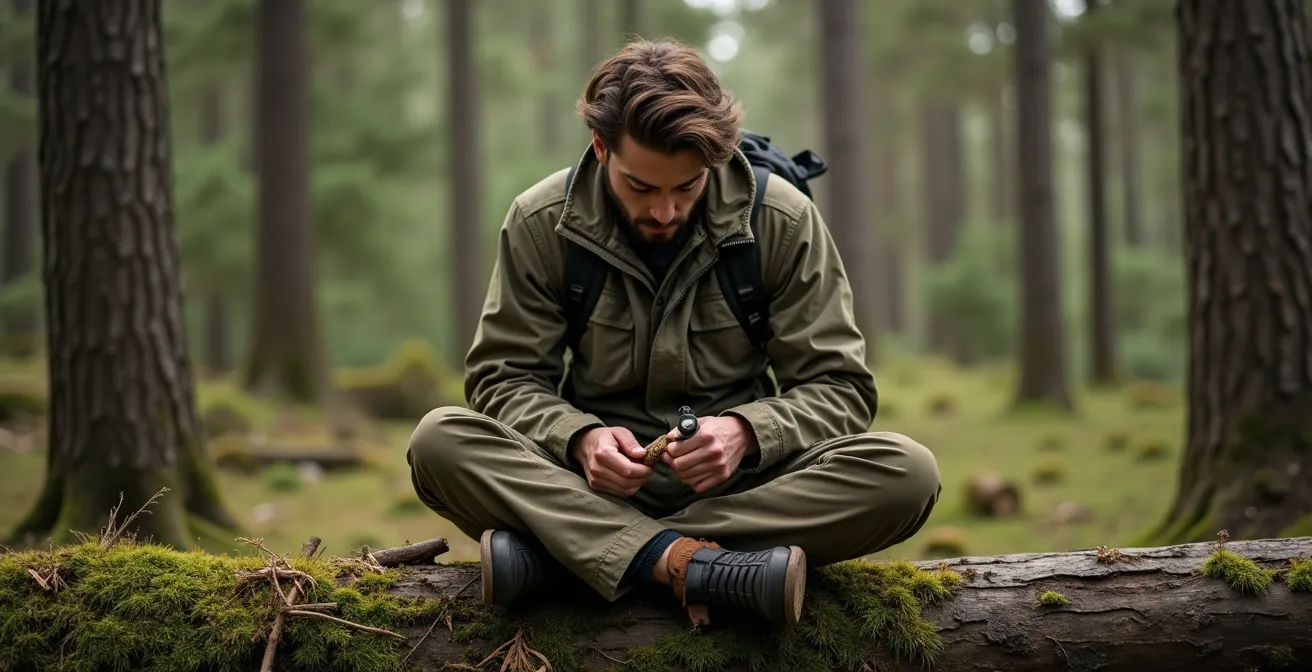
Contrary to popular belief, bushcraft’s power against anxiety doesn’t come from ‘escaping’ civilization, but from actively rewiring your brain through tangible, real-world problem-solving.
- It replaces abstract modern worries with immediate, solvable physical challenges, providing clear feedback loops that build agency.
- It forces a state of focused attention (a practical form of mindfulness) that physically calms the brain’s stress response.
Recommendation: Start with one skill, like fire-making without a lighter, to experience the profound mental shift from helplessness to competence.
In a world of constant notifications and abstract deadlines, a feeling of vague, persistent anxiety has become the background noise of modern life. You feel disconnected, perhaps even helpless, reliant on complex systems you can’t control. Many seek relief in meditation apps or digital detoxes, attempting to quiet the mind. But these often feel like temporary fixes, addressing symptoms rather than the root cause: a brain starved of tangible accomplishment and genuine agency.
What if the most potent antidote to this modern malaise wasn’t found by emptying your mind, but by focusing it with primal intensity? This is the core principle of bushcraft. It’s not about amassing gear or role-playing a post-apocalyptic scenario. It’s a powerful practice of cognitive re-engagement. By confronting and solving fundamental human problems—shelter, fire, navigation—you force your brain to shift from a state of passive worry to one of active, tangible problem-solving. This process doesn’t just distract you from anxiety; it fundamentally dismantles the feeling of helplessness that fuels it.
This guide isn’t a list of gadgets to buy. It’s a roadmap to a mindset. We will explore how specific, foundational bushcraft skills serve as practical exercises in mental resilience, rewiring your neural pathways to build a calmer, more capable, and self-reliant you. It’s about learning that you are more competent than you think, a realization that no app can provide.
For those who prefer a visual introduction, the following video explores how engaging with nature and learning outdoor skills can be a powerful tool for improving mental health, complementing the mindset-focused principles we’ll discuss.
To guide you through this journey of rediscovering your innate capabilities, we will break down the essential skills and the psychological benefits they unlock. This exploration will show you precisely how each task, from building a fire to navigating your way home, directly counters a specific aspect of modern anxiety.
Summary: How Bushcraft Builds Psychological Resilience
- Why Dependence on Lighters Is a Survival Liability
- How to Build a Debris Shelter That Actually Retains Heat?
- Foraging Myths: The Danger of “Look-Alike” Mushrooms
- The “STOP” Rule: What to Do the Moment You Realize You Are Lost
- Maintaining Your Tool: How to Sharpen a Knife in the Field?
- Adjusting Your Pack: The Torso Length Measurement You Must Know
- Why 3 Days in Nature Lowers Your Stress Markers by 50%
- How to Prepare for High-Altitude Trekking Safely?
Why Dependence on Lighters Is a Survival Liability
A lighter is a marvel of convenience, but its greatest weakness is psychological: it teaches you nothing. It provides fire without effort, reinforcing a mindset of dependency. When it fails—gets wet, runs out of fuel, breaks—it can trigger a cascade of panic because there is no underlying skill to fall back on. This is the essence of the “agency deficit” that plagues modern life. Learning to create fire by friction, with a bow drill, for instance, is the direct antidote. It’s a difficult, often frustrating process that provides an immediate and unambiguous feedback loop. It either works or it doesn’t.
The challenge is immense; it’s estimated that only one percent of the population can successfully make fire this way. But succeeding, even after dozens of failed attempts, is transformative. It’s not just about getting warm; it’s a visceral declaration of self-reliance. You have taken chaos—two sticks and a string—and created order and energy. This act of primal competence hard-wires a sense of capability into your psyche that a thousand successful emails at work never could. It proves, in the most fundamental way, that you can provide for your own needs.
As survival instructor Jon’s Bushcraft notes in his bow drill guide, the mental aspect is paramount. He explains that success is not just a matter of physical technique:
Half of the skill is in the mind. If you remain persistent and calm after many failed attempts you will eventually achieve fire.
– Jon’s Bushcraft, Bow Drill Tutorial Guide
This persistence in the face of failure is the core of resilience. The anxiety of “what if my lighter fails?” is replaced by the quiet confidence of “I know how to create fire.” You have traded a fragile dependency for a robust, internal skill.
How to Build a Debris Shelter That Actually Retains Heat?
The feeling of being exposed and vulnerable is a cornerstone of anxiety. Your home is a complex structure you likely had no hand in building. A debris shelter is the opposite: a direct, tangible solution to the fundamental need for safety, constructed by your own hands. This isn’t just about piling up leaves; it’s an exercise in applied physics and environmental awareness. To build one that works, you must understand principles of insulation, wind direction, and structural integrity. You are actively imposing order on your environment to meet a core need.
This process of tangible problem-solving is a powerful mental reset. While urban anxiety often stems from abstract threats with no clear solution, the problem of “being cold” has a direct, physical answer: build a better wall, add more insulation. Each branch laid and each handful of leaves packed is a small victory, a step toward a measurable goal. Evidence suggests that just living near nature helps, with studies showing that those around green spaces are 20% less likely to suffer from anxiety. Actively engaging with that environment to create something essential amplifies this effect exponentially.
A proper debris shelter, like a lean-to with thick, compressed walls of leaves and duff, creates a micro-environment. The goal is to make the interior space as small as possible to trap your body heat. The walls should be at least an arm’s length thick. This methodical, physical labor focuses the mind completely, leaving no room for the free-floating worries of daily life. You are not just building a shelter; you are building a physical manifestation of your own competence and ability to care for yourself.
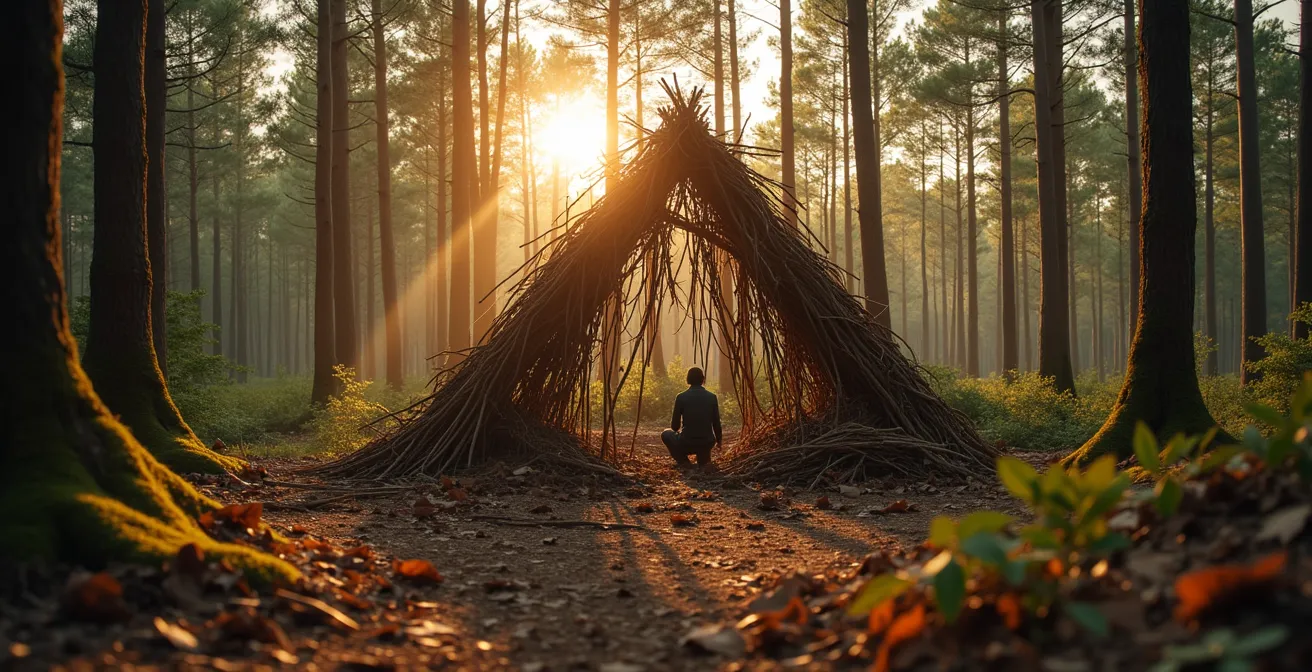
As you can see in this process, the act is meditative and purposeful. You are not just escaping stress; you are actively constructing security. The finished shelter, no matter how rustic, is a powerful symbol. It’s proof that you can turn the raw materials of the natural world into a place of safety and warmth, a profound realization for anyone feeling helpless in a complex world.
Foraging Myths: The Danger of “Look-Alike” Mushrooms
Foraging for wild edibles connects you to the landscape in an intimate way, but it’s also an exercise in high-stakes observation. The common myth is that you can learn a few “easy” plants and be set. The reality, especially with fungi, is that nature is full of dangerous look-alikes. The difference between a delicious Chanterelle and a toxic Jack-o’-Lantern mushroom can be subtle. This inherent risk is not a reason to avoid foraging, but the very reason it’s a powerful tool against anxiety. It demands absolute, unwavering attention to detail.
When you are scrutinizing the gill structure, spore color, and growth substrate of a mushroom, your mind has no capacity for abstract worry. Your focus is narrowed to the present moment and the tangible object in your hand. This is not passive mindfulness; it is an active, engaged state of hyper-awareness driven by a real need for safety. Research into the therapeutic benefits of crafting shows that such focused activities are highly effective, with studies indicating that incorporating crafts can lead to a reduction in symptoms for those with anxiety and depression. Foraging is nature’s craft, with the highest possible stakes.
This intense focus trains your brain to filter out noise and concentrate on what is real and immediate. You learn to trust your own judgment, backed by careful study and cross-referencing. This builds a form of intellectual self-reliance. Overcoming the initial fear through knowledge and cautious practice replaces anxiety with a deep sense of respect for nature and confidence in your ability to interact with it safely. To cultivate this focused state, you can apply principles from other bushcraft activities.
Your Action Plan: Training a Focused Mind
- Carving: Practice carving with full, granular focus on each slice of wood and the immediate texture.
- Fire Making: Engage in the process of creating fire by friction, as it demands your complete presence and attention to succeed.
- Wood Processing: Process wood for a fire methodically, focusing on the slow, steady progress to calm the brain.
- Flora Identification: Practice identifying local plants and fungi (without consuming them) to develop your sensory awareness and attention to detail.
- Wildlife Tracking: Attempt to find and follow animal tracks, a task that requires sustained, focused attention on patterns in the environment.
By engaging in these tasks, you are not just learning skills; you are actively practicing the art of being present and focused, a mental muscle that directly counteracts the scattered state of anxiety.
The “STOP” Rule: What to Do the Moment You Realize You Are Lost
The moment you realize you are lost is a critical juncture. The primal brain screams panic, an emotional flood that shuts down rational thought. This is the wilderness equivalent of a full-blown anxiety attack. The “STOP” rule is a simple but profoundly effective cognitive tool designed to override this destructive impulse. It’s an acronym that stands for Stop, Think, Observe, and Plan. It is the perfect metaphor for how bushcraft trains the mind: it replaces a chaotic emotional reaction with a structured, logical procedure.
Stopping is the most crucial and counter-intuitive step. Panic tells you to move, to do *something*. Stopping is an act of deliberate will that breaks the feedback loop of fear. It gives your rational mind a chance to come back online. This is the moment you reclaim control. Once calm, you can Think. Where did you last know your location? What resources do you have? You are shifting from victim to problem-solver. As experts at Texas Bushcraft emphasize, the simple act of stopping is the first and most critical step to prevent getting further lost and to manage the initial wave of stress.
Next, you Observe. You assess your immediate environment. Is there water? Shelter potential? What direction was the sun? This is data collection, not panicked guessing. Finally, with a calmer mind and a set of observations, you Plan. The plan might be simple: stay put and make yourself visible. Or it might be to follow a water source downstream. The plan itself is less important than the process of creating one. The act of planning transforms you from a lost person into a person who is temporarily stationary and working on a solution. This is the essence of agency, and it’s a skill that translates directly back to managing the “lost” feelings of modern life.
Maintaining Your Tool: How to Sharpen a Knife in the Field?
In bushcraft, a knife is not a disposable item; it is your primary tool, an extension of your will. Its effectiveness depends entirely on your ability to maintain it. The act of sharpening a knife in the field, using a whetstone or even a suitable river rock, is a deeply meditative and empowering practice. It embodies the principle of caring for that which cares for you. This task requires precision, patience, and a delicate touch—qualities that are the antithesis of a rushed, anxious mindset.
Holding a consistent angle, feeling the burr form on the edge, and methodically working your way through progressively finer grits demands a state of “flow.” Your world shrinks to the point of contact between steel and stone. As bushcraft writer Chris M. beautifully describes, this state is a paradox of intense focus and mental ease.
If you’ve ever sat carving a stick with a knife, you’ll know the paradox of being fully focused, while mentally at ease… You aren’t thinking about the stresses and concerns of life outside of the moment, because you need your attention on the task at hand. In combination with an acceptance to take your time with slow, methodical progress, this is a fantastic way of calming the brain.
– Chris M., Bushcraft UK – Bushcraft and Your Mental Health
This “calming of the brain” through a productive, focused task is a core benefit. Unlike the abstract goals of office work, the result of sharpening a knife is immediate and satisfying. It either cuts cleanly, or it doesn’t. This clear feedback reinforces your sense of accomplishment.
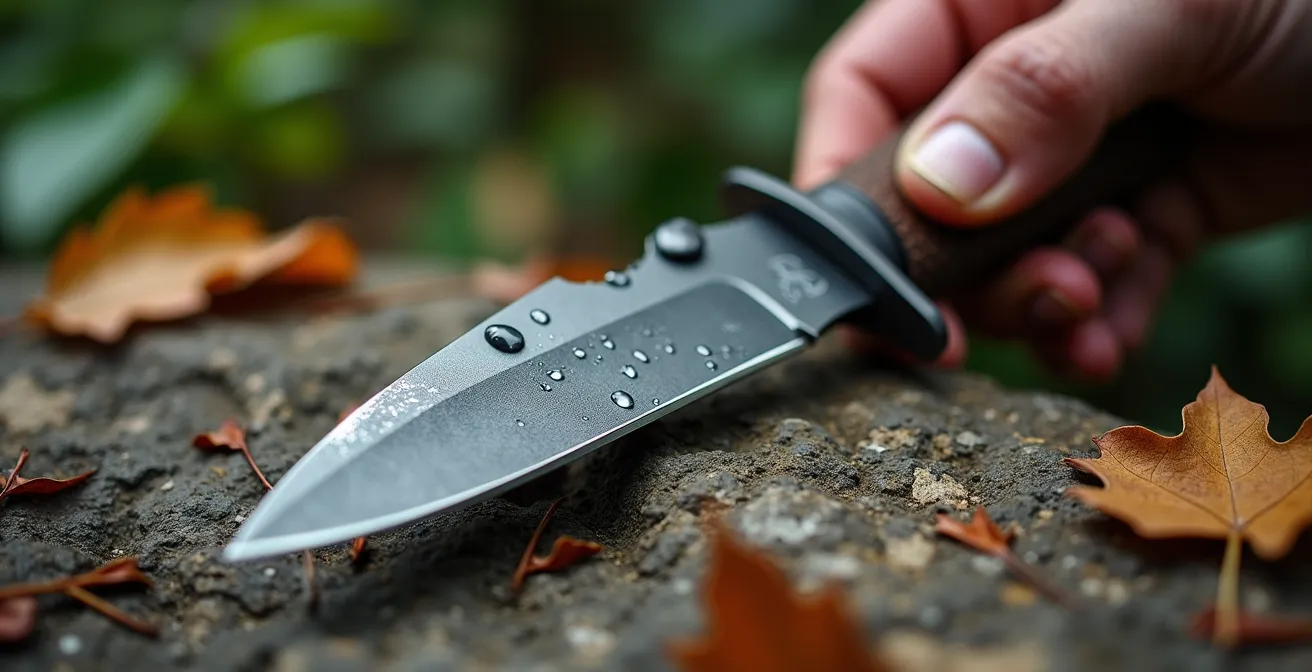
The responsibility of maintaining your most crucial tool builds a mindset of stewardship and foresight. You are not just reacting to problems; you are preventing them. This proactive competence is a powerful antidote to the reactive anxiety that comes from feeling like events are always happening *to* you. By maintaining your tools, you are affirming your ability to shape your circumstances.
Adjusting Your Pack: The Torso Length Measurement You Must Know
While the mindset is paramount, ignoring the physical realities of bushcraft is a recipe for misery. An improperly fitted backpack is a prime example. It creates hot spots, strains your shoulders, and puts undue pressure on your hips, turning a potentially restorative hike into an ordeal. This physical discomfort becomes a constant, nagging distraction, making it impossible to achieve the mental calm you’re seeking. This is why a seemingly mundane technical detail—your torso length—is critically important.
Your torso length, the distance from your C7 vertebra (the bony bump at the base of your neck) to your iliac crest (the top of your hip bones), determines how a pack’s internal frame and load-lifters will distribute weight. A proper fit ensures that the majority of the weight (around 80%) rests on your hips, not your shoulders. Getting this right is a form of proactive problem-solving. You are preventing the physical stress that would otherwise sabotage the psychological benefits of your time in nature.
Think of it as setting the stage for success. By taking the time to measure and adjust your gear properly *before* you set out, you are demonstrating foresight and respect for your own well-being. This act of preparation is a small but significant deposit in your bank of self-reliance. It reinforces the idea that you are in control of your comfort and safety. When your body is comfortable, your mind is free to engage with the environment, to observe, and to find the peace and focus that strong scientific evidence shows helps to reduce the stress hormone, cortisol. Ignoring this step is like trying to meditate in a room with a fire alarm blaring; it’s simply counter-productive.
Why 3 Days in Nature Lowers Your Stress Markers by 50%
The profound sense of calm that descends after a few days in the wilderness is not just a feeling; it’s a measurable physiological phenomenon. The generalized advice to “get some fresh air” vastly understates the biological reset that occurs when you immerse yourself in a natural environment. The key lies in the dramatic reduction of the stress hormone, cortisol. The constant, low-grade stressors of urban life keep our cortisol levels chronically elevated, contributing to anxiety and a host of other health problems.
Research from the University of Michigan provides compelling evidence for the power of a “nature pill.” In one study, participants were simply asked to spend time in a natural setting for at least 10 minutes, three times a week. The results were striking: the data showed that a nature experience led to a 21.3% per hour drop in cortisol levels. The study found the greatest efficiency came from sessions lasting 20 to 30 minutes. When this exposure is extended over several days, and combined with the tangible problem-solving of bushcraft, the effect is compounded.
The “why” behind this is twofold. First, nature removes the triggers of urban stress—traffic, noise, digital demands. Second, and more importantly for our purposes, it provides the brain with a different kind of stimulation. The fractal patterns in leaves, the sound of wind in the trees, and the feel of earth underfoot are complex but non-threatening stimuli. This “soft fascination” allows the mind’s directed-attention mechanisms to rest and recover. When you add the focused tasks of bushcraft to this restorative environment, you create the optimal conditions for lowering stress. You are not just passively receiving nature’s benefits; you are actively participating in a process that calms your body and sharpens your mind.
Case Study: The University of Michigan “Nature Pill” Study
In an 8-week study, researchers asked participants to take a “nature pill”—spending 10 minutes or more in a place that brought them a sense of contact with nature, at least 3 times a week. Saliva samples were taken to measure levels of the stress hormone cortisol before and after these nature experiences. The findings provided the first real estimate of how much time in nature is needed to tangibly lower stress, demonstrating a significant drop in cortisol and providing a scientific basis for prescribing nature experiences as a health intervention.
Key Takeaways
- True anxiety reduction from bushcraft comes from rewiring the brain through tangible challenges, not just “escaping” to nature.
- Skills like friction fire and shelter building provide immediate, non-ambiguous feedback loops that build a profound sense of agency and competence.
- The focused, high-stakes attention required for tasks like foraging or knife sharpening is a form of active mindfulness that physically calms the brain’s stress response.
How to Prepare for High-Altitude Trekking Safely?
Pushing into high-altitude environments represents the culmination of bushcraft philosophy: deliberately facing a significant, multifaceted challenge to forge resilience. The preparation required goes far beyond simply packing warm clothes. It demands a deep understanding of acclimatization, the symptoms of altitude sickness (AMS), and the humbling reality that the mountain, not you, dictates the pace. This is the ultimate exercise in letting go of ego and listening to your body and the environment.
Safely preparing involves a slow, staged ascent to allow your body to produce more red blood cells. It means staying hyper-hydrated and recognizing the early warning signs of AMS—headache, nausea, fatigue—not as weaknesses to be pushed through, but as vital data points requiring an immediate response: stop, rest, or descend. This process is a masterclass in self-awareness and humility. In a world that rewards rushing and “powering through,” high-altitude trekking forces a methodical, patient approach. The penalty for hubris is severe, making it a powerful teacher.
The anxiety here is not abstract; it’s the very real threat of physical incapacitation. By learning to manage this risk through knowledge, preparation, and cautious execution, you are building the highest form of resilience. You are learning to operate calmly under significant physiological and psychological pressure. Every step taken at altitude is a testament to your preparation and adaptability. The confidence gained from safely navigating such a challenging environment is immense and lasting. It’s the final proof that the skills and mindset cultivated at sea level are not just hobbies, but a robust framework for facing any of life’s challenges, no matter how high the peak.
Your journey into bushcraft is the first step toward reclaiming your innate capability and quieting the noise of modern anxiety. Begin by choosing one skill that calls to you and commit to the process of learning it. The path to a resilient mind starts not with a grand escape, but with a single, deliberate act of self-reliance.