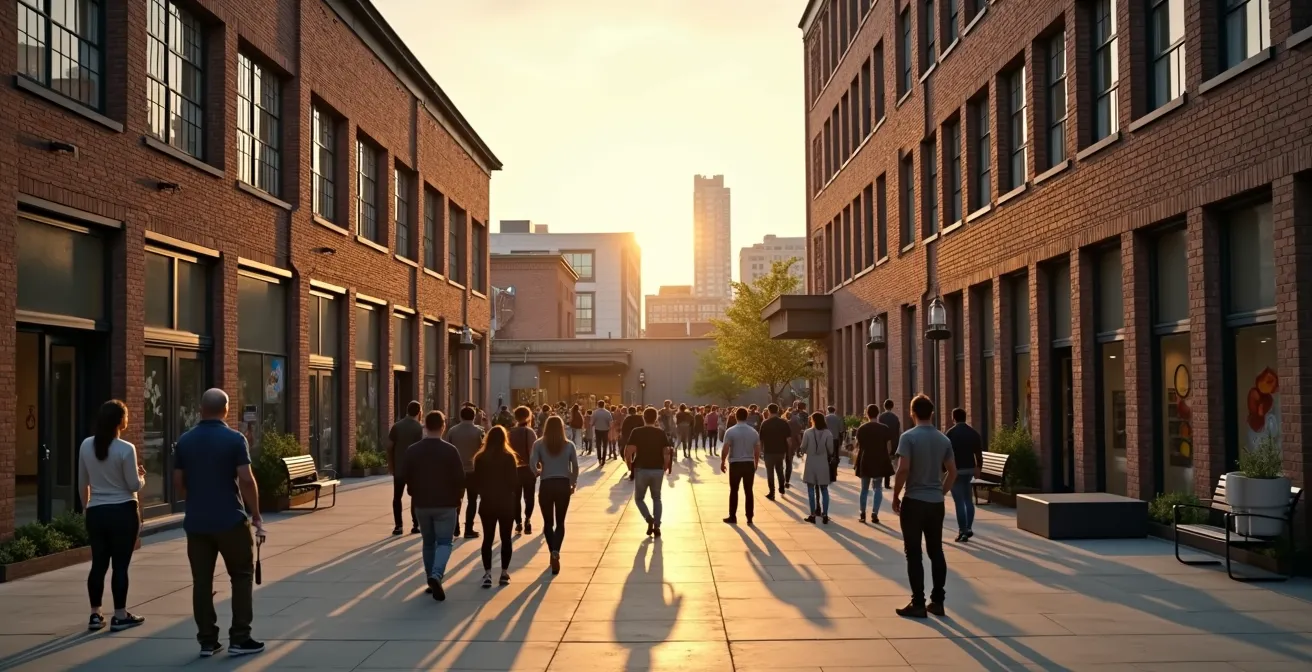
Creative urban renewal is not a gamble on culture, but a predictable economic engine when investments are properly sequenced and managed as a complete ecosystem.
- Success hinges on a phased approach, starting with low-cost temporary projects to prove viability before committing to permanent, capital-intensive infrastructure.
- A resilient “creative ecosystem” requires nurturing a mix of stable agency jobs and supported freelance talent, funded by a diverse “revenue stack” that goes beyond ticket sales.
Recommendation: Shift focus from building a single landmark to cultivating the entire ecosystem—talent, funding, and policy—to generate measurable and sustainable economic returns.
For decades, the story of urban revitalization through arts and culture has been dominated by the towering, titanium-clad image of the Guggenheim Museum in Bilbao. This narrative, often simplified to “build a museum and they will come,” has led many city planners and investors down a path of high-risk, high-cost landmark projects. This approach treats cultural investment as an act of faith, a hopeful gamble that often overlooks the complex economic mechanics required for true, sustainable transformation. The common advice to “support local artists” or “create an arts district” remains frustratingly vague, lacking a clear roadmap for measurable return on investment.
But what if the “Bilbao Effect” is not a miracle, but a replicable system? What if the key to unlocking the economic power of creative industries lies not in a single monumental gesture, but in understanding the underlying systems of talent, capital, and space? The real challenge for a city planner or investor is to move beyond cultural patronage and adopt the mindset of an urban economist. This means deconstructing the process into a series of calculated, sequential investments designed to build a complete, self-sustaining creative ecosystem.
This analysis will move beyond the platitudes to provide an economic blueprint for creative revitalization. We will explore the macro-economic justification for cultural investment, dissect the talent pipeline required to fuel it, and analyze the financial models that ensure its long-term stability. By focusing on investment sequencing and risk mitigation, we will demonstrate how temporary interventions can pave the way for permanent change, transforming dying urban centers into thriving, resilient hubs of innovation and growth.
To navigate this complex economic landscape, this article provides a structured analysis of the key components for a successful creative revitalization strategy. The following sections break down everything from the global economic impact of culture to the practical steps of funding and implementation.
Summary: The Bilbao Effect Deconstructed
- Why Nations Invest Billions in Cultural Exports
- How to Transition from Corporate to Creative Without Losing Income?
- Agency or Freelance: Which Creative Path Offers More Stability?
- The Risk of AI-Generated Content for Creative Professionals
- Identifying Grants: Where to Find Funding for Cultural Projects?
- Sequencing Urban Change: How Temporary Projects Lead to Permanent Fixes
- Why Are Hardware Companies Switching to Subscription Models?
- Skill-Based Volunteering: How to Donate Expertise Instead of Labor?
Why Nations Invest Billions in Cultural Exports
From an economic standpoint, the decision for nations to heavily invest in their cultural and creative industries (CCIs) is a strategic one, not a sentimental one. These investments are driven by the significant and measurable impact these sectors have on national economies and global influence. The economic stakes are substantial, with the creative economy contributing anywhere from 0.5% to 7.3% of national GDP, according to a 2024 global survey by UNCTAD. This demonstrates that culture is not a peripheral expense but a core economic engine capable of generating substantial revenue and fostering national identity on the world stage.
This national-level strategy provides the foundational logic for local-level urban investment. When a country champions its “soft power” through film, music, or design, it creates a powerful brand that cities can leverage. A prime example of this synergy is Seoul’s Digital Media City. The city leveraged the global “Korean Wave” phenomenon by transforming a former landfill into a state-of-the-art industrial cluster for media, entertainment, and IT. This was not merely an urban beautification project; it was a calculated move to capitalize on a national cultural trend, creating a physical hub that concentrates talent, production, and capital. For urban planners, this illustrates the importance of aligning local creative projects with broader national or global cultural currents to maximize impact and attract investment.
Ultimately, a nation’s investment in cultural exports creates a top-down validation for the economic viability of the creative sector. It sends a clear signal to global markets, tourists, and investors that the country’s creative output is a valuable asset. This macro-level support de-risks local investments and provides a framework within which cities can develop their own unique creative ecosystems, confident that they are contributing to a larger, economically significant national project.
How to Transition from Corporate to Creative Without Losing Income?
A thriving creative ecosystem is not built on starving artists. For urban revitalization to be sustainable, it must be powered by a stable, professional talent pipeline. This raises a critical question for planners: how do you attract and retain skilled individuals, many of whom may be transitioning from more traditionally stable corporate careers? The answer lies in demonstrating that the creative sector offers viable, long-term career paths, not just precarious gig work. The data shows this is more than a theoretical possibility. In hubs like New York City, for instance, the Creative Media segment saw an employment surge of almost 20% by 2022, indicating robust job creation.
However, a simple job count is insufficient. The structure of that employment matters. The transition from a salaried corporate job to a creative career often involves navigating the complex choice between freelance work and traditional employment within an agency or institution. This choice has significant implications for income stability, a key factor for anyone considering the leap. The perceived freedom of freelancing can come at a steep cost. As the NYC Comptroller’s Office noted in its “Spotlight on New York City’s Creative Economy” report, this disparity can be stark, highlighting the economic realities that professionals face.
For an urban planner, understanding this dynamic is crucial for designing effective support systems. Simply hoping creative talent will appear is not a strategy. A city must create an environment that addresses the economic anxieties of this transition. This could include policies that support “hybrid” careers, incubators that provide business training for freelancers, or incentives that encourage creative agencies to establish a local presence. By focusing on the economic security of creative professionals, a city can build a deep and resilient talent pool, ensuring its revitalized urban core is powered by skilled individuals who see a long-term future there.
Agency or Freelance: Which Creative Path Offers More Stability?
Delving deeper into the structure of the creative workforce reveals a fundamental dichotomy: the relative stability of establishment employment versus the autonomy of freelancing. For an urban economist analyzing the health of a creative ecosystem, this is not a philosophical debate but a practical one with significant economic implications. The stability of the workforce directly impacts tax revenues, real estate demand, and local spending. A city filled with financially insecure freelancers is a far more volatile economic base than one with a healthy mix of small businesses, agencies, and stable institutions.
The data provides a clear, if nuanced, picture of this trade-off. While freelance work offers flexibility, it often comes with a significant income penalty in many creative roles. Analyzing data from a major creative hub gives us a granular view of this reality.
The following table, based on analysis from the NYC Comptroller’s Office report on the creative economy, compares average incomes for several creative roles, highlighting the often-dramatic gap between those employed by an establishment and their freelance counterparts.
| Creative Role | Establishment Employment | Freelance Income |
|---|---|---|
| Actors | $78,000 | $52,000 |
| Musicians/Singers | $107,000 | $38,000 |
| Dancers/Entertainers | $69,000 | $36,000 |
| Artists | $63,000 | $82,000 |
Interestingly, the role of “Artist” is a notable exception, where freelancers report higher average incomes. This suggests that for certain disciplines, direct access to the market may be more lucrative. However, for most performance-based roles, the stability and benefits of institutional employment provide a clear financial advantage. This data is critical for urban planners. It suggests that a strategy focused solely on supporting individual freelancers may be insufficient. A truly resilient creative ecosystem needs to attract and retain both freelancers and established creative companies.
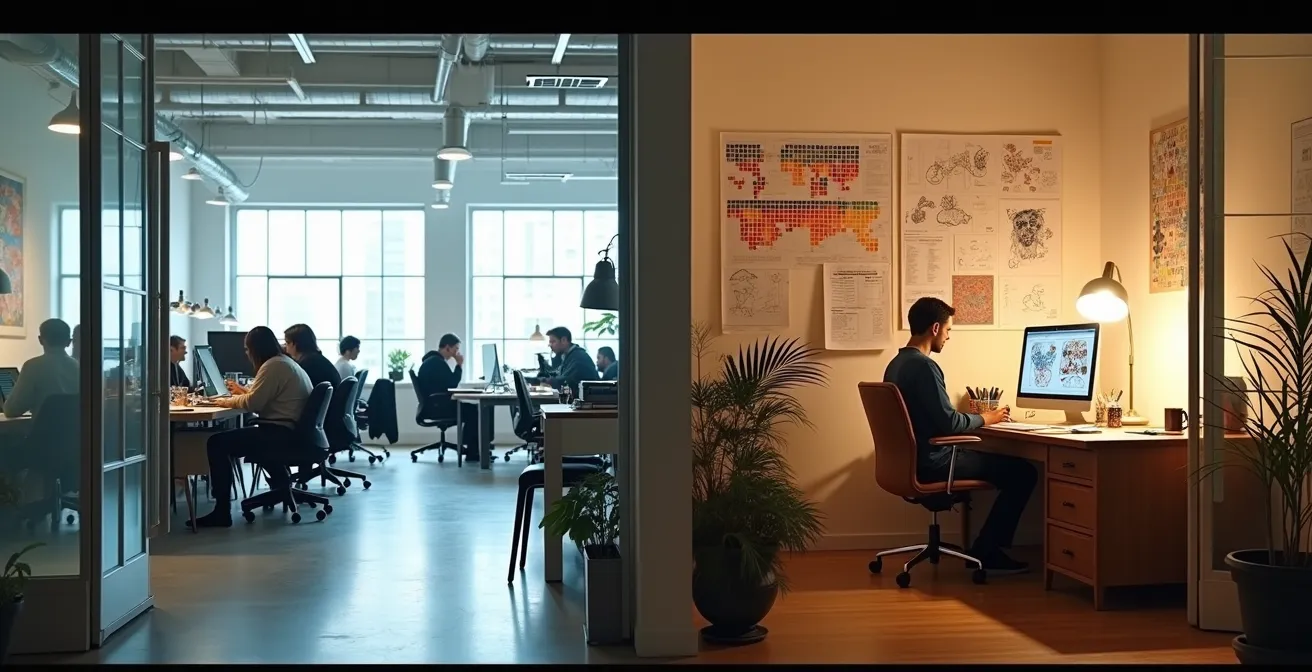
This duality—the collaborative energy of an agency versus the focused independence of a home studio—is the engine of a healthy creative economy. Planners can foster this by creating a diverse range of workspaces, from affordable co-working hubs for freelancers to larger commercial spaces suitable for growing agencies. Policy should aim not to pick a winner, but to ensure both paths are viable, creating a balanced and dynamic workforce that can weather economic shifts and drive sustained urban growth.
The Risk of AI-Generated Content for Creative Professionals
Any sound investment strategy must account for future risks, and in the creative sector, no risk looms larger than the rise of artificial intelligence. With global cultural and creative industries revenues estimated at $2.25 trillion annually, the economic disruption potential of AI is massive. For urban planners and investors betting on a creative-led revitalization, the question is stark: are we investing in a sector on the verge of obsolescence? This is not a distant threat; it is an active variable that must be factored into any long-term economic model for urban renewal.
The risk is that AI will commoditize the more generic forms of creative work, hollowing out the middle tier of the creative economy and devaluing skills that were once a stable source of income. This could undermine the very talent base a city is trying to cultivate. However, this risk also presents a strategic opportunity. The antidote to generic, AI-generated content is hyper-local, authentic, and uniquely human creativity. The future value of a city’s creative ecosystem will not lie in its ability to produce mass-market content, but in its capacity to nurture stories, aesthetics, and experiences that are inextricably tied to its specific place, history, and culture.
The story of Kobe, Japan, offers a powerful, if unconventional, lesson here. After the devastating 1995 earthquake, Kobe’s renewal strategy was built not on generic reconstruction, but on its unique history as Japan’s first open port—a legacy of tolerance and cultural exchange. This deeply human and historically specific identity became the foundation for its economic and cultural rebirth, fostering an inclusive creative environment that could never be replicated by an algorithm. For today’s urban planners, the lesson is clear: to future-proof a creative investment, one must double down on what makes a place unique. The most durable creative assets will be those that AI cannot fake: authenticity, community, and a deep sense of place.
Identifying Grants: Where to Find Funding for Cultural Projects?
Capital is the lifeblood of any revitalization effort, but simply throwing money at cultural projects is a recipe for failure. A strategic funding approach, much like a venture capital portfolio, requires diversifying investments across different stages of development. For an urban planner, this means creating a “funding stack” that can support projects from their initial experimental phase through to maturity and long-term sustainability. This is not about one-off grants; it’s about a sequenced financing strategy that nurtures the entire creative ecosystem.
This approach involves categorizing funding opportunities based on their strategic objective. Seed grants are for testing new, unproven ideas. Growth grants help scale successful pilots. Sustainability grants are perhaps the most critical and often overlooked; they protect the very creative ecosystems that have been successfully established from the pressures of their own success, namely gentrification. As a joint World Bank-UNESCO report warns, city leaders must actively manage these pressures, because “steep rents [can] kill a creative neighborhood.” This highlights that funding isn’t just for creation, but also for preservation.
City leaders must consider the effects on rents and livability for the poor… governments must address the dangers of gentrification before steep rents kill a creative neighborhood.
– World Bank-UNESCO, Cities, Culture, Creativity Report
To put this into practice, planners can develop a clear framework for identifying and deploying different types of financial support. The following checklist outlines a strategic approach to building a comprehensive funding program for urban creative development.
Action Plan: Structuring a Strategic Grant Program
- Seed Grants: Identify and fund temporary, experimental creative projects that can serve as low-cost prototypes for revitalization in its earliest stages.
- Growth Grants: Establish metrics to evaluate pilot projects and create a funding track to scale those that demonstrate clear community impact and economic potential.
- Sustainability Grants: Proactively allocate funds to protect established creative ecosystems from rent hikes and displacement, through mechanisms like affordable housing or commercial rent stabilization for artists.
- Safety Net Programs: Research and implement models like those in Angoulême (France) or Santos (Brazil) to provide income support and social protections for creative professionals with unstable earnings.
- Public-Private Partnerships: Structure initial public funding in a way that it serves as leverage to unlock larger private investments, de-risking the project for commercial backers and multiplying the impact of public money.
Sequencing Urban Change: How Temporary Projects Lead to Permanent Fixes
The most profound and sustainable urban transformations often begin not with a groundbreaking ceremony for a new museum, but with a pop-up gallery, a street festival, or a temporary art installation. This principle of investment sequencing is the core of a smart, low-risk revitalization strategy. Temporary, low-cost projects—often called “urban prototyping” or “tactical urbanism”—act as real-world feasibility studies. They allow planners and investors to test ideas, gauge community response, and gather data on foot traffic and local engagement before committing to massive, irreversible capital expenditures.
This phased approach effectively de-risks the entire process of urban renewal. A successful pop-up event can prove the demand for a permanent cultural venue. A series of weekend markets can build the case for pedestrianizing a street. This bottom-up momentum creates a powerful narrative of organic growth that is far more compelling to investors and residents than a top-down, master-planned project. The transformation of Belgrade’s Savamala district is a textbook example. The area’s revitalization was driven by grassroots, bottom-up creative activities that initially had very limited public support. These small-scale interventions gradually built a vibrant cultural scene that eventually attracted larger investments and led to the area’s wholesale transformation.
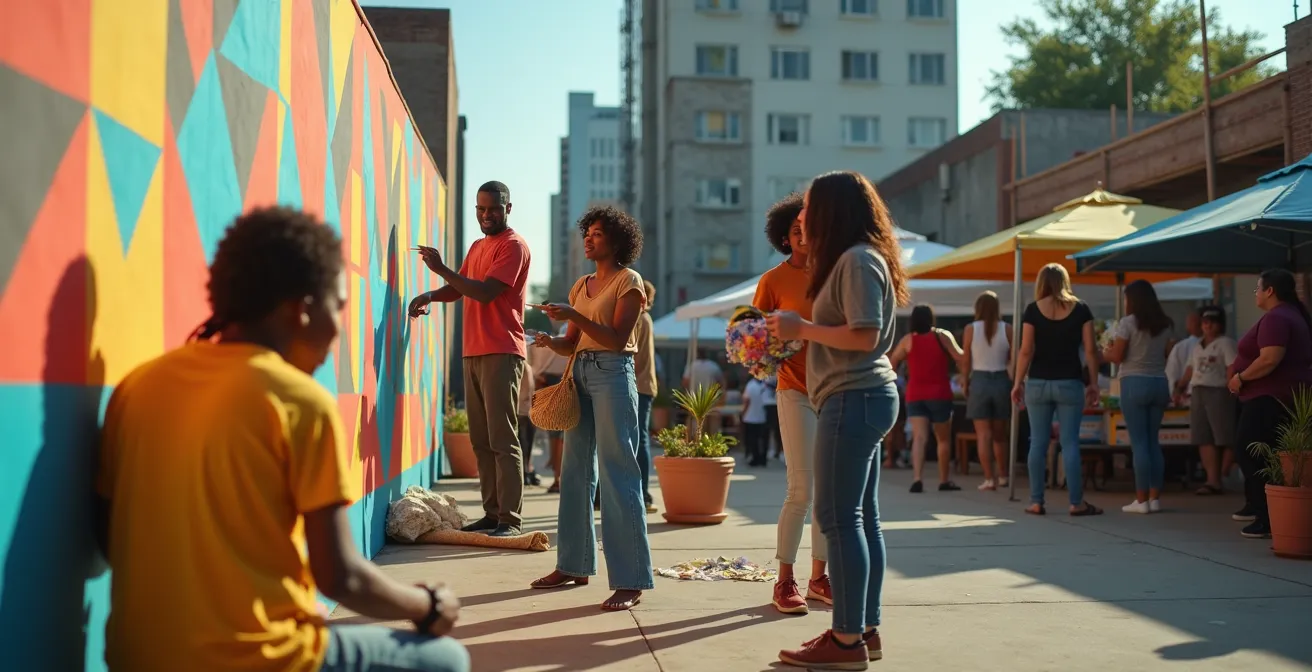
This image of collaborative creation captures the essence of the first phase of sequencing. It is in these small, human-scale interactions that the social fabric of a revitalized neighborhood is woven. This “soft infrastructure” of community trust and shared identity is just as critical as the “hard infrastructure” of buildings and roads that may follow. For the urban economist, the strategy is clear: invest first in people and temporary programming. If that succeeds, the subsequent investment in permanent physical infrastructure becomes a far more predictable and secure proposition. This sequence turns urban renewal from a high-stakes gamble into a calculated, phased investment.
Why Are Hardware Companies Switching to Subscription Models?
At first glance, the business models of hardware companies seem far removed from the world of urban cultural policy. Yet, their strategic shift towards subscriptions holds a vital lesson for building financially resilient creative ecosystems. The old model for many cultural institutions—selling a one-time ticket for a show or exhibition—is analogous to selling a single piece of hardware. It’s transactional and provides no stable, predictable revenue stream. The subscription model, by contrast, builds an ongoing relationship with the consumer, creating a reliable and forecastable income base.
This concept of a recurring “revenue stack” is directly applicable to a city’s creative economy. With the creative sector employing a significant portion of the population—globally, the creative economy employs between 0.5% to 12.5% of the workforce—ensuring its financial stability is a matter of significant economic importance. Cities can encourage or directly support their cultural institutions to move beyond one-off ticket sales and develop their own subscription-like models. This could include tiered memberships offering exclusive access, patronage platforms for supporting individual artists, or digital subscriptions for online content. This diversifies revenue and deepens community engagement.
The city of Kyoto provides an excellent case study in fostering this kind of sustainable business environment. City planners there took an active role in leading urban renewal by inviting creative ideas for technology-enabled art and, crucially, entrepreneurship. By creating city-sponsored creative spaces where entrepreneurs and artists could gather and collaborate, they built a true ecosystem. The result is that a remarkable 16-18% of all private enterprises in Kyoto are now in creative fields. This success was not achieved by simply funding art, but by fostering the business structures that allow creative endeavors to thrive financially. The lesson for other cities is that a revitalized urban center requires not just cultural assets, but a robust and modern business model to sustain them.
Key Takeaways
- Investment Sequencing is Key: True revitalization is a process, not an event. Start with low-cost, temporary projects to prove concepts and build momentum before committing to large-scale, permanent infrastructure.
- Build the Full Ecosystem: A landmark building is not enough. A resilient creative economy requires a complete system of talent (both freelance and agency), diverse funding streams, and supportive policies.
- Proactively Mitigate Gentrification: Success creates its own risks. Use strategic funding like sustainability grants and rent stabilization to protect the creative community from being priced out by the very revitalization it created.
Skill-Based Volunteering: How to Donate Expertise Instead of Labor?
The final, often-underestimated component of a thriving creative ecosystem is its ability to leverage high-value human capital from outside the sector itself. This is the concept of skill-based volunteering: channeling the expertise of professionals like lawyers, accountants, marketers, and technologists into the creative community. This is fundamentally different from traditional volunteering (e.g., painting a set or ushering at an event). It is a strategic injection of specialized knowledge that can help creative organizations and individuals professionalize their operations, scale their impact, and become more financially sustainable.
The economic impact of such contributions is far from trivial. It represents a significant, non-monetary subsidy that strengthens the entire sector. The role of Cultural and Creative Industries (CCIs) in economic development is widely acknowledged; in one European study, a staggering 74.4% of participants acknowledged CCIs’ role in reducing unemployment. By providing pro-bono access to critical business skills, skill-based volunteering helps these CCIs become more robust employers, amplifying their job-creation potential. It closes the gap between creative talent and business acumen, a common hurdle for many arts organizations.
This approach allows a city to multiply the impact of its creative sector without a direct financial outlay. It is about creating platforms and networks that connect the corporate and creative worlds for mutual benefit. The value of this connection is not just in the services rendered; it also builds social capital, fostering a deeper understanding and appreciation for the creative economy across the city’s entire professional landscape. As researchers confirm, the contribution of CCIs to regional development is a powerful force for growth.
CCIs significantly enhance job opportunities in European regions… 71.4% recognized the substantial contribution of CCIs to regional GDP.
– MDPI Research Team, Contribution of CCIs to Regional Development
To truly enact a creative revitalization, the next logical step for any urban planner or investor is to move from theory to action. This begins with an audit of your city’s current creative assets and identifying the most immediate opportunity for a low-cost, high-impact temporary project to begin the revitalization sequence.