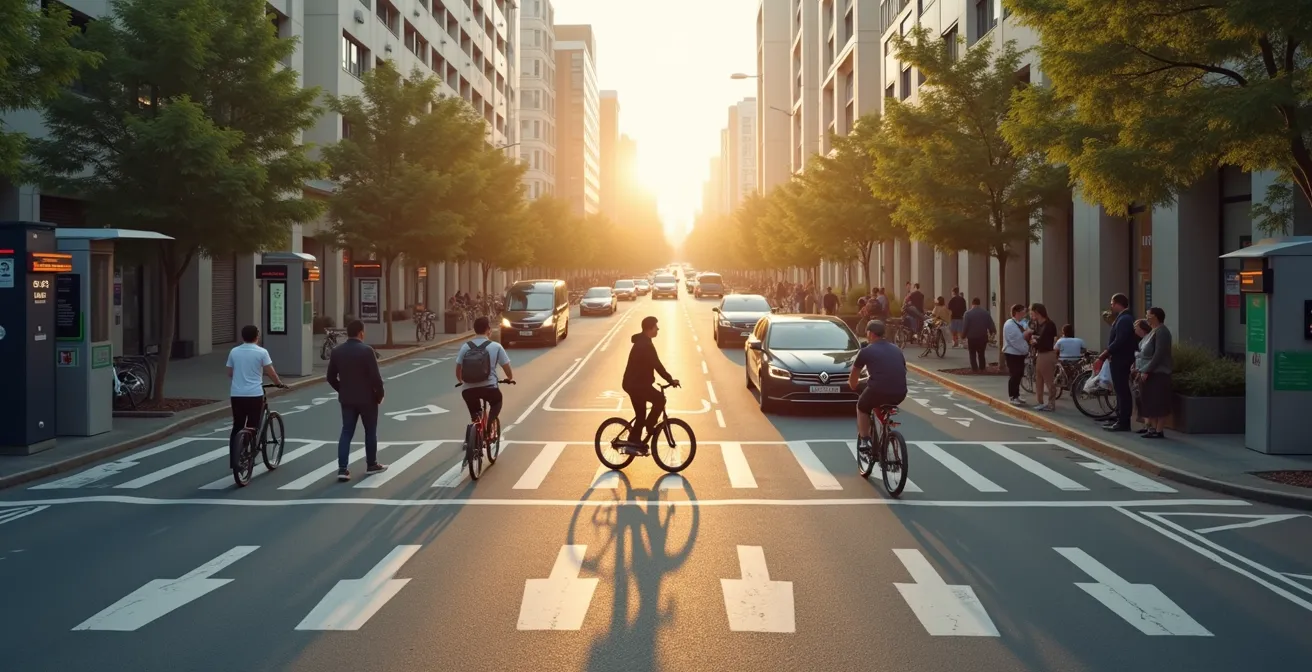
The daily commute isn’t just wasted time; it’s a major environmental stressor that actively degrades your mental and physical health. The solution lies in treating it not as a task to be endured, but as a transitional space to be intentionally managed.
- Varying your route and mode of transport stimulates brain plasticity and prevents cognitive decline.
- Proactive posture management and micro-exercises during travel can prevent chronic pain like “driver’s slump.”
- Reframing travel time as an opportunity for learning or mindfulness transforms a negative experience into a positive one.
Recommendation: Start by auditing a single, recurring stress point in your commute and apply one targeted strategy from this guide—like shifting your departure time by 30 minutes or trying an e-bike—to immediately reclaim hours of your life and improve your well-being.
The alarm blares, and the countdown begins. For millions, the daily commute is a non-negotiable drain—a twice-daily gauntlet of traffic, delays, and rising frustration. It’s a period of time we mentally write off, a stressful buffer between our personal and professional lives. Most advice centers on distraction: listen to a podcast, crank up the music, or just grin and bear it. This approach, however, merely papers over the cracks of a fundamental problem. The commute is not a passive activity; it’s an active environmental stressor that impacts our nervous system, posture, and even the physical structure of our brain.
But what if the key wasn’t simply to endure the journey, but to transform it? This guide moves beyond mere distraction to offer a neuro-ergonomic approach. We will explore how to actively reshape your commute’s impact on your well-being. This involves understanding the psychological triggers of road rage, the physical dangers of poor driving posture, and the cognitive benefits of breaking routine. It’s about turning dead time into growth time, and a source of stress into a moment of intentional transition. By making smarter mobility choices, you can do more than just get to work faster; you can arrive calmer, healthier, and more focused.
This article provides a complete framework for reimagining your daily travel. We’ll deconstruct the hidden stressors of your commute and provide actionable strategies to reclaim control, improve your mental health, and even make your journey a productive part of your day. The following sections will guide you through this transformation.
Summary: Reclaiming Your Well-being, One Commute at a Time
- Why Taking the Same Route Every Day Lowers Brain Plasticity
- How to Turn Traffic Jams into a University Education?
- Car vs E-Bike: Which Is Faster in Rush Hour Traffic?
- The Danger of “Driver’s Slump” for Lower Back Pain
- Timing Your Drive: How Shifting 30 Minutes Saves 20 Hours a Year?
- Why Road Rage Is a Symptom of Suppressed Stress
- Creating a “Fake Commute” to Signal the End of the Workday
- Car Ownership vs Car Sharing: Which Is Cheaper for City Dwellers?
Why Taking the Same Route Every Day Lowers Brain Plasticity
The human brain thrives on novelty. When you drive the same streets, turn at the same corners, and navigate the same intersections day after day, you are essentially putting your brain on autopilot. This cognitive coasting, while efficient, comes at a cost: it fails to challenge the spatial navigation centers of the brain, leading to a reduction in neuroplasticity. Neuroplasticity is the brain’s remarkable ability to reorganize itself by forming new neural connections. It’s the mechanism behind learning, memory, and cognitive resilience. A monotonous commute starves the brain of the new stimuli needed to build and strengthen these connections.
Breaking this routine is a powerful tool for mental well-being. The simple act of choosing an alternate route forces your brain to engage actively. It must process new visual information, make novel decisions, and update its internal map of the world. This mental workout strengthens the hippocampus, a brain region critical for memory and spatial awareness. It’s the cognitive equivalent of taking the stairs instead of the elevator.
To understand the power of this concept, it’s helpful to visualize the difference in brain activity. A familiar route activates a thin, well-worn neural pathway, while a new one lights up a complex, branching network of connections.

As this visualization suggests, each new path taken is an investment in your long-term cognitive health. It’s a proactive strategy to keep your mind sharp and adaptive. By gamifying your journey and rewarding yourself for exploration, you transform a mundane task into a brain-boosting exercise. The goal is to re-engage with your environment, turning a passive transit into an active exploration that nourishes your mind.
How to Turn Traffic Jams into a University Education?
A traffic jam feels like the ultimate time-waster—a black hole of productivity and a major source of stress. However, by reframing this forced downtime, you can convert it into one of the most consistent and valuable learning opportunities in your week. The key is to shift from a passive mindset of “being stuck” to an active one of “dedicated learning time.” With the wealth of audio-based educational content available, your car can become a mobile classroom, a lecture hall on wheels where you are the sole student.
This isn’t about aimlessly listening to a random podcast. It’s about creating a structured curriculum for your commute. You can finally learn that language you’ve been putting off, dive deep into a professional skill with a structured course, or explore complex subjects through long-form audiobooks. The secret to success is a structured approach that separates learning from review. This “Input/Output” method ensures that you not only consume information but also actively process and retain it.
By dedicating specific days or commute directions to learning versus reflection, you create a powerful cognitive rhythm. The morning drive can be for absorbing new material, while the evening drive becomes a time for synthesis, using voice memos to summarize key takeaways or formulate questions. This method transforms passive listening into an engaged educational experience, turning frustrating gridlock into protected time for personal and professional growth.
Input/Output Commute Learning Method
- Morning commute: Listen to structured educational content (language courses, professional development).
- Evening commute: Use voice memo apps to summarize learning and formulate questions.
- Create themed days: Monday/Wednesday for learning, Tuesday/Thursday for mindfulness, Friday for entertainment.
- Track progress weekly with a simple learning journal.
Car vs E-Bike: Which Is Faster in Rush Hour Traffic?
In the congested arteries of a city during rush hour, the perceived power of a car is an illusion. While a car’s top speed is high, its average speed plummets in dense urban traffic. The electric bike, or e-bike, emerges as a surprisingly dominant competitor in this environment. It leverages a network of bike lanes, shortcuts, and pathways that are inaccessible to cars, allowing riders to maintain a more consistent speed while drivers are stuck in gridlock.
The data paints a clear picture of this urban mobility mismatch. A real-world test comparing a typical urban journey revealed the stark difference: the car took 55 minutes to complete a route that an e-bike finished in just 28 minutes. This isn’t a marginal gain; it’s a time saving of nearly 50%. The e-bike rider not only arrived faster but also avoided the stress of stop-and-go traffic and the frustrating search for parking.
The following table breaks down the door-to-door time and average speed for a typical 7-mile urban commute, highlighting the significant advantage of two-wheeled options during peak hours.
| Transport Mode | Average Speed | Door-to-Door Time | Time Savings |
|---|---|---|---|
| Car (rush hour) | 15 mph | 48 minutes | – |
| E-bike (Class 3) | 12-18 mph | 27 minutes | 21 minutes |
| Regular Bike | 10-15 mph | 35 minutes | 13 minutes |
This advantage is not just theoretical. An independent test in London confirmed these findings on a 5.5km route, where the e-bike was 27 minutes quicker than the car. For the urban commuter, this means that choosing an e-bike is not a compromise; it’s a strategic decision to reclaim dozens of hours each month while simultaneously incorporating light physical activity into your daily routine.
The Danger of “Driver’s Slump” for Lower Back Pain
The act of driving often forces the body into a state of static, unsupported flexion known as “driver’s slump.” In this position, the lower back rounds, the head juts forward, and the core muscles disengage. Holding this poor posture for extended periods—as millions do during their daily commute—places immense and sustained strain on the lumbar spine, compresses spinal discs, and weakens the core muscles responsible for stabilizing the torso. It is a direct cause of chronic lower back pain, sciatica, and neck stiffness.
The solution isn’t to stop driving, but to transform the driver’s seat into a space of active postural awareness. This involves creating a proper ergonomic setup: adjusting your seat so your knees are slightly lower than your hips, using a lumbar support to maintain the natural curve of your spine, and sitting actively rather than slumping into the seat. An engaged core is your first line of defense against the compressive forces of a long drive.
This image highlights the critical area of focus: maintaining proper spinal alignment through conscious core engagement, even while seated.

Furthermore, you can use the inevitable stops in traffic as opportunities for “micro-workouts.” These are small, discreet movements that reactivate dormant muscles, improve circulation, and counteract the negative effects of the slump. Performing pelvic tilts, glute squeezes, and shoulder blade retractions at red lights can make a significant difference in preventing pain and stiffness, turning passive sitting time into a moment of physical rejuvenation.
Timing Your Drive: How Shifting 30 Minutes Saves 20 Hours a Year?
The difference between a stressful commute and a smooth one is often a matter of minutes. Most commuters follow a herd mentality, departing at peak times and resigning themselves to the resulting congestion. However, traffic volume is not linear; it often builds and dissipates in sharp waves. By strategically shifting your departure time by as little as 15-30 minutes, you can often bypass the worst of the peak, effectively saving yourself hours of wasted time and frustration over the course of a year.
The cumulative impact of this “dead time” is staggering; research shows the average car commuter loses 70 hours spent sitting in traffic annually. That’s nearly two full work weeks. Imagine saving just a fraction of that time. A daily commute shortened by just five minutes each way adds up to over 40 hours saved per year. Shifting your schedule by 30 minutes to miss the peak could easily save you 10 minutes each way, reclaiming over 80 hours a year.
Modern technology makes this “temporal shifting” easier than ever. Apps that analyze real-time traffic data can suggest optimal departure times, turning guesswork into a precise science. The key is to move from a rigid schedule to a flexible, data-informed one. This requires a small audit of your own travel patterns to identify your personal “stress peaks” and find the sweet spot for departure.
Your 5-Point Commute Stress Audit
- Contact Points: List every mode of transport and route you use in a typical week (e.g., Car on Highway A, Train Line B, walk from station).
- Pain Point Collection: For one week, inventory moments of stress or discomfort (e.g., “Gridlock at Main St. intersection,” “Lower back pain after 20 mins,” “Anxiety finding parking”). Be specific.
- Coherence Check: Confront these pain points with your well-being goals. Does “saving 5 minutes” on an aggressive route justify the stress? Is your car seat aligned with your goal to reduce back pain?
- Opportunity Scan: Identify dead time versus potential for growth. Where could you practice breathing (red lights)? When could you listen to a course (highway stretch)? Spot opportunities for positive change.
- Integration Plan: Choose ONE pain point to tackle first. (e.g., “This week, I will leave 15 minutes earlier to avoid the main jam,” or “I will install a lumbar support pillow”). Prioritize one small, achievable change.
Why Road Rage Is a Symptom of Suppressed Stress
Road rage—that explosive, disproportionate anger triggered by a minor traffic incident—is rarely about the incident itself. It is a classic symptom of an over-stressed nervous system. When you are already operating with high levels of cortisol and adrenaline from work, financial, or personal pressures, your car becomes an isolated, high-stakes environment. The perceived anonymity and lack of control create a perfect storm for what is known as an “amygdala hijack.”
This term, popularized by psychologist Daniel Goleman, describes a sudden, overwhelming emotional response. The amygdala, the brain’s threat-detection center, bypasses the rational, thinking part of the brain (the neocortex) and triggers a fight-or-flight response. The prevalence of this is alarming; according to AAA Foundation research, around 80% of drivers admit to expressing significant anger or road rage at least once in the past year. As Goleman explains in his work on emotional intelligence:
An amygdala hijack refers to an intense emotional reaction that’s out of proportion to the circumstance
– Daniel Goleman, Emotional Intelligence: Why It Can Matter More Than IQ
Recognizing road rage as a symptom rather than a character flaw is the first step toward managing it. It’s a signal that your underlying stress levels are too high. The solution lies in developing real-time de-escalation techniques that calm the nervous system and give the rational brain time to come back online. Simple, structured breathing exercises and the practice of creating a “counter-narrative” (e.g., “Maybe they are rushing to the hospital”) can short-circuit the hijack and prevent a dangerous escalation.
Creating a “Fake Commute” to Signal the End of the Workday
In the age of remote and hybrid work, the physical boundary between work and home has blurred. The traditional commute, for all its flaws, served a crucial psychological purpose: it was a ritual that signaled a transition. It provided a buffer of time and space to decompress and mentally shift gears. Without this boundary, many find themselves unable to “switch off,” leading to burnout and a feeling of being perpetually on the clock.
The solution is to create an artificial or “fake” commute. This is a short, deliberate ritual that mimics the transitional function of a real commute, creating a clear psychological endpoint to the workday. It’s not about the activity itself, but the intention behind it. This ritual signals to your brain that the professional part of the day is over and the personal part has begun. A fake commute can be tailored to your specific psychological needs—whether you need physical decompression, a mental shift, or social reconnection.
The table below outlines different types of fake commutes and their primary benefits, allowing you to design a ritual that works for you.
| Type | Activity | Duration | Benefit |
|---|---|---|---|
| Physical Decompress | 15-minute walk/bike ride | 15 min | Releases physical tension |
| Mental Shift | Reading in different room | 10-20 min | Cognitive transition |
| Social Reconnect | Scheduled call to friend/family | 10-15 min | Emotional grounding |
For this ritual to be effective, consistency is key. A “sensory shutdown” ritual, involving multiple senses, can be particularly powerful. This might involve changing out of work clothes, lighting a specific “end of day” candle, and playing a designated transition playlist. These sensory cues create a strong association in the brain, making the mental shift from “work mode” to “home mode” quicker and more complete.
Key Takeaways
- Rethink your commute as an active process; varying your route and mode of transport is a powerful tool for boosting brain health and cognitive function.
- Your posture during travel is not passive. Proactively managing “driver’s slump” with ergonomic adjustments and micro-exercises is critical for preventing chronic physical pain.
- The commute is a transitional space. By creating intentional rituals like a “fake commute” or using the time for structured learning, you can manage stress and reclaim it as a valuable part of your day.
Car Ownership vs Car Sharing: Which Is Cheaper for City Dwellers?
For many, car ownership is seen as a symbol of freedom and convenience. In dense urban environments, however, this “freedom” comes with a hefty and often underestimated price tag. Beyond the initial purchase price, the cost of ownership includes insurance, fuel, maintenance, parking, and depreciation. When added together, these expenses can make owning a car a significant financial burden, especially for those who don’t drive long distances daily.
The financial reality is often surprising. In fact, research from AAA shows the average annual cost of car ownership is over $10,049 per year for car ownership in urban areas. For city dwellers, car-sharing services and ride-hailing platforms present a compelling alternative. These services convert the high fixed cost of ownership into a variable, pay-as-you-go expense. For individuals who commute via public transit or bike but need a car for occasional trips, this model can lead to thousands of dollars in annual savings.
This financial logic is driving a major shift in urban mobility, with many city residents choosing to ditch car ownership altogether. The availability of reliable ride-sharing has made this choice more practical than ever, freeing up capital and eliminating the stresses of parking and maintenance. As a case in point, one study found that 250,000 Lyft users had given up their personal vehicles due to the convenience of the service.

Ultimately, the decision comes down to a personal cost-benefit analysis. For the modern city dweller, it is no longer a question of “if” you can get around without a car, but “how much” you could save and how much stress you could avoid by doing so. The choice is no longer just between driving and public transport, but among a rich ecosystem of mobility options.
To truly transform your daily travel from a source of stress to a pillar of your well-being, the next step is to take action. Start by analyzing your current commute using the audit framework, identify a single pain point, and commit to experimenting with one new strategy for one week. The path to a better commute begins with a single, intentional choice.