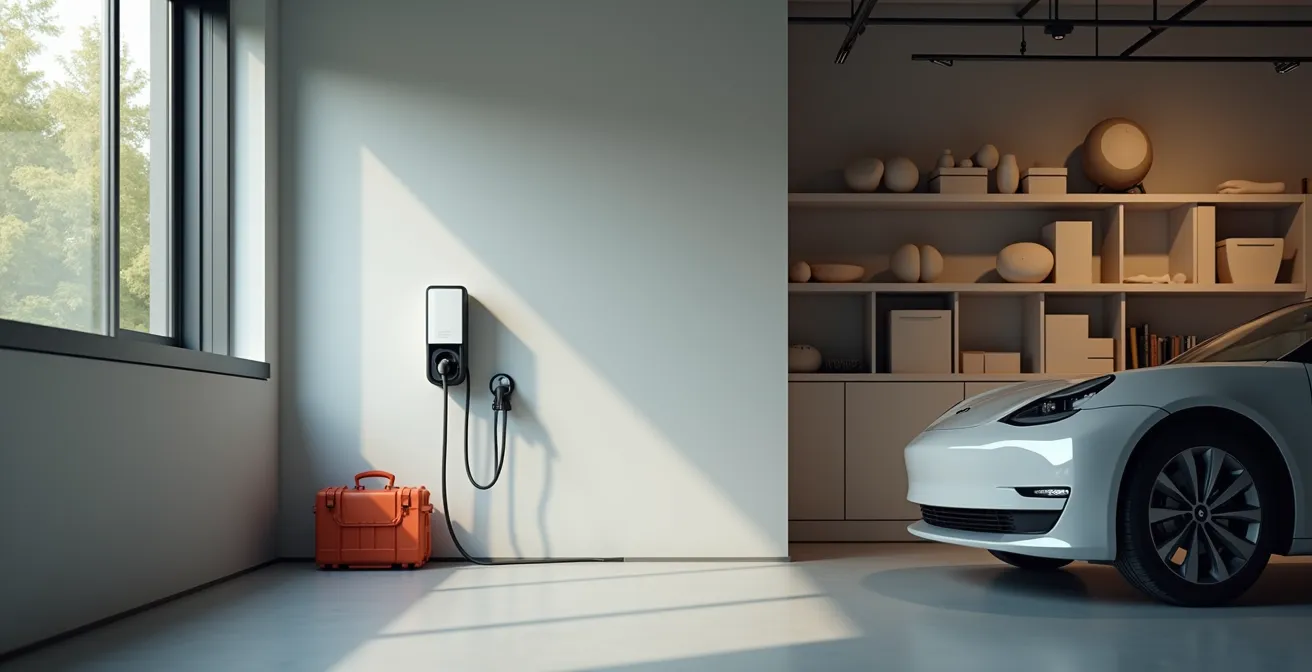
The true cost of home EV charging isn’t the charger itself, but your home’s electrical readiness.
- A standard outlet (Level 1) is often impractical and inefficient for daily driving, especially in cold climates.
- A proper installation requires a dedicated 240V circuit and, potentially, a costly electrical panel upgrade if your home’s capacity is insufficient.
Recommendation: Before buying a charger, perform a basic load calculation of your electrical panel. This proactive step helps you anticipate the real total cost and avoid unsafe, underpowered installations.
Congratulations on your new electric vehicle. The thrill of instant torque and silent driving is a game-changer. But once you park it in your garage for the first time, a new reality sets in: charging. Many new owners assume the standard 120V outlet that came with the car will suffice. While technically true for occasional top-ups, relying on it for daily commuting quickly reveals its limitations. You’ve entered the world of home infrastructure, where the most important decision isn’t which car you bought, but how well your home can support it.
The common advice is to simply “get a Level 2 charger.” This overlooks the most critical component: your home’s electrical system. As an electrician specializing in Electric Vehicle Supply Equipment (EVSE) installations, I’ve seen countless homeowners surprised by hidden costs because they focused only on the price of the charging unit. The real conversation should be about your electrical panel’s capacity, the existing load from your appliances, and your future needs.
This guide puts my diagnostic mindset in your hands. We won’t just cover the ‘what’; we’ll dive into the ‘why’. We’ll explore how to assess your own electrical panel, understand the economics of off-peak charging, and plan for a multi-EV future. The goal is to move beyond the sticker price of a charger and empower you to make a safe, cost-effective, and future-proof investment that serves you for years to come.
This article breaks down everything a new EV owner needs to know, from assessing your current electrical setup to making smart choices about vehicle types and charging strategies. Follow along to understand the complete picture of home charging infrastructure.
Summary: Home EV Charger Costs and Requirements Explained
- Why a Standard Outlet Isn’t Enough for Daily Commuters
- How to Know if Your Electrical Panel Needs an Upgrade?
- Off-Peak Scheduling: How to Save 30% on Your Electric Bill?
- The Risk of Buying an EV When You Live in an Apartment
- Planning Ahead: Installing Wiring for Two EVs Instead of One
- Google Home or Amazon Alexa: Which Is Better for Energy Management?
- Why Buying a PHEV Without Charging It Is a Waste of Money
- Plug-In Hybrid (PHEV) or Full Hybrid (HEV): Which Saves More Money for You?
Why a Standard Outlet Isn’t Enough for Daily Commuters
The charger that comes with your EV, often called a Level 1 charger, plugs into a standard 120V wall outlet. For many, this seems like the simplest solution. However, it’s a significant circuit bottleneck. This type of charging typically adds only 3-5 miles of range per hour. If you have a 40-mile round-trip commute, you’ll need 8-10 hours of charging just to break even. This leaves no room for extra errands or recovering a deeply discharged battery overnight.
The situation worsens significantly in colder climates. Your battery’s chemistry is less efficient in the cold, and the charging system has to work harder. In fact, research from Idaho National Laboratory shows that a Level 1 charger can deliver 36% less power at 36°F compared to 77°F. That 10-hour charge time can easily stretch to 14 hours or more, making it impossible to get a full charge overnight. This leads to constant range anxiety and the inconvenience of seeking out public chargers.
For a battery electric vehicle (BEV), the numbers are even more stark. According to the U.S. Department of Transportation, fully charging a BEV from empty can take an astonishing 40-50+ hours on a Level 1 charger. This makes it completely impractical for anyone who relies on their vehicle for daily transportation. A Level 2 charger, which uses a 240V circuit similar to an electric dryer, becomes a necessity, not a luxury. It can replenish a full daily commute’s worth of energy in just a couple of hours.
Ultimately, a Level 1 setup relegates your EV to a weekend car rather than a dependable daily driver, undermining the very convenience it’s meant to provide.
How to Know if Your Electrical Panel Needs an Upgrade?
This is the most critical question in any home EVSE installation. Your electrical panel is the heart of your home’s power system, and adding a high-draw appliance like an EV charger requires careful consideration. A Level 2 charger needs a dedicated 240V, 40-amp or 50-amp circuit, which is a significant load. If your panel is already near capacity, this addition can lead to tripped breakers or, in worst-case scenarios, an electrical fire.
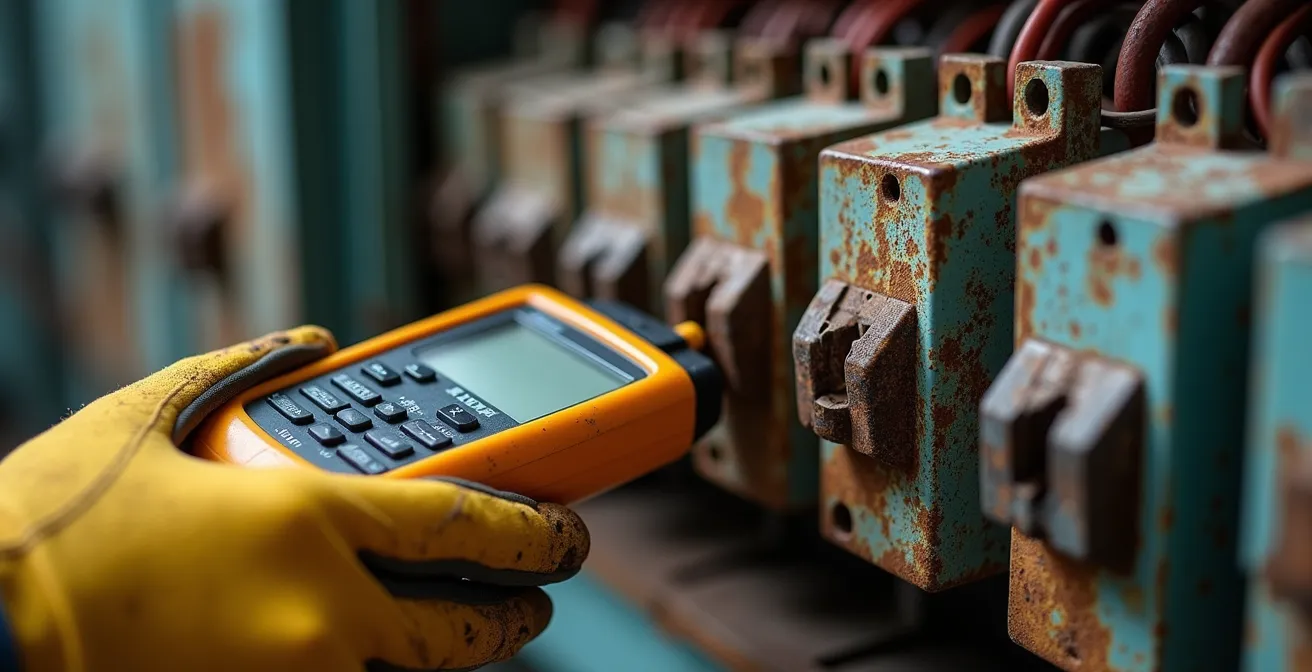
The key is understanding your panel’s electrical headroom—the available capacity after accounting for all your other appliances. An electrician performs a “load calculation” to determine this, but you can do a basic assessment yourself. The main breaker, usually the largest one at the top, will state your home’s total service capacity, typically 100A, 150A, or 200A. A 100A panel is common in older homes and is often a red flag that an upgrade might be necessary, as it may not safely support a new 40A circuit alongside an HVAC system, electric stove, and water heater.
Another telltale sign is the physical space in the panel. A 240V circuit requires two adjacent empty slots for a double-pole breaker. If your panel is completely full, you’ll need at least a sub-panel, if not a full service upgrade. Certain brands, like Federal Pacific or Zinsco, are known for being obsolete and hazardous and require immediate replacement regardless of available capacity.
Action Plan: Your DIY Electrical Panel Assessment
- Check Amperage: Locate your main electrical panel and identify the amperage rating printed on the main breaker switch (e.g., 100A, 150A, 200A).
- Count Open Slots: Open the panel door and count the number of available slots. You will need two adjacent vertical slots for a 240V double-pole breaker.
- List Major Appliances: Inventory all major 240V appliances in your home, such as central air conditioning (HVAC), an electric dryer, an electric water heater, and an electric range or oven.
- Estimate Peak Load: Consider a worst-case scenario: could you run your AC, cook dinner, and charge your EV simultaneously without exceeding your panel’s total amperage?
- Identify Unsafe Panels: Look for a brand name on the panel, either on the door or inside. If it says “Federal Pacific,” “FPE,” or “Zinsco,” contact an electrician immediately for a replacement.
While this self-assessment is a great starting point, it’s not a substitute for a professional evaluation. An experienced electrician can perform a precise load calculation to give you a definitive answer on whether your current setup is sufficient.
Off-Peak Scheduling: How to Save 30% on Your Electric Bill?
Once your hardware is safely installed, the next step is to optimize your charging strategy to minimize cost. This is where smart charging and utility rate plans come into play. Many electric companies offer “Time-of-Use” (TOU) or “Time-of-Day” pricing, which incentivizes customers to use electricity during off-peak hours when overall grid demand is low. By simply scheduling your EV to charge during these windows, you can dramatically reduce your transportation energy costs.
Typically, peak hours are in the late afternoon and early evening (e.g., 4 p.m. to 9 p.m.), when people return from work and school, turn on lights, cook dinner, and run their air conditioning. During this time, electricity is most expensive. Off-peak hours are usually late at night and in the early morning (e.g., 11 p.m. to 7 a.m.). By charging your car exclusively during this off-peak window, you could pay a fraction of the standard rate per kilowatt-hour (kWh).
For example, a utility program like the one offered by BC Hydro in Canada provides significant discounts for overnight charging while applying surcharges during peak demand. An EV owner participating in such a program can easily cut their charging bill by 30% or more without any change in driving habits. This not only saves you money but also contributes to grid harmony by helping the utility balance demand and avoid a strain on the system during peak times. It’s a win-win for your wallet and the community’s infrastructure.
Most modern EVs and smart chargers allow you to easily set a charging schedule. You simply plug in your car when you get home, but it won’t start drawing power until the designated off-peak hours begin, ensuring you get the cheapest rate automatically.
The Risk of Buying an EV When You Live in an Apartment
For homeowners, the path to home charging is relatively straightforward. For renters and apartment dwellers, it can be a significant hurdle. The primary risk is the lack of “right to charge.” Without a guaranteed place to plug in overnight, you become entirely dependent on public charging infrastructure, which can be expensive, unreliable, and time-consuming. Relying on DC fast chargers frequently can also be detrimental to long-term battery health.
The conversation with a landlord or homeowners association (HOA) can be difficult. They may have concerns about liability, the cost of installation, and how electricity usage will be billed. However, the legal landscape is slowly shifting in favor of tenants. Some regions have enacted “Right-to-Charge” laws that prevent landlords from unreasonably denying a tenant’s request to install a charger at their own expense.
For example, as Pacific Gas & Electric highlights in their guidance for EV owners, there are specific legal protections in some areas. They note that, in certain jurisdictions, the law is clearly on the tenant’s side:
California law requires property owners to allow tenants to install a residential charging station if the tenant pays for installation, maintenance, insurance and removal.
– Pacific Gas & Electric, PG&E EV Charging Installation Guide
To successfully navigate this, you must approach your landlord with a well-researched plan. This should include:
- Obtaining quotes from licensed electricians.
- Proposing a solution for metering and billing (such as a sub-meter).
- Providing proof of liability insurance.
- Highlighting the benefit to the property value and its appeal to future EV-owning tenants.
If a permanent installation is not feasible, portable Level 2 chargers that use existing 240V outlets (like those for dryers in a garage) can be a viable compromise, as they require no permanent modification to the property.
Planning Ahead: Installing Wiring for Two EVs Instead of One
As EV adoption grows, the one-EV household is quickly becoming the two-EV household. If you’re already going through the process of hiring an electrician and opening up walls, it is incredibly cost-effective to plan for a second vehicle. The most expensive part of an EVSE installation is often the labor involved in running the conduit and wiring from the electrical panel to the garage. Doing it twice is far more expensive than doing it right the first time.
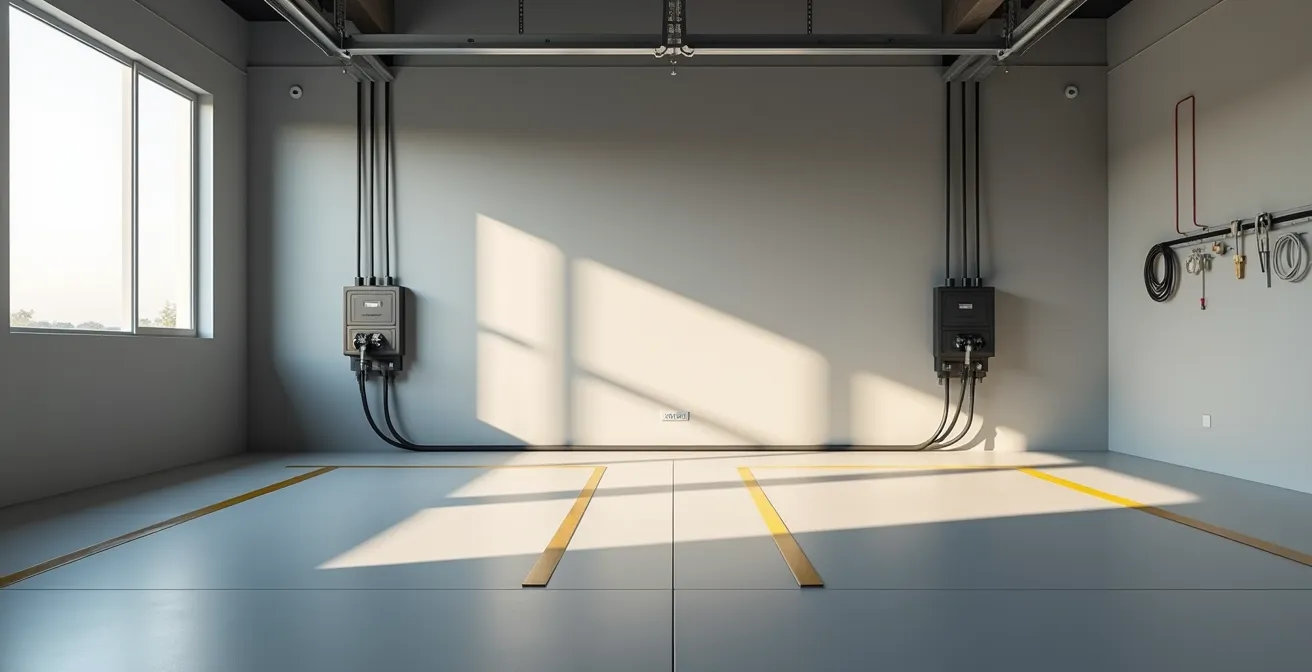
This is a classic case of future-proofing. You can have the electrician run a second 240V circuit at the same time as the first, even if you don’t install a second charger immediately. The wire can be safely terminated in a junction box, ready for a quick and easy charger installation down the road. According to EPA guidance, pre-wiring for a second EV costs 75% less during an initial installation or new construction than adding it later. This small upfront investment saves you thousands of dollars and significant hassle in the future.
Another smart strategy is to install a single, higher-amperage circuit (e.g., 60A or 100A) that can support two chargers with a “load sharing” or “power sharing” feature. These smart chargers communicate with each other to split the available power. If only one car is charging, it gets the full current. If both are plugged in, they share the load, dynamically adjusting to ensure the circuit is never overloaded. This provides charging for two vehicles without requiring an expensive service upgrade that two separate high-amperage circuits might necessitate.
In my experience, homeowners who pre-wire for a second charger are always grateful they did. It’s one of the simplest and most effective ways to maximize the value of your electrical work.
Google Home or Amazon Alexa: Which Is Better for Energy Management?
As your home gets smarter, it’s natural to want your EV charger to integrate seamlessly into your existing ecosystem, whether it’s controlled by Google Home or Amazon Alexa. These platforms can offer voice control for starting or stopping a charge, checking the status, and integrating charging schedules into your home’s other automated routines. However, the real power of energy management often lies one level deeper, either in the charger’s dedicated app or the vehicle’s own software.
While voice assistants are convenient for simple commands, they often act as a top-level interface for the more powerful software built by the charger or vehicle manufacturer. For instance, Tesla’s ecosystem allows for highly detailed power management directly through its app, which can control charging schedules, set current limits, and manage access for multiple vehicles. This system works independently of a broader smart home platform, offering a more robust and reliable feature set specifically tailored to the vehicle.
The choice between Google and Alexa for energy management often comes down to which platform has better integration with your specific smart charger brand. Some chargers have dedicated “skills” or “actions” that offer deep integration, while others may only support basic on/off functions. In many cases, you may find that using your car’s native app provides superior control. Most EVs today allow you to set charging schedules and limits directly from their onboard system or smartphone app, potentially making the smart features of the charger itself redundant.
Ultimately, the best system is the one you will consistently use. If voice commands through Alexa simplify your routine, it’s a valuable tool. But for fine-tuned cost and energy savings, the dedicated apps provided by your car or charger manufacturer will almost always offer more powerful and direct control.
Why Buying a PHEV Without Charging It Is a Waste of Money
A Plug-in Hybrid Electric Vehicle (PHEV) offers a compelling proposition: all-electric driving for daily commutes and the backup of a gasoline engine for long trips. However, the key to unlocking a PHEV’s economic and environmental benefits lies in one word: plugging in. When you don’t charge a PHEV, it essentially operates as a traditional hybrid, but one that’s carrying around the extra weight of a larger, depleted battery. This extra weight reduces fuel efficiency, meaning you’re spending more on gas than you would in a comparable, lighter full hybrid (HEV).
The entire financial model of a PHEV is based on displacing expensive gasoline with cheaper, grid-sourced electricity. If you rely solely on the gas engine, you’ve paid a premium for a sophisticated electric powertrain that you’re not using. This often happens when owners find Level 1 charging too slow and inconvenient to keep up with their daily driving, a sentiment echoed by many EV owners. In fact, J.D. Power research reveals that a staggering 60% of Level 1 users are unsatisfied and plan to upgrade to a faster Level 2 system.
For a PHEV owner, this dissatisfaction can lead to giving up on charging altogether. The result is that you’re simply hauling around a heavy, empty battery, which negatively impacts your miles per gallon (MPG). You lose the primary advantage of the vehicle. Therefore, if you are considering a PHEV, you must also commit to installing a reliable Level 2 charger. Without it, you are almost certainly better off financially with a standard, non-plug-in hybrid.
A PHEV is a tool designed for a specific use case. Using it without electricity is like buying a high-performance sports car and never taking it out of first gear—a true waste of its potential.
Key Takeaways
- Relying on a standard 120V outlet (Level 1) is often impractical for daily EV commuting due to slow speeds and inefficiency in cold weather.
- A home’s electrical panel capacity (at least 150-200A recommended) is the most critical factor determining the true cost and safety of a Level 2 charger installation.
- Future-proofing by wiring for a second EV or using power-sharing chargers during the initial installation offers significant long-term cost savings.
Plug-In Hybrid (PHEV) or Full Hybrid (HEV): Which Saves More Money for You?
The choice between a PHEV and a full hybrid (HEV) isn’t just about the sticker price; it’s a decision that deeply involves your home infrastructure. While both offer better fuel economy than a traditional gas car, their total cost of ownership is influenced by very different factors. An HEV, like the original Toyota Prius, uses its electric motor to assist the gas engine and charges its small battery through regenerative braking. It requires no external charging and has no impact on your home’s electrical system.
A PHEV, on the other hand, is designed to run on pure electricity for a significant range (typically 20-50 miles) before the gas engine kicks in. To achieve any real savings, it must be charged regularly. In fact, a recent survey indicates that approximately 80% of all EV charging happens at home, a habit that is essential for PHEV owners. This introduces costs that HEV owners completely avoid: the price of a Level 2 charger and, more significantly, the potential cost of a service panel upgrade, which can run into thousands of dollars.
To make an informed decision, you must factor these infrastructure costs into your calculation. A PHEV might be eligible for larger federal tax credits, but those savings can be quickly erased by a $3,000 electrical project. An HEV has no such associated costs and provides its fuel savings from day one, with no change to your home or habits.
| Factor | PHEV | HEV |
|---|---|---|
| Level 2 Charger Installation | $500 – $2,000 | $0 |
| Electrical Panel Upgrade | $800 – $3,000 (if needed) | $0 |
| Federal Tax Credits | Up to $7,500 | $0 – $3,750 |
| Daily Charging Required | Yes | No (gas only) |
For a driver with a short commute and a home that is “EV-ready” with a 200A panel, a PHEV will almost always save more money over time. But for someone in an older home with a 100A panel, the upfront infrastructure costs could make an HEV the more sensible financial choice.
Frequently Asked Questions About Home EV Charger Installation
Do I need WiFi for a smart EV charger to work?
A smart charger requires a stable WiFi connection to use its advanced features, such as remote monitoring, scheduling, and software updates. However, it will still function as a standard charger and power your vehicle without an internet connection; you will simply lose access to the “smart” capabilities.
Can I control charging through my car instead of the charger?
Yes, most modern electric vehicles allow you to manage charging settings directly through the car’s infotainment system or a dedicated smartphone app. This includes setting charge limits, scheduling charging sessions for off-peak hours, and preconditioning the cabin. This capability can often make the smart features of the charger itself redundant.
What data do smart chargers share with tech companies?
When connected to the internet, smart chargers may share anonymized or user-specific data with the platform provider. This typically includes charging habits (frequency, duration, energy consumed), charging schedules, and sometimes location data. It’s important to review the privacy policy of your charger manufacturer to understand exactly what information is collected and how it is used.