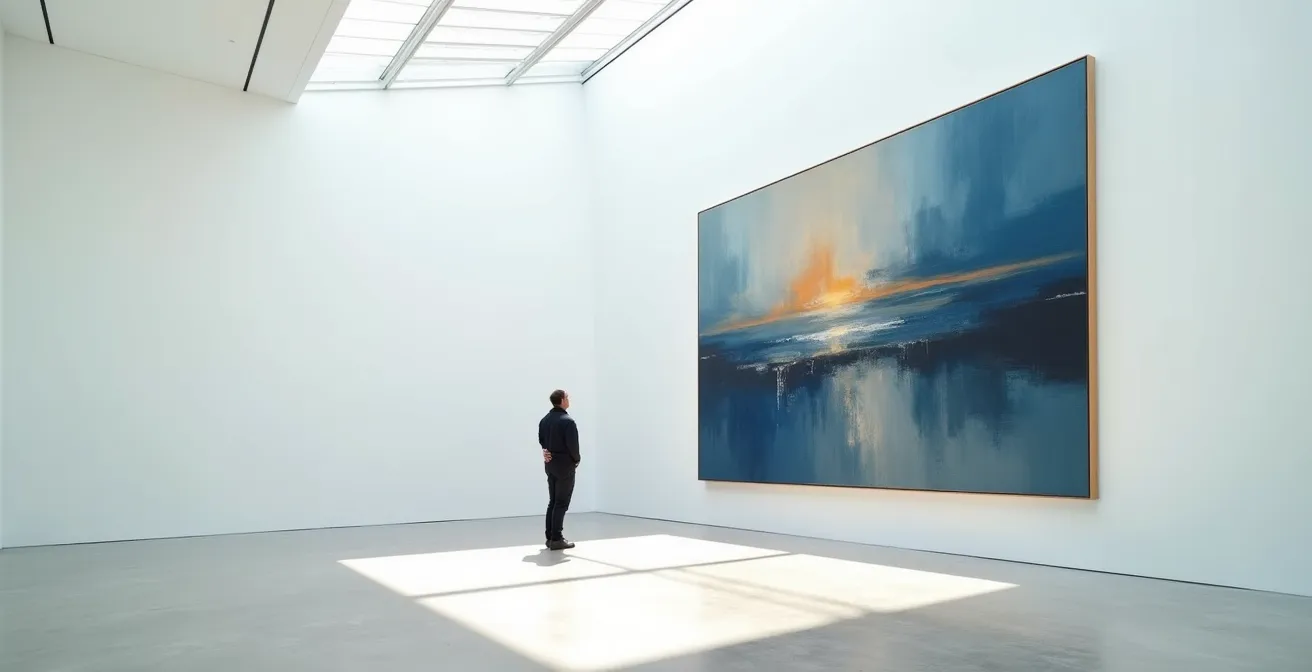
Art appreciation is a powerful tool for cognitive enhancement, not just creative inspiration; it actively restructures the brain’s prefrontal cortex to improve problem-solving.
- Engaging with abstract art directly trains the brain to tolerate ambiguity, a critical skill in complex decision-making.
- A structured “cultural diet” is essential for breaking out of cognitive echo chambers and fostering innovative thought patterns.
Recommendation: To maximize cognitive benefits, limit deep focus on art to a dedicated 45-minute session, preventing mental fatigue and enhancing insight.
For any results-driven leader or engineer, the landscape of problem-solving is often defined by data, logic, and established frameworks. When faced with a truly novel or ambiguous challenge, the default response is to seek more information or double down on analytical methods. We attend workshops on critical thinking and fill whiteboards during brainstorming sessions, yet often find ourselves circling the same conclusions. This happens when the tools we’re using are sharp, but the mind wielding them has become too rigid.
But what if the key to unlocking superior problem-solving wasn’t found in another spreadsheet or business book, but in a quiet art gallery? This isn’t about finding vague “inspiration” on a canvas. This is about understanding that art appreciation, when approached correctly, is an active cognitive training regimen. It’s a method for systematically dismantling cognitive rigidity by building new neural pathways, particularly in the brain’s executive hub: the prefrontal cortex. This isn’t a soft skill; it’s a neurological upgrade.
The common advice to “look at art to be more creative” is as unhelpful as telling someone to “be smarter.” It lacks a mechanism. This guide provides that mechanism. We will explore how specific engagements with art—from analyzing abstract works to diversifying your cultural intake—function as targeted exercises for the brain. We will delve into the neuroscience that proves these activities physically alter brain structure, and provide actionable frameworks you can use to turn your next museum visit into a high-impact session for enhancing lateral thinking and untangling your most complex professional challenges.
To help you navigate this cognitive toolkit, this article breaks down the essential strategies and the science behind them. The following summary outlines the key pillars of using art to sharpen your problem-solving abilities, from specific observation techniques to the practicalities of a focused gallery visit.
Summary: A Cognitive Scientist’s Guide to Art and Problem-Solving
- Why Looking at Abstract Art Trains Your Brain to Handle Ambiguity
- How to Diversify Your Cultural Intake to Escape Echo Chambers?
- Critique or Criticism: Which Mindset Fosters Better Growth?
- The Risk of Aesthetic Bias in Decision Making
- Timing Your Visit: Why 45 Minutes Is the Limit for Deep Focus
- Why Meditation Actually Changes the Structure of Your Prefrontal Cortex
- How to Use Structured Journaling to Untangle Complex Problems?
- How to Network at Art Fairs Without Being an Expert?
Why Looking at Abstract Art Trains Your Brain to Handle Ambiguity
The human brain is a pattern-matching machine. It craves certainty and defaults to familiar categories to make sense of the world quickly. This is efficient for routine tasks but becomes a liability when facing truly novel problems that defy easy classification. Abstract art is a direct challenge to this cognitive habit. Devoid of clear narrative or representation, a piece by Rothko or Pollock forces the brain into a state of productive uncertainty. It cannot default to “that’s a tree” or “that’s a person,” and is instead compelled to grapple with pure color, form, and texture. This process is a workout for your brain’s ability to tolerate ambiguity.
This isn’t just a theory; it’s a proven training method. Amy Herman’s “Art of Perception” program, for example, has been used to train individuals in the FBI, NYPD, and military. These are professionals for whom misinterpreting an ambiguous situation can have life-or-death consequences. They are taught to look at art to distinguish between objective observation and subjective inference, a core skill in any high-stakes analysis. By consciously engaging with ambiguity on a canvas, you are building the cognitive scaffolding needed to remain steady and analytical when faced with incomplete data in a boardroom or on a project plan.
Action Plan: The Three Layers of Interpretation Exercise
- Describe objective properties: Start by listing only what you can see without interpretation—colors, specific shapes, textures, lines. (e.g., “a thick red line intersects a blue field”).
- Articulate emotional response: Now, note the feelings or moods the piece evokes in you. (e.g., “The red feels aggressive, while the blue is calming”).
- Invent multiple stories: Create at least three different, plausible “meanings” for the artwork. This actively separates observation from assumption.
- Reflect on perspective shifts: Notice how each interpretation changes your understanding and emotional response to the same set of visual facts.
- Apply to a business problem: Take a current professional challenge and consciously apply this multi-perspective approach, generating three distinct interpretations of the “facts” you have.
How to Diversify Your Cultural Intake to Escape Echo Chambers?
Cognitive rigidity is often reinforced by our environment. If your media consumption, social circle, and professional field all operate within the same set of assumptions, you are living in a cognitive echo chamber. Your brain becomes highly efficient at solving one type of problem, but atrophies in its ability to think outside that framework. Diversifying your cultural intake acts as a direct antidote. It’s not about random consumption; it’s about a structured cultural diet designed to challenge your default thought patterns.
Think of it as cross-training for your brain. Just as an athlete trains different muscle groups to improve overall performance, you must expose your mind to different “logics” of creativity and expression. If your world is governed by the precision of engineering, spending time with the intuitive flow of surrealist poetry or the complex rhythms of West African drumming introduces new ways of structuring thought. This exposure doesn’t just give you new ideas; it makes your mind more flexible, allowing it to switch between different modes of thinking—analytical, intuitive, associative—more fluidly.
A simple yet powerful framework is the Cultural Diet Pyramid:
- Base Layer (60%): Continue to engage with the art, media, and genres you naturally enjoy. This is your comfort zone and maintains your core identity.
- Middle Layer (30%): Actively venture into adjacent genres. If you appreciate classical music, explore early 20th-century composers. If you like modern architecture, study the Bauhaus movement. These are small, manageable steps outside your norm.
- Top Layer (10%): Intentionally engage with “oppositional art”—genres or forms you actively dislike or do not understand. This is the most challenging but also the most potent layer for breaking down deep-seated cognitive biases and fostering true mental flexibility.
Critique or Criticism: Which Mindset Fosters Better Growth?
The way we talk about art—and by extension, new ideas—is as important as how we observe it. In a corporate setting, feedback often defaults to “criticism,” a process focused on finding flaws. This triggers defensive posturing and shuts down creative risk-taking. A “critique,” on the other hand, is a collaborative and structured investigation of a work, designed to understand it more deeply and uncover potential. Adopting a critique mindset, honed through discussing art, is a powerful tool for fostering psychological safety and innovation within a team.
The process involves de-personalizing feedback and sequencing the conversation to build understanding before jumping to judgment. One of the most effective models for this is the Liz Lerman Critical Response Process, which can be adapted for any project review. The process unfolds in four distinct steps: statements of meaning, questions from the creator, neutral questions from observers, and finally, a permission-based opinion stage. By following this protocol, you shift the dynamic from an adversarial “roasting” to a shared exploration. This builds the team’s capacity for creative abrasion—the ability to have rigorous, challenging debates about ideas without generating destructive, personal friction.
This introductory paragraph sets the stage for the visual representation of the creative process. The image below captures the essence of shaping and refining an idea with care and intention.

As the image suggests, a masterful critique is about shaping, not smashing. It requires focus, care, and a respect for the material at hand. Applying this disciplined, empathetic approach in a business context allows teams to refine nascent ideas into robust solutions, rather than discarding them at the first sign of imperfection. It transforms feedback from a threat into a shared tool for growth.
The Risk of Aesthetic Bias in Decision Making
While art can be a powerful tool, it also highlights a significant cognitive trap for leaders and engineers: the aesthetic-usability effect, a form of aesthetic bias. This is the tendency to perceive attractive products, presentations, or even people as more usable, intelligent, or effective than they actually are. A slick user interface can mask a clunky, inefficient backend. A beautifully designed PowerPoint deck can make a weak strategy appear compelling. Your brain is wired to equate “looks good” with “is good,” a shortcut that can lead to disastrous decisions.
Training in art appreciation helps you counteract this bias by teaching you to separate form from function. It trains you to ask deeper questions: What is the structure beneath the surface? What is the conceptual integrity of the work? Does the beautiful execution serve a purpose, or is it merely decoration? By learning to analyze a painting beyond its immediate visual appeal, you develop a “second-level” thinking that can be directly applied to business. You become the person in the room who, when presented with a dazzling prototype, asks the crucial question: “It’s beautiful, but does it work? Does it solve the right problem?”
To help distinguish these decision-making modes, a comparative analysis is useful. As outlined in research on how art affects our cognitive processes, the criteria for aesthetic versus functional choices differ significantly.
| Aspect | Aesthetic-Driven Choice | Function-Driven Choice |
|---|---|---|
| Initial Appeal | High visual impact | Clear utility focus |
| Decision Speed | Fast (emotional) | Slower (analytical) |
| Long-term Satisfaction | May decrease if impractical | Stable or increases with use |
| Risk Factor | Form over function bias | May overlook innovation |
| Best Application | Consumer products, branding | Technical tools, systems |
Recognizing which mode is appropriate for a given decision is a hallmark of a mature problem-solver. While branding and consumer products may lean on aesthetic appeal, critical systems and internal tools demand a function-first approach. Being consciously aware of this distinction prevents you from being seduced by superficial beauty when deep functionality is what’s truly required.
Timing Your Visit: Why 45 Minutes Is the Limit for Deep Focus
The typical museum visit is cognitively counterproductive. We wander aimlessly for hours, glancing at dozens of artworks, trying to “absorb” culture through sheer volume. The result is mental fatigue and shallow engagement. In fact, research shows the average museum-goer spends less than 30 seconds per artwork, barely enough time for the brain to move beyond simple object recognition. To use a gallery as a cognitive gym, you must trade duration for intensity. Your brain, like any muscle, has a finite capacity for deep focus. The optimal window for this kind of intense, structured observation is about 45 minutes.
This aligns with established productivity principles like the Pomodoro Technique. By setting a hard limit, you create a sense of urgency and purpose. You are not there to “see everything”; you are there to have a deep engagement with one or two key pieces that relate to a problem you are trying to solve. This intentionality transforms the visit from a passive stroll into an active mission. You enter with a question and leave with potential insights.
A structured approach like the “Pomodoro for Museums” framework can guide this process:
- 0-15 min (Priming): Before you even enter the gallery, clearly define a specific problem or question you are mulling over. Write it down.
- 15-40 min (Intense Focus): Spend 25 minutes in a single room or with a single artwork. Apply the observation techniques discussed earlier. Actively look for metaphors, structures, or tensions that relate to your problem.
- 40-45 min (Reflection Break): Step away. Walk to a cafe or sit in the lobby without looking at any art. Let your mind wander and process the information in the background.
- Post-visit (30 min): Immediately after, find a quiet spot and journal. Free-associate and draw explicit connections between what you observed in the art and the problem you defined at the start. This synthesis is where the real breakthroughs happen.
Why Meditation Actually Changes the Structure of Your Prefrontal Cortex
The connection between art, focus, and problem-solving is not merely psychological; it is neurological. The state of deep, non-judgmental observation you cultivate when looking at art is functionally similar to mindfulness meditation. And decades of neuroscience have shown that this practice isn’t just a momentary relaxation technique—it physically restructures your brain. Specifically, it strengthens the prefrontal cortex (PFC), the region responsible for executive functions like decision-making, emotional regulation, and complex problem-solving.
When you engage in focused observation, you are strengthening the neural circuits that allow you to control your attention and inhibit distracting thoughts. Furthermore, neuroscience research reveals that the DMN is surprisingly active during both artistic creation and appreciation. The Default Mode Network (DMN) is a brain system associated with self-referential thought and mind-wandering. Its engagement during art viewing suggests a unique mental state that combines focused external attention with internal reflection—the very essence of insight.

This process has been demonstrated empirically. For instance, as demonstrated in a 10-week study on the effects of visual art production, participants showed significant improvements in psychological resilience. This was accompanied by measurable bilateral increases in the functional connectivity of the PFC and other related areas. In short, the act of engaging with art builds a more robust, flexible, and resilient brain, better equipped to handle stress and complexity.
How to Use Structured Journaling to Untangle Complex Problems?
The insights gained from observing art can be fleeting. To make them concrete and applicable, you must build a bridge between the art gallery and the office. Structured journaling is that bridge. It’s a dedicated practice for translating the abstract, visual language of art into the analytical, verbal language of business problems. It provides a formal method for mapping the structures, tensions, and relationships you observe in a piece of art onto the challenge you are facing.
The goal is not to “find the answer” in the painting, but to use the painting as a metaphorical scaffold to re-frame your problem. By forcing yourself to describe your professional challenge using the vocabulary of art—talking about its “composition,” “focal point,” “negative space,” or “color palette”— you break free from your usual jargon and assumptions. This act of cross-modal translation activates different regions of the brain, often revealing connections and solutions that were previously invisible.
A powerful technique is the “Art-as-Metaphor” journaling method, which uses a two-page layout:
- On the left page, analyze the artwork:
- What is the central tension or conflict in this piece? (e.g., light vs. dark, order vs. chaos)
- Where does the eye naturally go? What is the visual hierarchy?
- What is the relationship between the foreground and the background?
- What might exist just outside the visible frame of the piece?
- On the right page, map your problem:
- What is the central tension in my project?
- What aspect is currently getting all the attention (the focal point)? What is being ignored (the negative space)?
- What is the relationship between the immediate task (foreground) and the long-term strategy (background)?
- What external factors (outside the frame) are we not considering?
This side-by-side process creates a powerful cognitive resonance, allowing you to see your problem with the fresh eyes of an art critic, uncovering new angles for intervention.
Key takeaways
- Art is a cognitive gym: Engaging with art, particularly abstract art, is an active training regimen that builds your brain’s tolerance for ambiguity.
- The brain changes physically: Practices like structured observation and art-based journaling measurably increase functional connectivity in the prefrontal cortex, enhancing executive function.
- Method over volume: The key to unlocking these benefits is not how much art you see, but how you see it. A short, focused, and structured approach is far more effective than hours of passive viewing.
How to Network at Art Fairs Without Being an Expert?
For many leaders and engineers, environments like art fairs can feel intimidating. There’s a pressure to have an expert opinion, to “get” the art, and to speak the insider language of the art world. This performance anxiety can prevent you from engaging authentically and reaping the cognitive benefits of the experience. The key is to shift your goal from “being an expert” to “being a curious observer.” Your strength is not your art history knowledge; it’s your highly developed analytical mind. Use it.
Instead of trying to offer a profound interpretation, approach artists and gallerists with neutral, open-ended questions that come from a place of genuine curiosity. Ask about the artist’s process, the material choices, or the technical challenges they faced. These are questions you are uniquely equipped to explore. This transforms a networking conversation from a test of your knowledge into a shared exploration of a creative problem. It puts the other person at ease and allows for a more genuine connection.
The most respected experts often follow the simplest rules. As Amy Herman, who trains top professionals in observation, states in an interview with Quartz on art and problem-solving:
The optimal way to look at art, whether alone or with others, is to look at the object first, speak after looking, and only then, read the label
– Amy Herman, Quartz Interview on Art and Problem-Solving
This simple three-step rule—look, speak, read—is incredibly empowering. It gives you permission to trust your own observations before being influenced by the “official” interpretation. It is the ultimate tool for the non-expert, grounding your experience in what you can see for yourself rather than what you think you’re supposed to see. This confident, observation-first mindset is not only effective for navigating an art fair but is the very essence of clear-headed leadership.
Ultimately, these skills in observation, critique, and structured thinking are not confined to the gallery. They are directly transferable to the boardroom, the lab, or the project team. The ability to look at a complex situation, manage ambiguity, withhold judgment, and see the underlying structure is the core of effective leadership. Start practicing these techniques today to transform not just how you see art, but how you solve problems.