
Sitting for 8 hours a day causes systemic physiological damage that a single daily workout cannot undo.
- Prolonged sitting actively compresses the spine, deactivates crucial muscles like the glutes, and promotes a forward-head posture that leads to chronic pain.
- The body enters a state of “anabolic resistance,” making it harder to maintain muscle mass, a condition known as sarcopenia, which is a major threat to long-term independence.
Recommendation: Instead of relying on one big fix, implement a system of “movement microdosing”—frequent, short, and targeted movements and postural resets—integrated throughout your entire workday to continuously counteract the negative effects.
If you’re an office worker, you know the feeling all too well: that deep stiffness in your lower back and the tightness across your shoulders as you finally stand up after hours glued to your chair. Chronic back pain and a general sense of physical decline can feel like an inevitable consequence of a desk job. The common advice is often to “get a better chair” or “hit the gym after work,” but these solutions rarely address the root of the problem. They treat the symptoms, not the underlying condition that develops hour by hour, day after day.
The truth is, your body undergoes specific, negative physiological adaptations when held in a static seated position. It’s not merely a lack of movement; it’s an active process of compression, deactivation, and postural distortion. A single, intense workout session, while beneficial, is often too little, too late to counteract the cumulative damage of the preceding eight hours. The key to truly reversing the harm isn’t about one grand gesture.
What if the real solution lies not in a single fix, but in a complete paradigm shift? This guide, grounded in the principles of ergonomics and physical therapy, introduces a more effective strategy: a system of continuous, targeted countermeasures. We will explore how to integrate “movement microdosing”—small, frequent, and intelligent movements—and deliberate postural resets throughout your day. This approach is designed to systematically dismantle the damage of sitting before it becomes chronic.
This article provides a comprehensive framework to reclaim your physical well-being. We will dissect the specific damages caused by a sedentary work life and provide actionable, evidence-based strategies to counteract them, transforming your workday from a source of pain into an opportunity for restoration.
Summary: A Systematic Approach to Undo the Harm of a Desk Job
- Why Your Office Chair Is Slowly Compressing Your Spine
- How to Transition to a Standing Desk Without Hurting Your Feet?
- Ergonomic Chair or Swiss Ball: Which Is Better for Core Strength?
- The Risk of Digital Eye Strain leading to Chronic Headaches
- Timing Your Breaks: The 20-20-20 Rule for Visual Health
- Why Sarcopenia Is the Biggest Threat to Your Retirement Quality
- The Danger of “Driver’s Slump” for Lower Back Pain
- How to Maintain Muscle Mass After 40 to Ensure Long-Term Independence?
Why Your Office Chair Is Slowly Compressing Your Spine
The modern office chair, even an expensive ergonomic one, creates a fundamental conflict with your body’s natural design. Humans are not built for prolonged sitting. In fact, studies show that the average adult spends 6.5 to 8 hours per day in a seated position, a posture that systematically dismantles spinal health. The core of the problem lies in how sitting alters the natural S-curve of your spine. When you stand, your lumbar (lower) spine has a gentle backward arch, which helps distribute load evenly. When you sit, this curve is often reversed, flattening or even rounding forward.
This postural shift has immediate consequences. Without proper support or active muscle engagement, the pressure on your intervertebral discs increases significantly. Over time, this can lead to disc compression and degeneration. Furthermore, the thoracic spine (upper back) compensates by increasing its forward curve, a condition known as thoracic kyphosis. This forces your shoulders to round forward and your chest muscles to tighten. As explained in physical therapy case studies, this disruption of natural spinal curves is a primary driver of chronic back pain, neck stiffness, and reduced mobility. Your body is essentially adapting to the shape of the chair, a shape that is detrimental to its long-term function.
The damage is not just structural. The constant pressure and lack of movement reduce blood flow to the muscles supporting your spine, leading to weakness and fatigue. The very muscles designed to hold you upright become dormant, forcing smaller, less-equipped muscles to take over, resulting in strain and pain. Understanding this mechanism is the first step: your chair is not a neutral resting place but an environment that actively encourages spinal compression and postural degradation.
How to Transition to a Standing Desk Without Hurting Your Feet?
The standing desk is often touted as the ultimate antidote to the “sitting disease,” but transitioning improperly can trade back pain for foot, knee, and hip pain. The key is not to replace eight hours of sitting with eight hours of static standing. This simply shifts the postural load without resolving the underlying issue of inactivity. The goal is to create a dynamic workstation that encourages frequent changes in position. Your body craves variety, not a new static posture.
The transition should be gradual and systematic. Start by standing for short periods, such as 30 minutes at a time, and then alternate back to sitting. As your endurance builds, you can gradually increase the standing intervals. However, even seasoned standing desk users should not stand statically for long periods. A healthier approach is to follow a “movement microdosing” schedule, where experts recommend taking 5-minute breaks every 30-45 minutes to walk around or perform mobility drills. This prevents the fatigue and joint stiffness that comes from holding any single posture for too long.
Furthermore, make your standing time active. This is where an anti-fatigue mat or, even better, a balance board can be invaluable. These tools encourage small, subconscious movements in your feet and ankles, engaging the muscles in your lower legs and improving circulation. You can also incorporate simple foot exercises, like toe raises and ankle rolls, while you work.
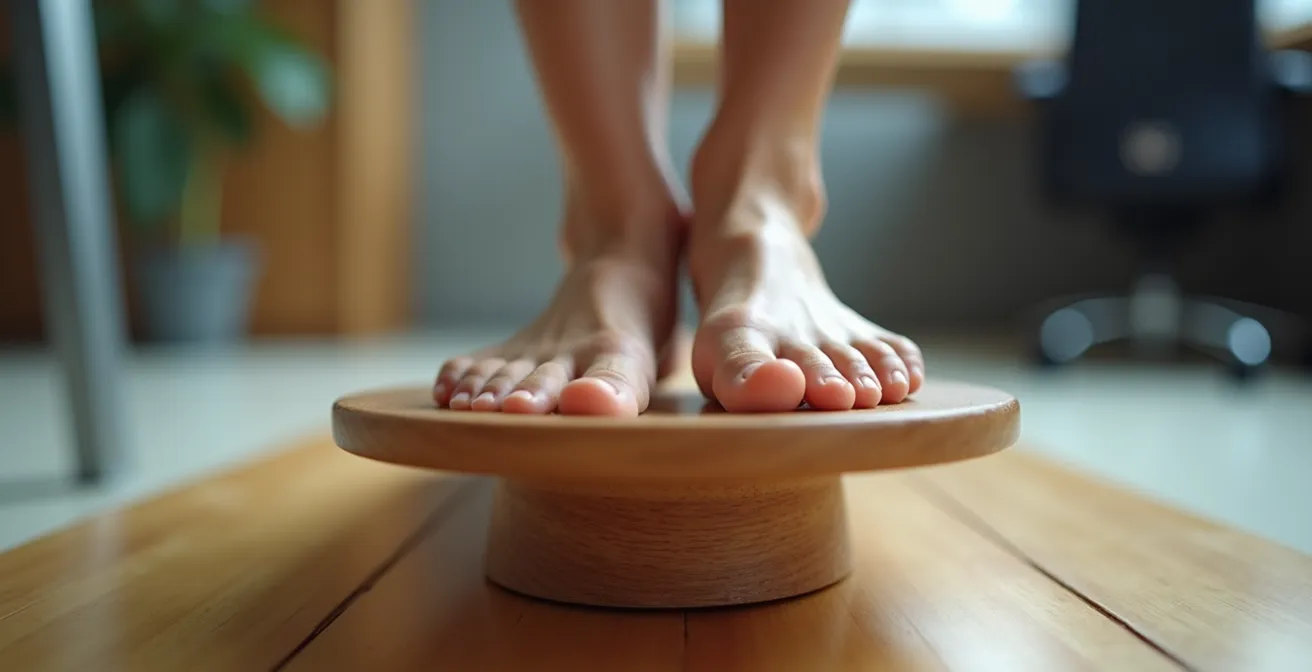
As this image demonstrates, an active standing setup engages your entire lower body. By focusing on dynamic movement rather than static posture, you can reap the benefits of a standing desk—improved circulation, better posture, and higher energy levels—without creating a new set of orthopedic problems. The transition is successful when standing becomes just one of several healthy postures you cycle through during your workday.
Ergonomic Chair or Swiss Ball: Which Is Better for Core Strength?
The debate between a high-end ergonomic chair and a simple Swiss ball is a common one for those seeking to improve their sitting posture and engage their core. Each option operates on a fundamentally different principle. An ergonomic chair is designed for passive support; its purpose is to hold your body in an ideal posture with minimal muscular effort. A Swiss ball, conversely, demands active engagement. Its inherent instability forces your core muscles to fire continuously to maintain balance.
While the idea of a constant core workout sounds appealing, the Swiss ball is often a poor choice for a full-time office chair. The constant micro-adjustments required for stability can become a distraction, detracting from focus-intensive tasks. More importantly, it’s very difficult to maintain an ideal, neutral pelvic tilt on a ball for extended periods; most people eventually fatigue and slump into a posture that is often worse than what they would hold in a decent chair. For this reason, physical therapists typically recommend using a Swiss ball for short “movement snacks” of about 20 minutes, not as a primary seat.
An ergonomic chair, when adjusted correctly, provides the stability needed for focused work while maintaining proper spinal alignment. The key is that it *supports* a good posture rather than forcing you to create it from scratch every second. However, this doesn’t mean it should be a completely passive experience. The most advanced ergonomic chairs now incorporate features that encourage “active sitting,” allowing for subtle shifts in pelvic tilt and posture. As a comparative analysis from CoreChair demonstrates, the two options serve very different purposes.
| Factor | Ergonomic Chair | Swiss Ball |
|---|---|---|
| Core Activation | Minimal, passive support | Active engagement required |
| Stability for Focus Tasks | Excellent | Poor – constant adjustment needed |
| Pelvic Tilt Impact | Maintains neutral with proper adjustment | Encourages anterior tilt |
| Recommended Duration | Extended periods (with breaks) | 20-minute ‘movement snacks’ |
| Diaphragmatic Breathing | Neutral effect | May improve through posture variation |
Ultimately, the best approach is often a hybrid one. Use a well-adjusted ergonomic chair for the majority of your focused work, and integrate the Swiss ball for short, active breaks to engage your core and change your posture. As the CoreChair Research Team notes in their report, the goal is to make sitting itself more active.
Using the CoreChair doesn’t replace walking and exercise, but you can gain health benefits from sitting if you use active sitting solutions
– CoreChair Research Team, CoreChair Sitting Disease Report
The Risk of Digital Eye Strain leading to Chronic Headaches
The negative effects of prolonged screen time extend far beyond your eyes. Digital eye strain is a major contributor to a cascade of musculoskeletal issues, culminating in chronic headaches. This process often begins with a subtle but persistent change in posture known as “tech neck” or forward head posture. As you stare at a screen, especially one that is poorly positioned, your head naturally drifts forward and down. For every inch your head moves forward, its effective weight on your cervical spine doubles, placing immense strain on the muscles in your neck and upper back.
This sustained forward head posture is a direct pathway to cervicogenic headaches—headaches that originate from problems in the neck. The muscles at the base of your skull become overworked and tight, which can irritate nerves that travel up into the head, causing pain that is often mistaken for a migraine or tension headache. Correcting this requires a conscious “postural reset.” As outlined in physical therapy protocols, a key corrective exercise is the chin tuck: sit or stand upright, and gently tuck your chin as if trying to make a double chin, holding for a few seconds. This strengthens the deep neck flexors and reverses the forward head pattern. Performing this simple movement several times throughout the day can provide significant relief.
Preventing this entire cascade starts with proper workstation ergonomics. Your physical environment should support a neutral posture, not fight against it. A systematic audit of your desk setup is the most powerful preventative measure you can take. By ensuring your monitor, chair, and lighting are correctly configured, you can dramatically reduce the physical stress that leads from eye strain to chronic headaches.
Action Plan: Your 5-Point Workspace Ergonomic Audit
- Screen Position: Sit upright and ensure the top of your monitor is at or slightly below eye level. You should not have to tilt your head up or down to see the center of the screen.
- Screen Distance: Position the monitor approximately an arm’s length away (about 20-26 inches) from your eyes to reduce visual strain.
- Lighting: Arrange your primary light source (like a window or lamp) to the side of your monitor, not directly behind it, to minimize glare and screen reflections.
- Neck Angle: Consciously check your posture. Your ears should be aligned vertically over your shoulders. If they are forward, you are in “tech neck” posture.
- Chair and Arm Height: Adjust your chair so your elbows are bent at a comfortable 90-degree angle when your hands are on the keyboard, with your shoulders relaxed.
Timing Your Breaks: The 20-20-20 Rule for Visual Health
The 20-20-20 rule is a well-known guideline for combating digital eye strain: every 20 minutes, look at something 20 feet away for 20 seconds. This simple practice helps to relax the ciliary muscles inside your eyes, which work hard to maintain focus on a close-up screen. While this rule is an excellent starting point for visual health, its benefits can be massively amplified by expanding it from a purely visual break into a full-body postural reset. The most effective breaks are those that counteract the total physical stagnation of sitting.
An enhanced protocol integrates movement directly into this timed structure. Instead of just looking away, use those 20 seconds to stand up and perform a targeted mobility drill. A simple spinal roll-down, a gentle thoracic rotation, or a few cat-cow stretches can reintroduce movement to your spine, improve blood flow, and release muscular tension. This transforms a passive eye break into an active “movement microdose” that addresses both visual and musculoskeletal strain simultaneously.

As shown here, even a simple stretch by your desk can be a powerful reset. To make this a consistent habit, leverage technology. Use a timer app or a simple desk reminder to prompt you every 20 minutes. The goal is to make these breaks non-negotiable. For longer breaks, such as the 5-minute pauses in a Pomodoro workflow, you can incorporate more substantial movements like hip flexor lunges or wall slides. This systematic approach ensures that you are continuously interrupting the damaging patterns of static posture.
By upgrading the 20-20-20 rule, you create a powerful, recurring opportunity to reverse the negative effects of sitting. This protocol is not just about preventing eye strain; it’s about building a sustainable system of movement that keeps your entire body resilient and pain-free throughout the workday. Here is an example of an enhanced protocol:
- Every 20 minutes: Look at something 20 feet away for 20 seconds.
- Add a 20-second postural reset: Stand up and perform a spinal roll-down or thoracic rotation.
- During longer (5-minute) breaks: Perform more substantial mobility drills like hip flexor lunges and wall slides to target areas tightened by sitting.
- Track your compliance: Use a timer app or physical reminder to build the habit until it becomes automatic.
Why Sarcopenia Is the Biggest Threat to Your Retirement Quality
While we often associate the damage of sitting with immediate aches and pains, its most insidious long-term threat is sarcopenia—the age-related loss of muscle mass, strength, and function. This condition is a primary determinant of long-term independence and quality of life in retirement, and a sedentary lifestyle dramatically accelerates its onset. When you sit for hours, you are sending a powerful signal to your largest muscle groups, particularly the glutes and legs, that they are no longer needed. The biological principle is simple and ruthless: “if you don’t use it, you lose it.”
This process is a form of disuse atrophy. Your gluteal muscles, the powerhouse of your lower body, become dormant and weak, a phenomenon often called “gluteal amnesia.” Your leg muscles, no longer required to support your body weight, begin to lose mass and strength. This is not just a cosmetic issue; it’s a profound metabolic shift. Muscle is a metabolically active tissue that plays a crucial role in regulating blood sugar and burning calories. As you lose muscle, your metabolism slows down, making you more susceptible to weight gain and related conditions.
The connection between sitting and metabolic health is well-documented. For instance, research discovered that obese people spent two hours more per day sitting than their lean counterparts. Prolonged sitting promotes a state of “anabolic resistance,” where the body becomes less efficient at using protein to build and repair muscle, even after a workout. This means that an office worker who sits all day and then goes to the gym has to work much harder to achieve the same muscle-building results as someone who is active throughout the day. Sarcopenia is not a distant problem for the elderly; its foundations are laid during decades of sedentary work.
The Danger of “Driver’s Slump” for Lower Back Pain
The damaging effects of sitting are not confined to the office. For many, the daily commute represents another significant period of sedentary posture, often in an environment that is even less ergonomic than an office chair. The typical posture adopted while driving, often called the “driver’s slump,” is particularly detrimental to the lower back. This posture is characterized by a rounded lumbar spine, a forward-jutting head, and often a slight twist in the torso to operate the pedals and controls. It’s a perfect storm of spinal compression, muscular imbalance, and sustained tension.
Car seats are notoriously poor at providing adequate lumbar support, causing the lower back to flatten and placing direct pressure on the intervertebral discs. The vibration of the vehicle further exacerbates this stress. This slumped posture deactivates the core and gluteal muscles, forcing the small muscles of the lower back and hamstrings to overwork, leading to stiffness and pain. The problem is cumulative; a 45-minute commute twice a day adds up to 7.5 hours of poor posture per week before you even set foot in the office. This is a significant contribution to the overall “sitting disease,” as extensive research shows direct correlations between sedentary lifestyles and conditions like heart disease, diabetes, and obesity.
Counteracting the driver’s slump requires a specific and immediate “postural reset” the moment you get out of the car. Instead of walking straight into your home or office and sitting down again, take just two minutes to reverse the postural patterns of your drive. This small investment of time can prevent the stiffness from setting in and helps to reset your muscular activation patterns before your next activity. A simple post-drive routine can make a world of difference in managing commute-related back pain.
A simple yet effective 2-minute routine includes:
- Immediate Standing: Upon parking, simply stand by your car for 30 seconds before doing anything else.
- Standing Pelvic Tilts: Gently tuck and untuck your pelvis to reintroduce movement to the lumbar spine.
- Cat-Cow Movements: Place your hands on the car roof or hood and perform 5 gentle cat-cow movements.
- Hip Circles: Perform 10 slow hip circles in each direction to loosen up your hip joints.
Key Takeaways
- Sitting is not passive rest; it’s an active process of systemic adaptation that includes spinal compression, muscle atrophy, and negative metabolic changes.
- The most effective solution is not a single, intense workout but a system of continuous “movement microdosing”—frequent, short, and targeted movements integrated throughout the day.
- Combating sedentary damage requires a holistic approach that includes dynamic workstations, active sitting strategies, and specific postural resets for activities like screen use and driving.
How to Maintain Muscle Mass After 40 to Ensure Long-Term Independence?
Maintaining muscle mass after the age of 40 is the single most important factor for ensuring a long, independent, and high-quality life. As we’ve seen, a sedentary office job is a direct antagonist to this goal, creating a state of anabolic resistance that makes it harder to build and preserve muscle. This raises a critical question: is an hour at the gym enough to counteract eight hours of sitting? The emerging science suggests it is not. The key to fighting muscle loss is not the intensity of a single session, but the frequency of muscular activation throughout the day.
Remarkably, studies comparing a single intense workout to frequent, short breaks from sitting have found the latter to be more effective in combating anabolic resistance. Taking five-minute breaks every 30 to 45 minutes to stand up, walk, and perform simple exercises sends a continuous signal to your muscles to stay active and ready. These “movement snacks” keep your metabolism elevated and prime your body to utilize nutrients for muscle repair and growth. This approach systematically interrupts the catabolic (muscle-wasting) state induced by prolonged inactivity.
The most effective exercises for these movement snacks are those that directly target the muscles weakened and tightened by sitting—collectively known as the posterior chain (glutes, hamstrings, and lower back). By focusing on activating these muscles, you directly counteract gluteal amnesia and restore proper pelvic alignment. A simple workout focusing on these areas can be broken up and performed in short bursts throughout the day or done as a dedicated session.
An effective posterior chain workout to combat sitting includes:
- Glute Bridges: 3 sets of 15 reps to reactivate the glutes.
- Single-Leg Deadlifts: 3 sets of 10 per leg for balance and hamstring strength.
- Back Extensions (Supermans): 3 sets of 12 reps to strengthen the lower back.
- Bird Dogs: 3 sets of 10 per side to improve core stability and coordination.
- Wall Sits: 3 sets of 30-45 seconds to build isometric strength in the quads and glutes.
This strategy of frequent activation is the cornerstone of maintaining muscle mass in a modern, sedentary world. It shifts the focus from “working out” to building a lifestyle of continuous, integrated movement.
The journey to reversing the damage of sitting is a marathon, not a sprint. It begins not with a drastic overhaul, but with a single, conscious choice. Start today by incorporating one “movement snack” or one postural reset into your next hour of work. By consistently applying these principles, you can transform your relationship with your workspace and build a foundation for long-term health and vitality. Your body will thank you for it.