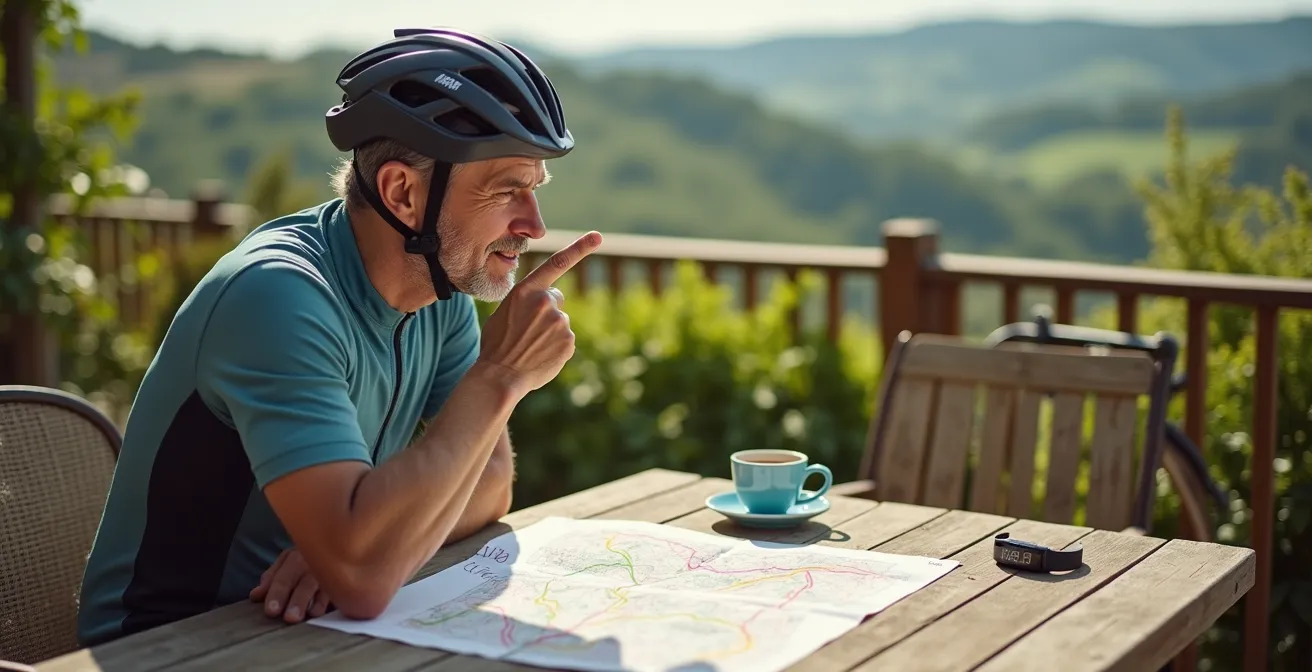
The secret to a perfect cycling holiday isn’t your peak fitness; it’s planning based on sustainable effort rather than ambitious mileage.
- Shift from distance-based goals (e.g., 60 miles/day) to effort-based goals that account for elevation, terrain, and weather.
- Realistically assess your multi-day stamina with a pre-trip simulation, as cumulative fatigue is the real challenge.
- Use logistics like e-bikes, luggage transfers, and train travel as strategic tools to manage your daily energy budget.
Recommendation: Always plan your itinerary for your ‘average’ self, not your ‘superhero’ self. This builds in a crucial buffer for enjoyment, exploration, and the unexpected.
The image of a cycling holiday is often one of serene landscapes, charming village stops, and a profound sense of freedom. Yet, for many, this dream is shadowed by a nagging fear: “Will I be able to keep up?” The worry of being the slowest in the group, of turning a dream vacation into a grueling test of endurance, is a powerful deterrent. Conventional advice often falls into two unhelpful camps: either a vague “get in shape before you go” or an oversimplified “just pick a flat route.” Both of these platitudes miss the fundamental challenge of a multi-day tour.
The real variable that can make or break your trip isn’t your peak speed or the total distance covered. It’s cumulative fatigue. The exhaustion you feel on day four is entirely different from what you feel after a single long ride at home. But what if the entire framework of planning—measuring success in miles or kilometers—is flawed? The key to unlocking a truly joyful and sustainable cycling holiday is to shift your mindset from planning by distance to planning by effort. This means treating your energy as a finite daily budget, one that is spent not just on distance, but on every hill, every rough patch of gravel, and every pound of luggage.
This guide is designed to give you that new framework. As a travel consultant, I’ll walk you through the same strategic principles I use to design custom itineraries that match a traveler’s reality, not just their ambition. We will deconstruct how to map routes based on energy expenditure, leverage modern logistics as performance tools, and realistically prepare your body and mind. The goal is to trade anxiety for anticipation, ensuring your cycling holiday is remembered for the memories you made, not the miles you suffered.
This article provides a comprehensive roadmap to help you plan your adventure with confidence. Below, the table of contents outlines the key strategic areas we will cover, from initial route mapping to on-the-ground logistics and preparation.
Summary: A Strategic Guide to Planning Your Fitness-Matched Cycling Holiday
- Why Slow Travel Is the Most Impactful Eco-Choice You Can Make
- How to Map a scenic Route Avoiding Major Highways?
- E-Bike or Manual: Which Provides the Best Touring Experience?
- The Risk of Overestimating Your Stamina on Multi-Day Trips
- Optimizing Logistics: Is Luggage Transfer Worth the Extra Cost?
- Optimizing Transit: Combining Bikes and Trains for Fastest Commutes
- Why Trail Runners Are Replacing Boots for Long-Distance Hikes
- How to Prepare for High-Altitude Trekking Safely?
Why Slow Travel Is the Most Impactful Eco-Choice You Can Make
The philosophy of planning by effort naturally aligns with the principles of slow travel. When the goal shifts from “how far can I go?” to “how much can I experience within my energy budget?”, the entire nature of the trip changes. Slow travel on a bicycle isn’t about being slow; it’s about being present. It’s the choice to engage deeply with a smaller area rather than superficially skimming a larger one. This approach is not only more rewarding but also represents a more sustainable form of tourism. By spending more time and money in local communities, you contribute directly to the regional economy, supporting small cafes, independent inns, and local artisans.
From an environmental perspective, the benefits are clear. A human-powered journey has a minimal carbon footprint. But the impact goes deeper. Slow cycling encourages you to use resources at a local scale, reducing the complex supply chains associated with mass tourism. This focus on leisure and immersion over speed is the dominant force in the market; market analysis shows that leisure cycling accounts for the vast majority of bicycle tourism revenue. Opting for a slow travel mindset means you’re choosing a path that is not just more manageable for your fitness, but also gentler on the planet and more enriching for your soul.
Ultimately, this approach reframes the entire holiday. An “off day” due to fatigue or bad weather is no longer a failure to meet a mileage target; it becomes an opportunity to explore a local market, read a book in a cafe, or simply rest and recover. It transforms the journey from a physical challenge to be conquered into a holistic experience to be savored. This is the most profound impact of all: sustainability for both the destination and for yourself.
How to Map a scenic Route Avoiding Major Highways?
The heart of effort-based planning lies in route mapping. Instead of simply tracing a line between two points on a map and dividing the mileage, a strategic consultant looks at the terrain with a critical eye. The goal is to create a route that is both scenically rewarding and physically manageable, which means avoiding busy, unpleasant highways and understanding the true effort required. Modern tools like Komoot, Ride with GPS, and even Google Maps’ cycling layer allow you to favor backroads, dedicated bike paths, and quiet country lanes. They also provide the most critical data point for effort-based planning: the elevation profile.
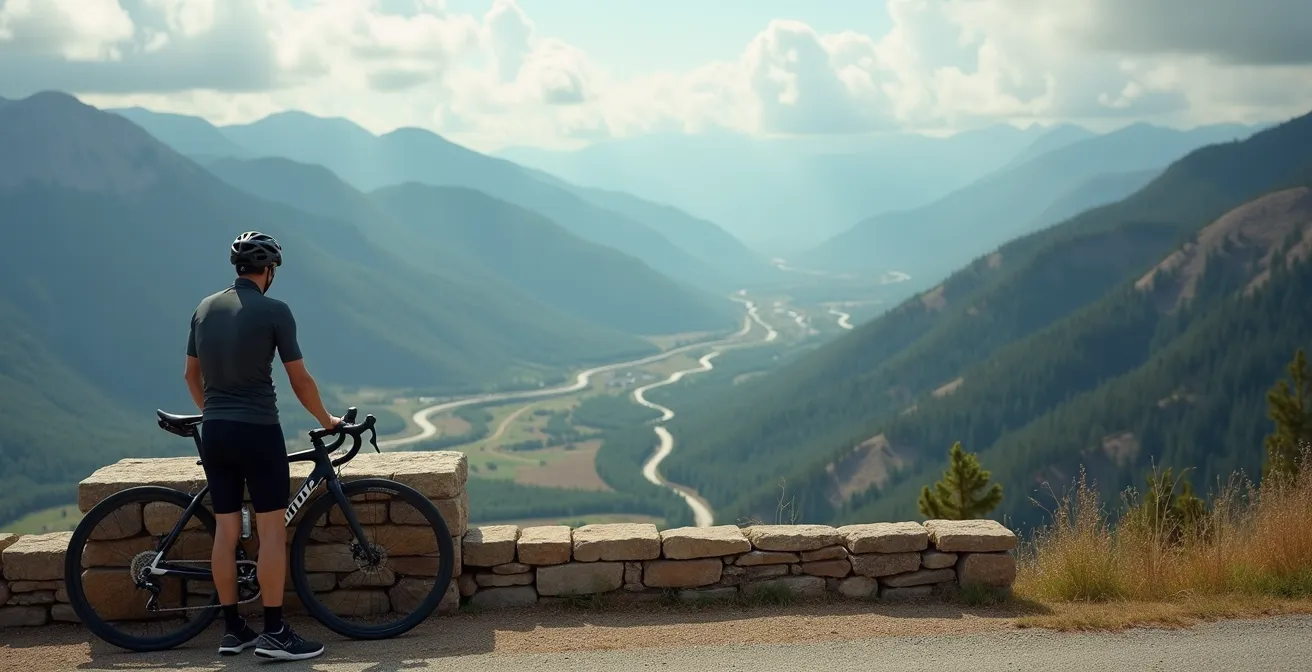
A 50-mile flat ride is a completely different physical undertaking than a 50-mile ride with 4,000 feet of climbing. Similarly, a route on smooth asphalt requires significantly less energy than one on loose gravel. This is where the concept of an “effort budget” comes into play. Rather than a fixed daily distance, you plan for a fixed daily effort. This paradigm shift is the single most important factor in designing a successful tour that matches your fitness.
Case Study: The West Kernow Way
Launched by Cycling UK, the West Kernow Way in Cornwall is a perfect example of modern route design. This 150-mile loop was intentionally created to guide cyclists through stunning landscapes using a network of quiet roads, bridleways, and trails. By curating a path that avoids major traffic arteries and showcases local heritage, it provides a blueprint for how to build an immersive and enjoyable route that prioritizes experience over directness.
The following table illustrates the fundamental difference between these two planning philosophies. For a traveler worried about keeping up, adopting an effort-based approach is non-negotiable.
| Factor | Distance-Based Planning | Effort-Based Planning |
|---|---|---|
| Primary Metric | Miles/kilometers per day | Caloric expenditure & elevation gain |
| Surface Consideration | Minimal | Critical (gravel adds 20-30% effort) |
| Daily Target Example | 60 miles flat or hilly | 2,000 calories regardless of distance |
| Recovery Planning | Fixed rest days | Flexible based on accumulated effort |
| Best For | Flat terrain tours | Mixed terrain & elevation tours |
E-Bike or Manual: Which Provides the Best Touring Experience?
The debate between e-bikes and manual bikes often devolves into a simplistic argument about authenticity or “cheating.” As a travel strategist, I see it very differently. An e-bike is not a compromise; it’s a powerful tool for managing your energy budget. For a traveler concerned about hills, headwinds, or keeping up with a fitter partner, an e-bike can be the key that unlocks a previously inaccessible holiday. It doesn’t eliminate the work; it equalizes the effort, turning a dreaded mountain pass into a challenging but achievable climb.
The true “best” experience is one that minimizes stress and maximizes enjoyment. For many, this means a hybrid approach. You don’t have to commit to an e-bike for the entire trip. By carefully analyzing your route map (as discussed in the previous section), you can identify the days with the most significant challenges—typically those with substantial elevation gain—and rent an e-bike specifically for those segments. On flatter, easier days, you can enjoy the simplicity of a manual bike. This strategy provides the best of both worlds: you get the assistance when you need it most, and you save on rental costs when you don’t.
This approach also solves a common social dynamic. In a group with mixed fitness levels, providing e-bikes for those who need them ensures the entire party can ride together, sharing the same pace and experience. It transforms the journey from a struggle for some into a shared adventure for all. The goal is to finish each day pleasantly tired and excited for the next, not utterly depleted. An e-bike is simply another lever you can pull to guarantee that outcome.
Your Action Plan: The Strategic Hybrid E-Bike Rental Approach
- Map your route: Clearly identify the most challenging segments, specifically noting days with over 3,000 feet (approx. 900 meters) of elevation gain.
- Book strategically: Arrange for e-bike rentals only for those pre-identified high-effort days.
- Optimize costs: Use standard manual bikes for flatter sections, which can reduce overall rental expenses by 40-60%.
- Research logistics: Find rental shops that accommodate one-way hires or are located at the start and end points of your challenging segments.
- Consider the group: If riding with others, rent e-bikes for less confident or slower riders to ensure the group can maintain cohesion and enjoy the ride together.
The Risk of Overestimating Your Stamina on Multi-Day Trips
The single biggest mistake travelers make is confusing their single-day fitness with their multi-day endurance. Being able to ride 60 miles on a Saturday at home does not automatically mean you can ride 60 miles every day for a week. This is the danger of cumulative fatigue—the deep, systemic weariness that builds day after day from sustained effort, new environments, and less-than-perfect sleep. Ignoring it is the fastest way to turn an adventure into an ordeal.
Your body’s ability to recover is finite. Even with a good night’s sleep, small muscular deficits and energy depletion add up. This is backed by science; research on athletic performance demonstrates that VO2 max begins to decline after just 10 days of no training, showing how quickly aerobic conditioning can be affected by changes in routine. On a trip, you’re constantly drawing from your reserves. The most successful trips are built on a foundation of honest self-assessment. As legendary coach Chris Carmichael advises:
Plan the trip for your ‘7/10′ self, not your ’10/10’ self, to build in a realistic buffer for bad weather, poor sleep, or a simple ‘off day’.
– Chris Carmichael, CTS Holiday Training Plan
To avoid this trap, you need a realistic test. A single ride isn’t enough. The most effective method is a weekend simulation.
Protocol: The Weekend Simulation Test
To gauge your true multi-day readiness, tour operator VBT Bicycling Vacations recommends a simple but effective protocol. Ride 70% of your planned average daily distance on a Saturday. Then, on Sunday, ride the same distance again. The real test is Monday morning: how do you feel? Are you sore but recovering, or are you deeply fatigued and dreading another ride? This two-day test mimics the cumulative effect of a tour and provides invaluable, real-world data to set a realistic daily mileage or effort target.
Proactively managing this fatigue is crucial. It means building structured rest into your itinerary. This doesn’t just mean a day off the bike, but also planning shorter, lighter days after particularly strenuous ones.
- Plan ‘zero-mile’ days every 3-4 days of continuous cycling to allow for full muscle recovery.
- Schedule lighter, 30-40 mile days immediately following challenging 60+ mile stages.
- Incorporate buffer days into your schedule to account for unexpected fatigue or poor weather.
- Prioritize morning rides, leaving afternoons free for rest, recovery, and spontaneous exploration.
Optimizing Logistics: Is Luggage Transfer Worth the Extra Cost?
After elevation, the second biggest drain on your daily energy budget is weight. Carrying your own luggage in panniers—a practice known as bikepacking or self-supported touring—is a noble and rewarding endeavor, but it comes at a significant physical cost. Each extra pound requires more effort on every pedal stroke, especially on climbs. A fully loaded touring bike can easily weigh 20-30 pounds (9-14 kg) more than an unladen one, which can increase your energy expenditure by 20-30%. For a traveler already concerned about their stamina, this is a critical factor.
This is where luggage transfer services come in. These services, which transport your main suitcase from one hotel to the next, transform a tour. By allowing you to ride a light, nimble bike carrying only a daypack with essentials, you save an enormous amount of energy. This “saved” energy can then be reinvested into enjoying the ride, tackling an extra hill, or simply finishing the day with more in the tank. While it comes at an extra cost, it’s often best viewed as an investment in your own performance and enjoyment. Market data confirms this value perception, indicating that over 70% of cycle tourism revenue comes from multi-day tours that include premium services like luggage transfer.
The decision doesn’t have to be all or nothing. A hybrid approach can be highly effective. You might opt for luggage transfer only on the hilliest days of your tour and carry your own gear on the flatter, easier sections. This allows you to balance cost with energy savings strategically. The table below breaks down the trade-offs, helping you decide which approach best suits your itinerary and your energy budget.
| Option | Daily Cost | Energy Impact | Best For |
|---|---|---|---|
| Full luggage transfer | $30-50 | Saves 15-20% energy | All mountain stages, older riders |
| Selective transfer | $15-25 average | Saves energy on hard days | Mixed terrain tours |
| Self-carry panniers | $0 | Uses 20-30% more energy | Flat routes, budget tours |
| Hybrid approach | $10-20 average | Optimized energy use | Flexible itineraries |
Optimizing Transit: Combining Bikes and Trains for Fastest Commutes
A truly smart itinerary recognizes that not every mile of a route is worth riding. Industrial outskirts, unpleasantly busy highway stretches, or simply long, monotonous sections can drain your energy and morale without offering any scenic or cultural reward. The most experienced tour planners use regional transit, particularly trains, as a strategic tool to “leapfrog” these undesirable segments, preserving their energy for the parts of the journey that matter most.
This bike-and-rail approach offers incredible flexibility. It allows you to build a “hub-and-spoke” tour, where you base yourself in one town for several days and use the train to access different rides each day without having to pack up and move. Alternatively, on a point-to-point tour, a train can turn a grueling 80-mile day into a pleasant 40-mile ride connected by a relaxing hour of transit. It’s also an essential safety net, providing a bailout option in the case of unexpected mechanical failure, sudden illness, or extreme weather.
Case Study: European Rail-Bike Integration
Europe is the master of this model, and its success is a major reason why European cycle tourism represents nearly 40% of the global market. Countries like Germany, Switzerland, the Netherlands, and Denmark have seamlessly integrated bicycle transport into their regional train networks. This allows cyclists to create highly flexible, customized itineraries on the fly, skipping urban sprawl to start their rides directly in the countryside and maximizing their time in scenic areas.
To effectively use this strategy, a little pre-planning is required. You need to understand the local train network’s policies on bicycles. Here are the key steps to what I call the “Leapfrog Strategy”:
- Research Policies: Before you go, investigate the bike policies for the train operators in your destination region. Check for reservation requirements, special fees, and any blackout periods during peak commuter hours.
- Book in Advance: During high season, it’s wise to book your bike space on trains at least 48 hours in advance, as spots can be limited.
- Bypass Undesirable Zones: Use trains to skip industrial areas, dangerous highway sections, or long, uninteresting stretches of road.
- Plan Hub-and-Spoke Tours: Consider basing yourself in a single, well-connected town and using daily train journeys to start your rides in different locations.
- Have a Bail-Out Plan: Keep emergency train schedules and station locations saved offline on your phone in case you need an escape route due to weather or fatigue.
Why Trail Runners Are Replacing Boots for Long-Distance Hikes
A fascinating shift has occurred in the long-distance hiking world: heavy, rigid hiking boots are being replaced by lightweight, flexible trail running shoes. This trend holds a powerful lesson for cycle touring. For decades, the prevailing wisdom in cycling, driven by the professional racing scene, was that footwear had to be ultra-stiff for maximum power transfer. This led to road cycling shoes with rock-hard carbon soles and slippery plastic bottoms—perfect for racing, but terrible for walking into a cafe or exploring a village on foot.
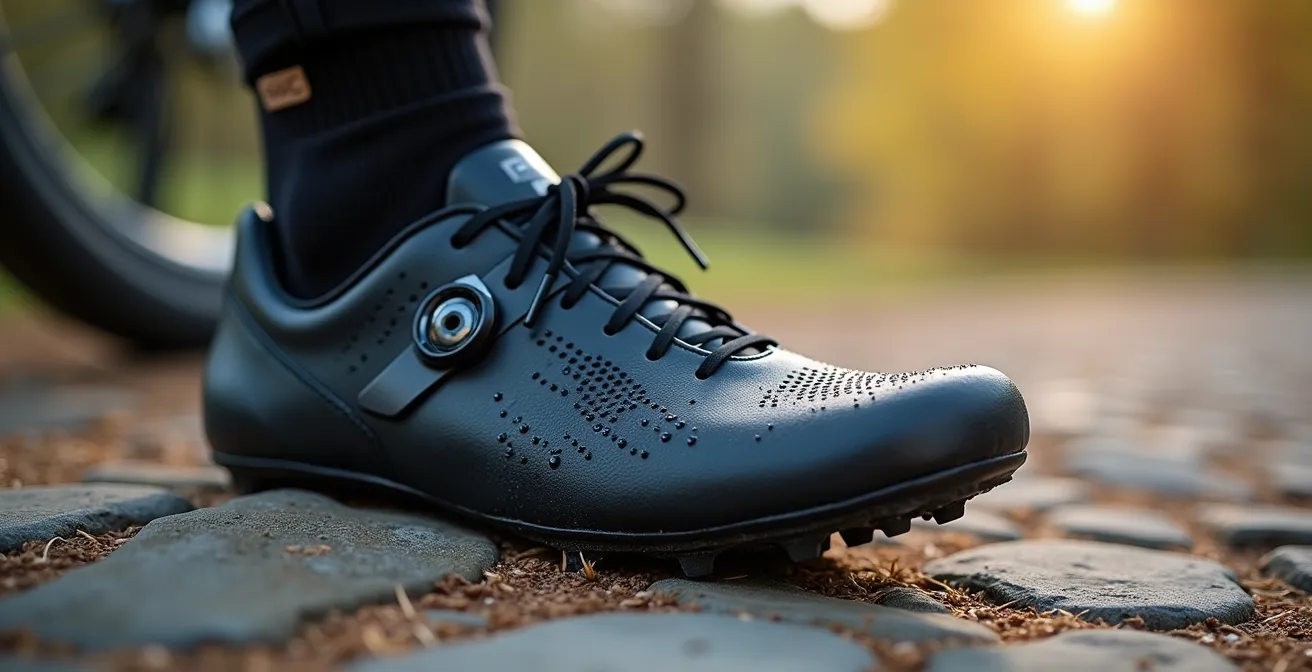
Just as hikers realized comfort and reduced weight were more important over long distances than ultimate ankle support, the cycling world is embracing a more versatile philosophy, especially in the realms of gravel riding and touring. Modern “all-road” or “gravel” cycling shoes are the equivalent of trail runners. They offer a sole that is stiff enough for efficient pedaling but has just enough flex to allow for comfortable walking. They feature recessed cleats that don’t click-clack on the pavement and have rubberized, grippy treads. This seemingly small change has a huge impact on the quality of a tour. It removes the barrier between being on and off the bike.
You no longer have to choose between performance and practicality. You can seamlessly transition from riding to exploring a historic castle, walking through a market, or climbing a set of stairs to a scenic viewpoint without waddling like a penguin. As former professional cyclist turned gravel and adventure icon Ted King puts it, the priorities for touring are different.
For touring, comfort and the ability to walk normally during a coffee stop are more important than marginal watt savings.
– Ted King, former pro cyclist
When selecting your gear, apply this lesson. Look beyond the pure performance specs and ask: “Will this piece of equipment make my entire experience, both on and off the bike, better?” Choosing a walkable cycling shoe is a perfect example of this holistic, experience-first mindset.
Key Takeaways
- Plan your days around effort (elevation and terrain), not just distance, to create a sustainable itinerary.
- Honestly assess your multi-day stamina with a two-day simulation test before your trip to set realistic goals.
- Use logistics like luggage transfers, e-bikes, and train travel as strategic tools to manage your daily energy and maximize enjoyment.
How to Prepare for High-Altitude Trekking Safely?
While a typical European cycling holiday won’t involve true high-altitude trekking, the underlying principle of preparing for environmental stressors is directly applicable. A cyclist’s performance and energy budget are hugely influenced by external factors like heat, humidity, and—most notoriously—wind. A well-laid plan can be quickly derailed by an unexpected 20 mph headwind or a sudden heatwave. A truly resilient itinerary, therefore, must account for the weather.
Thinking like a strategist means anticipating these challenges. Before your trip, study the prevailing wind patterns for your destination during that time of year. If the wind typically blows west-to-east, planning your route in that direction can provide a gentle push instead of a soul-crushing battle. Similarly, if you are traveling to a hot climate, your preparation should include heat acclimatization. This involves doing some of your training rides in warmer conditions in the weeks leading up to your departure to help your body adapt.
On the trip itself, flexibility is key. You must be willing to adjust your daily goals based on the conditions. A day with extreme heat or a brutal headwind is not the day to attempt your longest or hilliest ride. This is where your “7/10 self” planning pays off, as the buffer you built in gives you the freedom to cut a day short, start earlier to avoid midday heat, or even take an unplanned rest day without derailing your entire schedule. Preparing a sound strategy for managing environmental stress is the final layer of a truly professional plan.
Here are some actionable steps for weather stress preparation:
- For Heat: Begin heat acclimatization rides two weeks before your trip, and plan a detailed electrolyte strategy, increasing sodium intake in hot conditions.
- For Headwinds: Study prevailing wind patterns and, where possible, plan your daily route direction accordingly to gain a tailwind advantage.
- Adjust Goals: Be prepared to reduce your daily distance or effort targets by 20-30% on days with extreme weather.
- Schedule Smartly: Plan your most challenging segments for the early morning when temperatures are typically milder and winds are often calmer.
With this comprehensive framework—shifting from distance to effort, assessing your stamina honestly, and using logistics and preparation as strategic tools—you are no longer just hoping for a good trip. You are engineering one. You have the consultant’s toolkit to build a cycling holiday that truly honors your fitness, respects your limits, and ultimately, maximizes your joy. The next logical step is to put this theory into practice. Start exploring potential routes with this new perspective, and begin designing an adventure that is perfectly tailored to you.