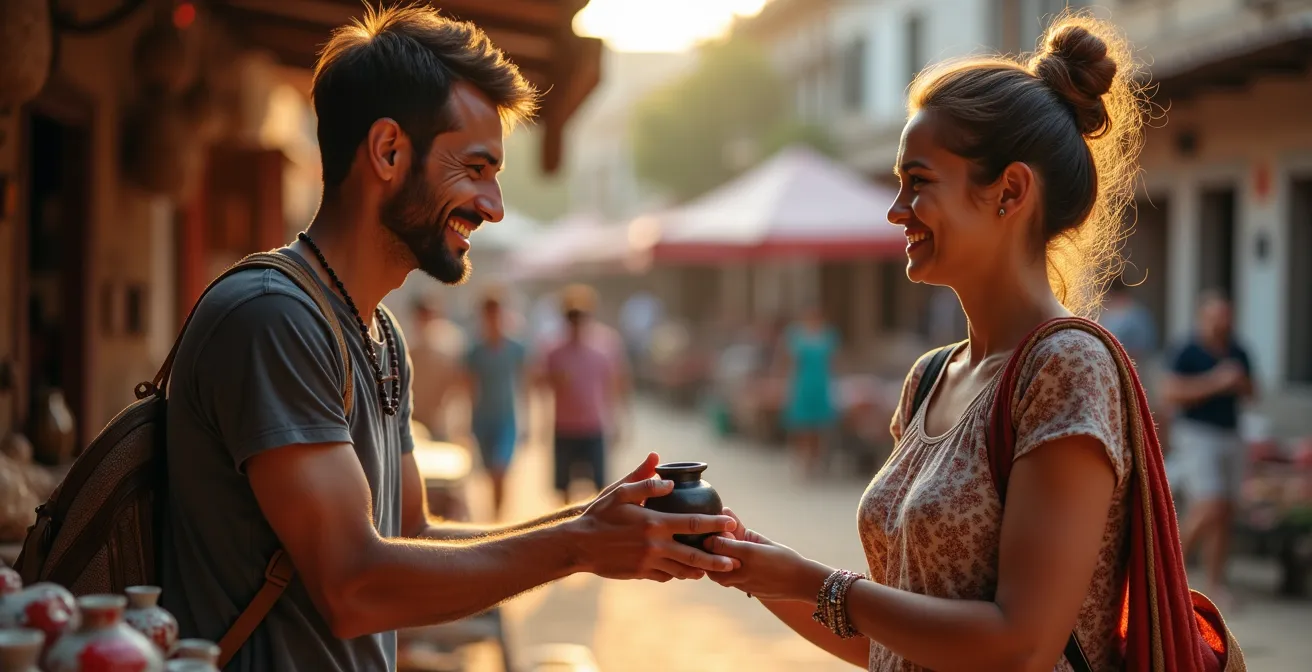
Authentic travel isn’t about discovering a hidden spot; it’s about shifting your mindset from a spectator to a respectful participant.
- This involves understanding a culture as a living ecosystem, not a product to be consumed.
- The key is seeking reciprocal exchange and structured participation, not just passive observation.
Recommendation: Start by preparing a “cultural dossier” on your destination before you even leave home to engage on a deeper, more meaningful level.
For the seasoned traveler, the feeling is all too familiar. You’ve ticked off the world’s wonders, navigated bustling cities, and collected passport stamps, yet a nagging sense of superficiality remains. You’ve seen the sights, but have you truly connected with the soul of a place? The standard travel advice—”eat where the locals eat,” “learn a few phrases”—often leads to a curated, tourist-friendly version of authenticity, a comfortable performance rather than a genuine encounter. This approach treats culture as a checklist, leaving you on the outside looking in, a consumer of experiences rather than a participant in a living, breathing community.
The frustration mounts when you realize you’re trapped in a cycle of observation, moving from one photo opportunity to the next without understanding the context behind them. But what if the solution wasn’t about finding a more remote location or a more obscure restaurant? What if the key to unlocking profound cultural experiences lies not in where you go, but in *how* you approach the journey? The real transformation begins when you shift your perspective from that of a tourist to that of a cultural anthropologist: someone who values depth over breadth, respect over consumerism, and understanding over simple sightseeing. This guide offers a framework to make that shift, moving beyond the platitudes to cultivate genuine, memorable, and transformative connections.
This article provides a structured approach to redefine your travels. We will explore the mindset shifts necessary for immersive travel, practical methods for respectful engagement, and strategies for planning trips that foster deep cultural insight rather than surface-level tourism.
Summary: A Traveler’s Framework for Deep Cultural Connection
- Why Does Immersive Travel Transform Your Perspective More Than Sightseeing?
- How to Approach Local Communities respectfully Without Being Intrusive?
- Private Guide or Small Group: Which Offers Better Cultural Insight?
- The Mistake That Turns Cultural Appreciation into Appropriation
- When to Visit Sacred Sites to Avoid Crowds and Ensure Respect
- Why Staying in an Expat Bubble Defeats the Purpose of Travel
- Why 3 Days in Nature Lowers Your Stress Markers by 50%
- How to Plan a Month-Long Homestay for True Immersion?
Why Does Immersive Travel Transform Your Perspective More Than Sightseeing?
Sightseeing is a passive act of consumption; you look at a monument, take a picture, and move on. Immersive travel, in contrast, is an active process of structured participation. It transforms your perspective because it forces you to engage with a culture as a living, dynamic system rather than a static backdrop. By participating in daily routines, you begin to understand the “why” behind local customs, unraveling the intricate web of relationships, history, and values that a simple photo can never capture. This shift from observer to participant is the foundation of a true perspective change, challenging your own cultural assumptions and fostering genuine empathy.
This process is often described as “cognitive decentering”—the ability to step outside your own cultural framework to understand another on its own terms. It is not about “going native,” but about developing the mental flexibility to see the world from multiple viewpoints. This deeper level of engagement creates memories anchored in human connection and personal growth, which are far more lasting than a gallery of photos. The goal is to move from being a tourist who takes things (photos, souvenirs) to a traveler who engages in reciprocal exchange (sharing skills, stories, and genuine curiosity).
Case Study: Drew Binsky’s Journey from Tourist to Cultural Bridge-Builder
Travel vlogger Drew Binsky, who visited all 197 countries, exemplifies this transformation. His approach evolved from taking photos of landmarks to living with local families, learning traditional crafts, and participating in community rituals. His documentaries show how vulnerability and a genuine desire to learn create profound perspective shifts that are impossible to achieve through conventional tourism, turning travel into a platform for building cultural bridges.
To begin this transformation, you must consciously change your travel habits. Instead of planning your day around sights, plan it around experiences that require interaction. This mental shift is the first and most crucial step toward a more meaningful journey. As you practice this, you’ll find that the most memorable moments are rarely the ones you can capture with a camera. Instead, they are the shared meals, the misunderstood jokes, and the quiet moments of mutual understanding.
How to Approach Local Communities respectfully Without Being Intrusive?
The greatest fear for a conscious traveler is the line between curiosity and intrusion. The key to navigating this is to replace assumptions with permission and observation with participation—always on their terms. Begin with humility. Your presence as an outsider is a disruption, no matter how well-intentioned. The most respectful approach is to start from a position of learning, not teaching or showing. Frequent local-owned businesses—cafes, small shops, guesthouses—where your presence is not just tolerated but economically welcome. In these spaces, you can observe the rhythm of daily life from a respectful distance before attempting to engage.
When you do engage, let your actions speak first. Learning and using basic greetings is a given, but true respect is shown through non-verbal cues: a nod, a smile, and patient waiting. Instead of immediately asking for a photo, ask a question about a craft, a food item, or a local game. This shows you are interested in their culture, not just in them as an object for your camera. Always ask for permission before taking photos of people, and be prepared to accept “no” with grace. The goal is to be invited into a space or an interaction, not to force your way in.
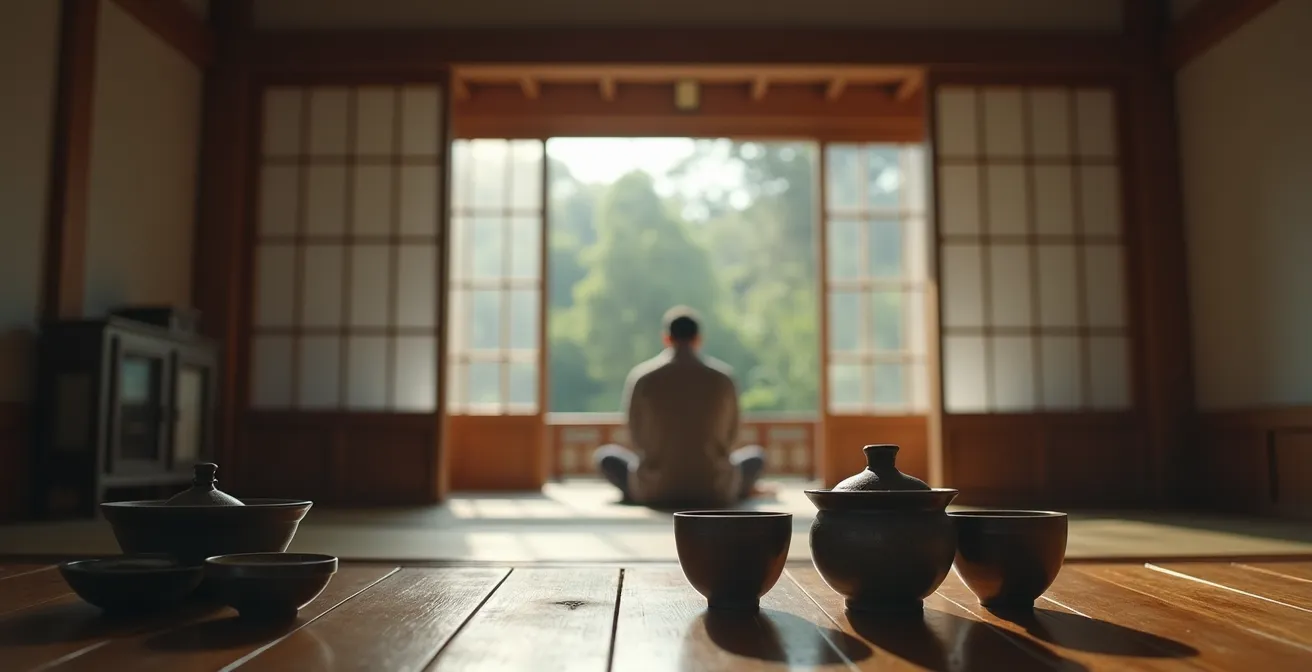
This image of a tea ceremony perfectly illustrates the principle of respectful observation. The visitor is present and engaged but remains in the designated guest area, honoring the sanctity of the ritual without becoming the center of it. This embodies the ideal approach: be present, be attentive, and participate within the boundaries set by the host community. True connection is a slow burn, built on a foundation of trust that can only be earned through consistently respectful behavior.
Humanity is beautiful no matter where you go.
– Drew Binsky, Plugged In YouTube Review
Private Guide or Small Group: Which Offers Better Cultural Insight?
The choice between a private guide and a small group tour often seems like a trade-off between personalization and cost. However, for deep cultural insight, the critical distinction isn’t the size of the group, but the nature of the guide. The most authentic experiences come not from professional tour guides with rehearsed scripts, but from “passion guides”—local experts, artists, students, or hobbyists who share their world out of genuine enthusiasm rather than commercial obligation. These individuals offer an unfiltered, personal perspective that is impossible to find on a standard tour.
A private passion guide can open doors to experiences far beyond the tourist trail, from a spontaneous visit to a family celebration to an invitation to a local music jam. This offers unparalleled flexibility and depth. A small group, however, can also offer unique benefits. The varied interests and questions from different group members can lead to discoveries you might not have made on your own, creating a shared learning environment. If the small group is also led by a passion guide, it can offer a fantastic balance of deep insight and diverse perspectives.
Case Study: Finding Passion Guides Through University Networks
Many experienced travelers find that connecting with university students or local hobbyist associations yields the most authentic exchanges. For example, a history PhD student in Athens can provide archaeological insights unavailable from commercial tours, while a traditional musician in Marrakech might open doors to underground music scenes. These passion guides share their genuine knowledge and enthusiasm, offering a collaboration rather than a scripted performance, which is the essence of cultural exchange.
The following table, based on an analysis of different guide types, breaks down the key differences in cultural depth.
| Criteria | Professional Tour Guide | Passion Guide (Local Expert) | Small Group Dynamic |
|---|---|---|---|
| Cultural Authenticity | Rehearsed narratives, tourist-friendly version | Unfiltered local perspective, personal stories | Multiple perspectives create richer understanding |
| Access to Experiences | Standard attractions, scheduled stops | Insider locations, spontaneous opportunities | Varied interests unlock unexpected doors |
| Learning Depth | Surface-level facts, photo opportunities | Deep expertise in specific area | Peer learning amplifies insights |
| Flexibility | Fixed itinerary | Highly adaptable to interest | Moderate – group consensus needed |
| Cost | $50-150/day | Often voluntary or tip-based | $20-40/person |
The Mistake That Turns Cultural Appreciation into Appropriation
Cultural appreciation is about respectfully learning and honoring another culture, while appropriation is about taking elements from that culture without understanding or respecting their context, often for personal gain or aesthetic pleasure. The line is crossed when a traveler removes an item, practice, or symbol from its original meaning and reduces it to a trend or a souvenir. For example, wearing a sacred ceremonial garment as a casual fashion accessory or getting a traditional tattoo without understanding its spiritual significance are common forms of appropriation. It turns a piece of living culture into a prop.
The core mistake is treating culture as a commodity. When you buy mass-produced “tribal” masks from a tourist shop or take a selfie with a traditionally dressed local as if they were a theme park character, you are engaging in a form of consumption that disregards the humanity and history behind the cultural expression. Appreciation involves engagement; appropriation involves theft, whether intellectual, spiritual, or aesthetic. To avoid this, your interaction with a culture must be rooted in a desire to understand its context, credit its creators, and, where appropriate, ensure fair compensation flows back to the community.
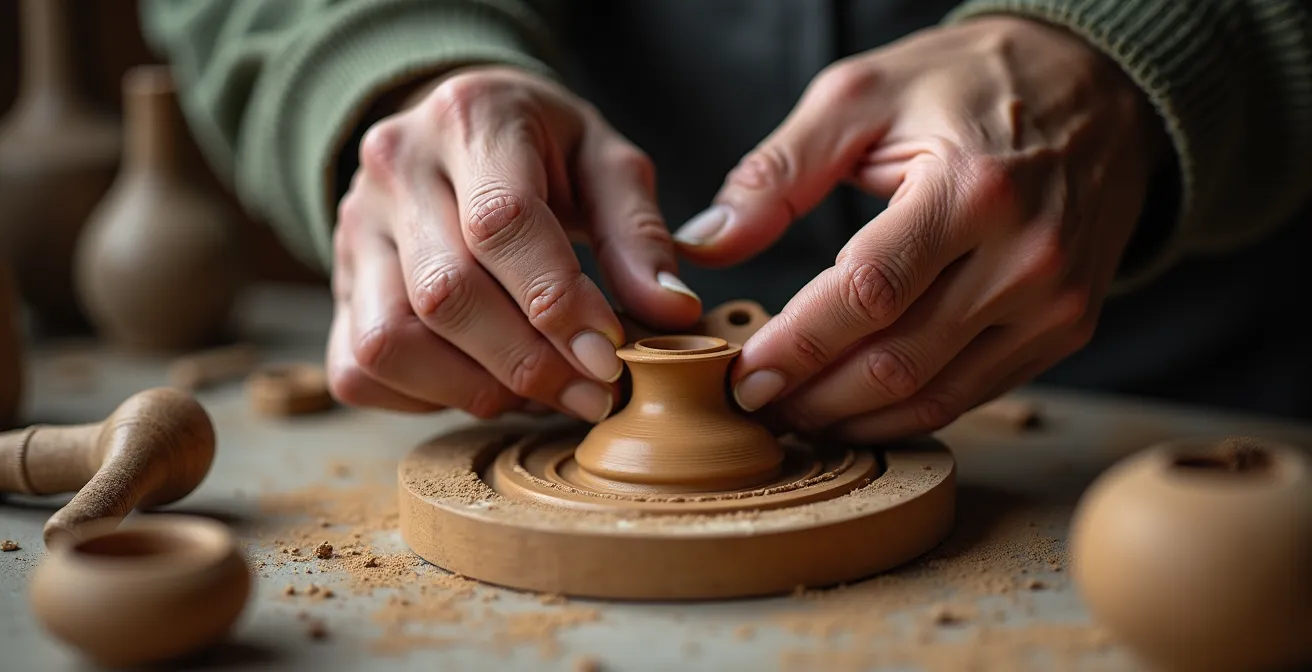
Observing and supporting local artisans directly in their workshops, as depicted here, is a powerful act of appreciation. It allows you to understand the skill, history, and materials behind a craft. By purchasing directly from the creator, you are not just acquiring an object; you are participating in a reciprocal economic exchange that honors their labor and helps sustain their tradition. This direct connection ensures your money supports the community and helps prevent the dilution of their culture into mass-produced trinkets.
A helpful way to navigate this is by using the CCC framework, which an excellent guide on cultural experiences details as Context, Credit, and Compensation. Before you buy, wear, or share something from another culture, run through this simple checklist:
- CONTEXT Check: Research the item or practice’s significance. Is it sacred? Ceremonial? Everyday use? Is it restricted to certain groups within that culture?
- CREDIT Protocol: Always name the specific community or artisan when you share your experience. Tag their location or social media, and link to local organizations that preserve their heritage.
- COMPENSATION Audit: Buy directly from the creators, not from third-party vendors selling mass-produced copies. Support organizations that work to preserve these traditions and ensure the economic benefit is shared fairly.
When to Visit Sacred Sites to Avoid Crowds and Ensure Respect
The standard advice for visiting popular sites is to “go early or go late” to avoid the midday crowds. While this is practical, it doesn’t solve the core problem for sacred sites: your presence, along with hundreds of others, can disrupt the very sanctity you’ve come to witness. A more profound approach is not just to manage your timing, but to reconsider your destination. For many world-famous sacred sites, there are often lesser-known “sister sites” or active monasteries nearby that are just as significant but are not on the main tourist circuit. These places offer a chance for genuine spiritual encounters rather than a battle for a clear photo.
The key to finding these places is through local engagement. Instead of relying on a guidebook, seek out connections with the local religious community. A respectful conversation with a shopkeeper near a temple, a local guide, or even a monk (if the context is appropriate and they are open to it) can yield incredible insights. Ask about other important places of worship in the region or about specific times of day when the community gathers for rituals. Attending a ceremony as a silent, respectful observer in a place meant for worship—rather than for tourism—is an infinitely more powerful experience.
Remember that these are not attractions; they are active spiritual centers. Your behavior should reflect this. Dress conservatively, covering your shoulders and knees. Remove your shoes if required. Speak in hushed tones, and never use a flash. The goal is to be an invisible, respectful presence, absorbing the atmosphere without altering it. By seeking out these alternative sites, you not only get a more authentic experience but also help relieve the pressure of over-tourism on the most famous landmarks.
Case Study: Discovering Satellite Sacred Sites Through Local Networks
Experienced cultural travelers often report that their most profound moments came from asking local religious communities about lesser-known sister sites. For example, instead of braving the crowds at Angkor Wat’s main temple, some visitors were guided to active monastery complexes in the surrounding jungle. There, monks still conduct daily rituals, offering a truly authentic spiritual encounter far from the tourist throngs, a strategy that highlights the value of local knowledge.
Why Staying in an Expat Bubble Defeats the Purpose of Travel
For long-term travelers or those on an extended stay, the siren call of the expat bubble is strong. It offers comfort, familiarity, and an easy social life in a foreign land. You can find your favorite foods, speak your native language, and complain about the local bureaucracy with like-minded foreigners. While it can be a useful resource for practical matters, relying on it for your social and cultural life is the ultimate act of self-sabotage. It creates a “home away from home” that effectively insulates you from the very culture you traveled so far to experience.
The expat bubble is a comfort trap. It reinforces your own cultural biases and prevents you from developing the resilience and adaptability that immersive travel is meant to foster. Every meal you have at an expat bar is a missed opportunity to discover a local delicacy. Every conversation you have with another foreigner is a missed chance to practice the local language and gain a new perspective. Staying within this bubble is akin to traveling thousands of miles to watch a movie of a country instead of stepping outside and living in it. You end up observing the local culture from a sanitized distance, just as a tourist does, defeating the entire purpose of an immersive journey.
A healthy balance is key. It’s not about completely shunning your fellow expatriates, but about consciously limiting that interaction to practical necessities. A useful framework is the 80/20 rule for cultural immersion:
- 20% Expat Networks (Practical Use Only): Use these connections for essential, non-cultural tasks like finding an apartment, navigating visa bureaucracy, or getting a recommendation for an English-speaking doctor.
- 80% Local Immersion: Dedicate the vast majority of your free time to activities that immerse you in the local cultural ecosystem. This includes social events, dining, entertainment, joining local sports clubs, finding a language exchange partner, and taking weekend trips to non-touristy areas.
- Daily Practice: Start each day at a local coffee shop or tea house, not an international chain.
- Weekly Challenge: Attend one local event—a concert, a market, a festival—where you are likely to be the only foreigner.
This deliberate approach ensures that you use expat resources as a tool for living, not as a substitute for it. It keeps you oriented towards the goal of immersion, forcing you to step outside your comfort zone and into the rich, complex, and rewarding world of the local community.
Why 3 Days in Nature Lowers Your Stress Markers by 50%
While the title references the well-documented mental health benefits of nature, a cultural anthropologist sees a deeper connection. For the immersive traveler, spending time in the local landscape is not an escape from the culture; it is a direct path to understanding it. A culture does not develop in a vacuum. It is shaped by the mountains, deserts, rivers, and coastlines that surround it. This concept, known as “cultural terroir,” suggests that to truly understand a people, you must first understand the land that feeds, shelters, and challenges them.
Why are certain foods staples? Why are houses built a certain way? Why do myths and legends feature specific animals or landscapes? The answers are almost always found in the natural environment. A multi-day trek through the mountains reveals why hospitality is so crucial in isolated communities. Spending time in a coastal village makes you understand why the ocean is a central figure in their folklore. This immersion in nature provides a rich context that makes cultural practices, which might seem arbitrary in a city, suddenly make perfect sense. It transforms the landscape from a pretty backdrop into a key character in the nation’s story.

Joining a local hiking group or taking a guided nature walk, as shown here, is an ideal way to experience this connection. You are not just seeing the landscape; you are learning to read it through the eyes of those who have lived in it for generations. They can point out medicinal plants, explain the significance of a particular rock formation, or share stories about the spirits of the forest. This turns a simple hike into a profound lesson in the local cultural ecosystem, bridging the gap between nature and society.
Case Study: Understanding Society Through Landscape
An analysis of deep travel experiences, such as those of Drew Binsky in Namibia, demonstrates how desert landscapes shape Himba tribal customs—from their use of ochre for sun protection to their water conservation rituals. Similarly, the highlands of Ethiopia are inextricably linked to the origins of coffee ceremonies and unique religious practices. By spending time in local nature with a curious mind, nature immersion becomes a form of cultural education.
Key takeaways
- True authenticity is a mindset of respectful participation, not a destination on a map.
- Shift from a consumer of experiences to a participant in a living cultural ecosystem.
- Thorough preparation and a spirit of reciprocal exchange are the foundations of meaningful travel.
How to Plan a Month-Long Homestay for True Immersion?
A month-long homestay is one of the most powerful tools for cultural immersion, but its success is not guaranteed. Simply sharing a roof is not enough; true immersion requires a deliberate and structured approach, both before and during your stay. The most critical phase is the preparation. Arriving as a blank slate and expecting your host family to be your personal cultural tutor is both lazy and disrespectful. Your goal should be to arrive as an informed and curious guest who has already demonstrated a genuine investment in their culture. This builds a foundation of mutual respect from day one.
During your stay, the key is to find the right balance between integration and independence. The first week should be dedicated to observing and participating in the family’s daily routines without imposing your own schedule. This is a time for listening and learning. As you become more comfortable, you can begin to explore independently, bringing back stories and experiences to share with the family. This creates a dynamic of reciprocal exchange, where you are not just a passive recipient of their culture but an active contributor to the household’s daily life and conversations.
Case Study: Structured Independence for Successful Immersion
Successful month-long immersions often follow a natural rhythm. Week 1 is for full integration with family routines. Week 2 involves morning solo explorations with evenings reserved for family time. By Week 3, the traveler can confidently join local clubs or activities independently, sharing their new experiences at dinner. In the final week, the traveler can become a bridge, facilitating connections between their host family and the hidden gems they’ve discovered in the family’s own city, solidifying their role as a temporary member of the cultural ecosystem, not just a guest.
The following action plan provides a protocol for preparing for your homestay, ensuring you arrive ready to engage on a meaningful level.
Your Pre-Homestay Action Plan: The 30-Day Preparation Protocol
- Days 1-10 (Literary & Cinematic Context): Read one novel by a local author and watch three films from the country (with subtitles, not dubbed) to understand cultural narratives and social nuances.
- Days 11-20 (Historical Perspective): Learn about one major historical event from the local perspective. Seek out sources from that country, not just Western interpretations, to grasp their point of view.
- Days 21-25 (Culinary Contribution): Master one simple, traditional recipe from the region. Practice cooking it at least three times before you depart so you can confidently prepare a meal for your host family.
- Days 26-30 (Reciprocity Planning): Prepare your contribution plan. Identify one skill you can teach, one meal from your own culture you can cook, and one story or tradition you can share in return for their hospitality.
- Arrival Day (Informed Curiosity): Based on your research, prepare three thoughtful questions to ask your hosts during the first few days. This demonstrates genuine, pre-existing interest beyond surface-level curiosity.
Your next journey is an opportunity to be more than a tourist. Start planning it not just by choosing a destination, but by preparing your mindset for true, respectful, and unforgettable immersion.