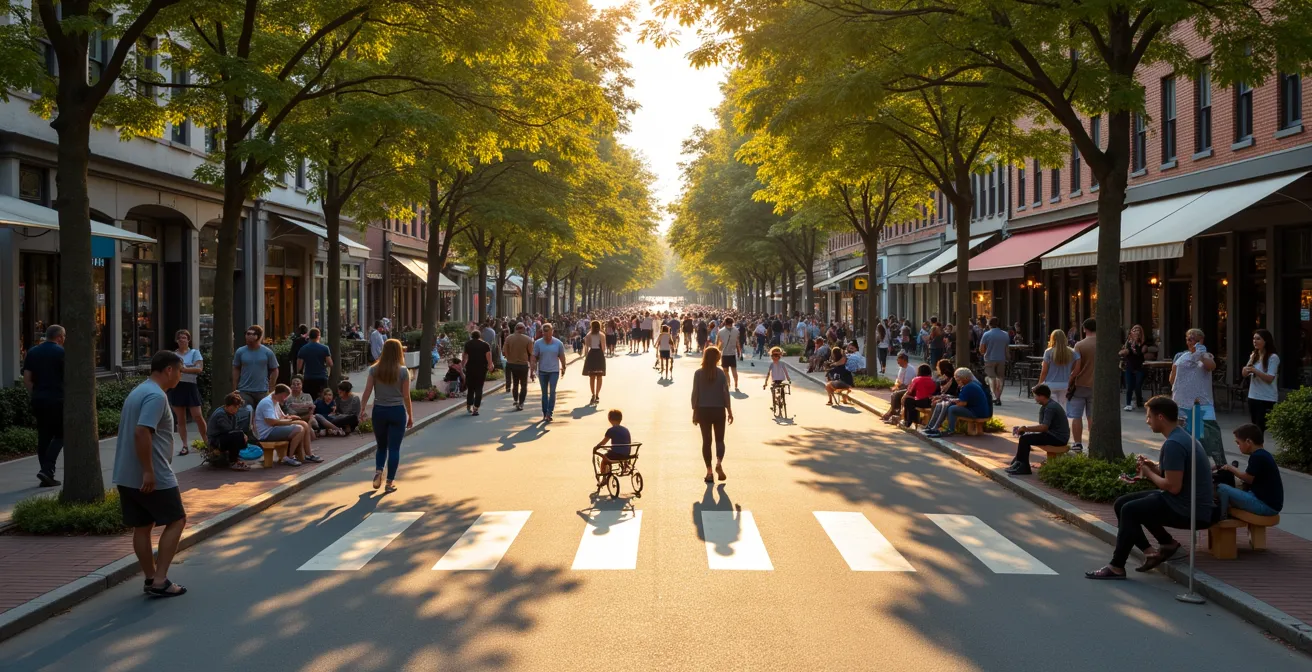
Effective urban advocacy isn’t about one grand petition; it’s a strategic process of demonstrating value through small, temporary projects that build unstoppable momentum for permanent change.
- Walkable neighborhoods dramatically improve physical health, mental well-being, and social connection, directly increasing life expectancy.
- The most successful campaigns use data and temporary, low-cost “tactical urbanism” projects to prove their case before asking for expensive, permanent infrastructure.
Recommendation: Instead of immediately demanding a multi-million dollar project, start by proposing a one-week, paint-and-planter “demonstration project” to show your community the benefits firsthand.
The daily reality for many city dwellers is a frustrating cycle of traffic, the hunt for parking, and a landscape designed for cars, not people. You feel it when you can’t safely walk to a local cafe, when your kids have no independent mobility, and when the noise and pollution of a nearby arterial road feel inescapable. It’s easy to feel powerless against the sheer inertia of car-centric design. The common advice—”start a petition” or “talk to your city council”—often feels like shouting into the void, a small gesture against a massive, unyielding system.
While these actions are part of the solution, they are rarely the start of it. For decades, we’ve approached urban change as a monolithic, top-down process. We ask for the perfect, permanent solution and are often met with silence, budget concerns, or political resistance. This approach is backward. It presumes that persuasion happens through words alone, when in reality, the most powerful tool for change is tangible experience. The true key to transforming our neighborhoods isn’t just to ask for a better future, but to start building a temporary version of it, right here and now.
This guide reframes the challenge. We will shift from a mindset of “asking” to one of “demonstrating.” By embracing the principles of tactical urbanism and the 15-minute city, you can learn how to build a compelling, evidence-based case for change. We will explore how to sequence your advocacy from small, temporary interventions to lasting, permanent infrastructure. This is not just about building sidewalks or bike lanes; it’s about building a movement, one block at a time, by showing your neighbors and leaders what’s possible when we prioritize people over parking spots.
For those who prefer a visual format, the following video provides a concise overview of traffic calming techniques, which are a fundamental component of creating the safe, walkable streets we will be discussing.
This article is structured to walk you through every critical aspect of building a successful advocacy campaign. From understanding the profound health benefits that fuel your argument to mastering the art of the incremental project, you’ll gain a comprehensive toolkit for enacting real change.
Table of Contents: A Roadmap for Urban Transformation
- Why Living in a Walkable Area Increases Your Life Expectancy
- How to petition Your Local Council for Better Bike Lanes?
- Green Spaces or Gyms: Which Improves Community Mental Health More?
- The Risk of Exercising Near Major Roadways
- Sequencing Urban Change: How Temporary Projects Lead to Permanent Fixes
- Car vs E-Bike: Which Is Faster in Rush Hour Traffic?
- Why Inclusive Design Expands Your Market Reach
- Car Ownership vs Car Sharing: Which Is Cheaper for City Dwellers?
Why Living in a Walkable Area Increases Your Life Expectancy
The argument for walkable neighborhoods often begins with physical health—more walking, less driving—but its deepest impact is on our social and mental well-being, which are intrinsically linked to longevity. A human-centric environment is not merely a convenience; it’s a powerful public health intervention. When streets are designed for people, they encourage spontaneous interactions, build community trust, and combat the modern epidemics of loneliness and isolation.
Case Study: Social Capital and Walkability
This connection is not just anecdotal. A study across Seattle, Baltimore, and Washington D.C. found that adults in walkable neighborhoods are significantly more likely to interact with their neighbors and report a stronger sense of community. This research supports the U.S. Surgeon General’s strategy to address loneliness as a public health crisis. The “social capital” built by these daily, casual encounters—bumping into a neighbor at the corner store, chatting with another parent while walking kids to school—creates a resilient social fabric. This network of weak ties is a crucial buffer against stress and a key predictor of overall happiness and health.
This sense of belonging and community connection directly translates into better health outcomes. Beyond the obvious cardiovascular benefits of daily activity, living in a connected, walkable neighborhood reduces chronic stress and improves mental health. You are part of an ecosystem where people look out for one another. This environment fosters a sense of safety and security that car-dependent, isolating suburbs simply cannot replicate. Therefore, advocating for walkability is advocating for a built environment that actively nurtures the social bonds essential for a long and healthy life.
How to petition Your Local Council for Better Bike Lanes?
A petition is not just a list of names; it’s a political tool. A successful petition is a demonstration of organized, informed, and widespread public demand. To move from a simple request to an undeniable mandate for change, your strategy must be data-driven and coalition-backed. The goal is to present council members not with a problem, but with a well-researched, popular, and nearly shovel-ready solution.

The first step is building a broad coalition. A petition from a single person can be ignored, but one backed by thousands of signatures from multiple advocacy groups becomes a significant political event. As seen in the successful Spruce and Pine Streets campaign in Philadelphia, where groups like 5th Square and Families for Safe Streets united, a collective voice is exponentially more powerful. At least 5,223 people signed the petition organized by these allied groups, forcing the city to commit to concrete action. This demonstrates that you’re not a lone voice but the representative of a significant constituency.
Your petition should also be framed as a systemic change, not a one-off project. Referencing forward-thinking policies, like California’s SB 960 which mandates connected networks, shows you’ve done your homework. The most effective petitions go even further by including pre-written policy language and a FAQ section that proactively addresses common objections like parking loss or cost. By anticipating and neutralizing opposition before it forms, you control the narrative and make it easy for officials to say “yes.”
Your Action Plan: Auditing Your Advocacy Strategy
- Points of contact: List all potential allies for a coalition. This includes neighborhood associations, parent-teacher groups, local businesses, and environmental organizations. Who shares your vision?
- Collecte: Inventory existing data and create new evidence. Use traffic heat maps to show “desire lines” where people already want to bike. Conduct surveys to gather local stories and support.
- Cohérence: Frame your request in the context of the city’s master plan, climate goals, or public health initiatives. Show how your project helps the city achieve its own stated objectives.
- Mémorabilité/émotion: Prepare a concise, powerful narrative. Arm yourself with pre-written policy language and a clear FAQ sheet to counter common arguments about parking, cost, and traffic impact.
- Plan d’intégration: Develop a media strategy. Plan to share your petition, data visualizations, and success stories on social media, tagging local officials and news outlets to amplify your message.
Green Spaces or Gyms: Which Improves Community Mental Health More?
While a gym membership offers a structured way to exercise, its benefits are largely individual and transactional. Green spaces, on the other hand, are a form of collective wealth, offering a powerful, passive, and accessible boost to community-wide mental health. You don’t need a membership card to walk in a park, and the benefits extend far beyond physical exertion. The simple act of being in a natural, public setting has profound psychological effects.
Research consistently shows that exposure to green space reduces stress, anxiety, and depression. It provides a venue for both quiet contemplation and social connection. Unlike the often-intimidating or exclusive atmosphere of a gym, public parks and greenways are inherently inclusive. They are places where people of all ages, incomes, and fitness levels can coexist and interact, fostering the “social capital” we know is critical for well-being. A study of 1,064 adults in Dublin provided clear evidence, finding that living in walkable neighborhoods directly increased happiness for adults aged 36-45.
The power of great public space lies in its ability to facilitate happiness effortlessly. As the renowned former Mayor of Bogota, Enrique Peñalosa, articulated, it’s a kind of urban magic.
Great public space is like magic, it’s almost happiness itself
– Enrique Peñalosa, quoted in walkability research
This “magic” comes from creating an environment where positive social and psychological experiences are the default. A well-designed park or plaza doesn’t need to instruct people on how to be happy; it simply provides the conditions for happiness to emerge organically. Therefore, while gyms serve a purpose, investing in high-quality, accessible public green spaces is a far more effective and equitable strategy for improving the mental health of an entire community.
The Risk of Exercising Near Major Roadways
The encouragement to “get outside and exercise” comes with a significant caveat in many urban environments: the invisible danger of traffic-related air pollution. While the cardiovascular benefits of activities like running or cycling are well-known, exercising near major roadways can partially negate these gains by exposing the body to high concentrations of harmful pollutants like particulate matter (PM2.5) and nitrogen oxides (NOx).
When you exercise, your breathing rate and depth increase, causing you to inhale a larger volume of air—and any pollutants it contains. These pollutants can penetrate deep into the lungs and enter the bloodstream, triggering inflammation and oxidative stress, which are risk factors for cardiovascular disease. This creates a paradox where the very act of trying to improve one’s health could pose its own risks. However, the solution isn’t to stop exercising. The data is clear that the net benefits of living in a walkable area, even with ambient pollution, are overwhelmingly positive. A massive study showed that over 900,000+ adults studied showed lower cardiovascular disease risk factors in walkable neighborhoods compared to car-dependent ones.
The key is not to avoid activity, but to advocate for smarter urban design that mitigates exposure. This involves creating a buffer between people and traffic. Proven strategies include:
- Installing dense vegetation barriers or “green walls” at least 2 meters thick.
- Maintaining a significant setback distance (at least 50 meters) for paths and parks from high-traffic roads.
- Positioning new recreational routes upwind of major traffic corridors based on prevailing wind analysis.
These design choices actively reduce the health risks associated with urban exercise, ensuring that the pursuit of fitness doesn’t come at a hidden environmental cost. It reinforces the idea that true walkability is not just about having a sidewalk, but about having a safe and healthy environment to walk in.
Sequencing Urban Change: How Temporary Projects Lead to Permanent Fixes
The most significant barrier to urban transformation is often not a lack of good ideas, but the perceived risk and cost of permanent change. City governments are hesitant to commit millions of dollars to projects that might face public backlash or fail to deliver results. This is where “tactical urbanism”—the use of short-term, low-cost, scalable interventions—becomes the most powerful tool for an advocate. Instead of asking for a concrete bike lane, you ask for a temporary one made of paint and planters.
This approach, often called a demonstration project, fundamentally de-risks the process of change. It allows the community and decision-makers to experience the benefits firsthand before committing to a permanent installation. It shifts the conversation from abstract debates about parking loss to concrete experiences of safer streets and more vibrant public spaces. Richmond’s incremental approach to bike infrastructure is a prime example. The city started with a two-way separated bike lane on Franklin Street using simple flex posts. The project’s clear success, evidenced by distinct commute patterns, provided the political capital and public support needed to upgrade to permanent concrete curbing.
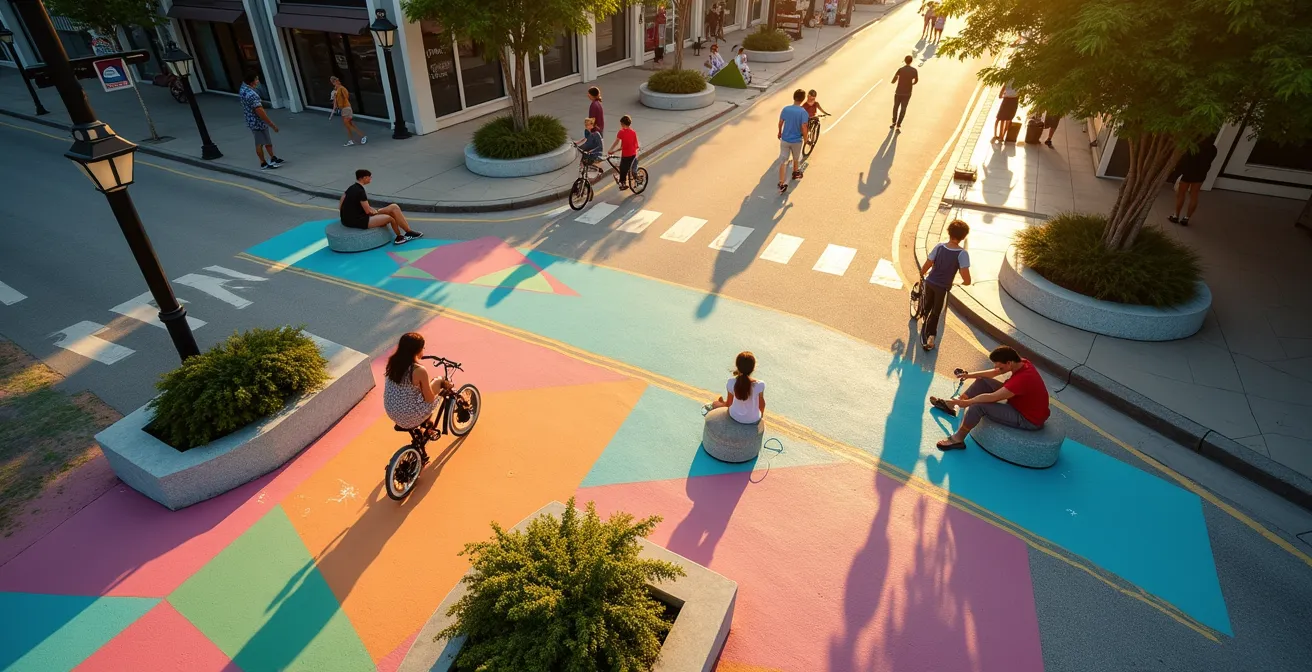
This phased approach is not only politically savvy but also fiscally responsible. It allows a city to test and refine designs at a fraction of the cost of a full build-out. The table below illustrates how the timeline, cost, and approval process evolve as a project gains momentum.
| Phase | Duration | Cost | Approval Process |
|---|---|---|---|
| Temporary (Paint/Planters) | 1-2 weeks | $5K-20K | Department level |
| Pilot Program | 3-6 months | $20K-50K | Administrative approval |
| Semi-Permanent (Flex posts) | 1-2 years | $50K-200K | Council committee |
| Permanent (Concrete) | 3-5 years | $500K+ | Capital budget process |
By understanding and advocating for this sequence, you transform from a mere requester into a strategic partner. You provide the city with a low-risk pathway to innovation and build an undeniable, evidence-based case for permanent, positive change.
Car vs E-Bike: Which Is Faster in Rush Hour Traffic?
In the congested heart of a city, our perception of speed is often distorted. The car, a symbol of freedom and speed on the open road, becomes a metal box trapped in a sea of traffic. An e-bike, by contrast, leverages agility and a network of alternative paths to often become the faster mode of transport for typical urban trips. The true measure of speed isn’t top-end velocity; it’s total door-to-door travel time.
When you factor in the “last mile” challenges of driving in a dense urban core, the car’s advantage evaporates. The time spent circling for a parking spot, followed by the walk from that distant spot to your actual destination, adds significant and unpredictable minutes to every journey. An e-bike trip, however, ends right at the front door. This eliminates the parking search entirely and makes the total travel time far more reliable.
This analysis breaks down a typical 5-mile urban trip during rush hour, revealing the hidden time costs of driving.
| Factor | Car (5-mile urban trip) | E-Bike (5-mile urban trip) |
|---|---|---|
| Travel time | 20-35 minutes | 18-22 minutes |
| Parking search | 5-15 minutes | 0 minutes |
| Walk from parking | 3-7 minutes | 0 minutes |
| Total door-to-door | 28-57 minutes | 18-22 minutes |
| Time reliability | High variance (±20 min) | Low variance (±3 min) |
You can even conduct your own “Commute Race” to generate compelling local data. Simply document both journeys with a GPS tracking app during peak hours, record the entire process, and share the results on social media, tagging local officials. This kind of citizen-led data collection provides powerful, relatable evidence that challenges the ingrained assumption of the car’s superiority in an urban context and makes a strong case for investing in alternative infrastructure.
Why Inclusive Design Expands Your Market Reach
Inclusive design in urban planning is often framed as a moral imperative, but it is equally a powerful economic strategy. Creating neighborhoods that are safe, accessible, and comfortable for everyone—from an eight-year-old child to an eighty-year-old grandparent—doesn’t just serve a niche group; it expands the total addressable market for local businesses and enhances the value of the entire area. When a street feels safe for a child to walk on, it also feels safe for a senior with a walker, a parent with a stroller, or a tourist exploring the city.
This principle is what urbanists call the “8 80” city. If the public realm works well for an 8-year-old and an 80-year-old, it works for everyone in between. This broad usability directly translates to economic vitality. People who feel safe and comfortable are more likely to linger, explore local shops, and spend money. This is supported by research showing that walkable neighborhoods correspond to higher property values in cities across the U.S. This “walkability premium” reflects the high demand for environments where daily needs can be met on foot.
As Renee Schoonbeek, a senior consultant at Arcadis, notes, this is the foundation of a truly resilient and prosperous city.
The most sustainable cities are truly resilient and include design for walkability, allowing people to get around on two feet with easy access to key business and cultural hubs without putting their health at risk
– Renee Schoonbeek, Senior consultant at Arcadis
By advocating for features like wider sidewalks, curb cuts, frequent benches, and protected bike lanes, you are not just asking for amenities. You are advocating for an economic development strategy that makes your neighborhood more attractive to residents, businesses, and visitors alike. Inclusive design is not a cost center; it’s a value creator that unlocks the full economic potential of a community.
Key Takeaways
- Advocacy is a marathon, not a sprint; success comes from strategic, incremental steps, not a single grand gesture.
- Temporary, low-cost “tactical urbanism” projects are the most effective tool to de-risk change and build public and political support.
- The benefits of walkability are holistic, encompassing physical health, mental well-being, community connection, and economic vitality.
Car Ownership vs Car Sharing: Which Is Cheaper for City Dwellers?
For many urban residents, private car ownership is a deeply ingrained habit, but it’s also a significant and often underestimated financial drain. The true cost of owning a car extends far beyond the monthly payment. When you factor in insurance, parking fees, fuel, and maintenance, the total cost of ownership can easily reach several thousand dollars per year, making it one of the largest expenses for a household after housing.
A car-light or car-free lifestyle, enabled by a robust ecosystem of public transit, car-sharing, and bike-sharing services, presents a dramatically cheaper alternative. By unbundling transportation, you pay only for what you use. A monthly transit pass combined with occasional car-share or bike-share use almost always costs a fraction of owning a private vehicle that sits parked for over 95% of its life. A typical calculation shows that ditching a private car can save a city dweller between $5,000 and $12,000 annually.
Policy in Action: Los Angeles’s Measure HLA
This shift from ownership to access is accelerated by “Complete Streets” policies. For example, the voter-approved Measure HLA in Los Angeles requires the city to implement its own mobility plan—including bike and pedestrian infrastructure—whenever a road is repaved. This type of policy directly reduces dependency on cars by making other options safer and more convenient, unlocking massive potential savings for households and paving the way for more equitable and sustainable urban mobility.
This financial argument is one of the most persuasive you can make to a broad audience. It reframes the debate from an abstract discussion about urban form to a concrete conversation about household finances. By showing your neighbors and leaders the direct financial benefits of a multi-modal transportation system, you can build a powerful coalition for change that transcends typical political divides.
Now that you are armed with the data, strategies, and a new framework for thinking about urban change, the next step is to move from theory to practice. The journey to a more walkable, human-centered city begins with a single, small, and visible first step. Don’t wait for permission; start demonstrating the future you want to see.