
Contrary to popular belief, minimalist design fails not because of its simplicity, but because it prioritizes aesthetics over the fundamental cognitive principles of usability.
- Stripping away visual cues (affordances) increases a user’s mental effort (cognitive load), leading to frustration.
- True value lies in functional, inclusive, and timeless design, not fleeting visual trends.
Recommendation: Shift from an aesthetic-first to a human-centered approach by relentlessly prioritizing user testing from the earliest stages of development.
We’ve all been there: staring at a sleek, beautiful interface, unable to find the menu or figure out what a mysterious, unlabelled icon does. This is the paradox of modern minimalism. Marketed as the pinnacle of simplicity and elegance, it often delivers an experience that is anything but. We are told that “less is more,” a mantra that champions clean lines, abundant white space, and a reduction of visual clutter. In theory, this should create a serene and intuitive user experience. Yet, for many product managers and consumers, the reality is a growing frustration with products that look stunning in a portfolio but are maddeningly difficult to use in real life.
The problem isn’t the principle of simplicity itself, but its flawed interpretation. The movement has been co-opted by a purely aesthetic agenda, one that equates minimalism with visual emptiness rather than cognitive ease. This is where the critical disconnect happens. When form is pursued at the expense of function, design ceases to be a tool for empowerment and becomes a source of friction. The core failure is a neglect of fundamental human-centered principles: affordance, discoverability, and accessibility.
But what if the true path to effective design wasn’t about stripping things away, but about making function beautiful? This article dismantles the myth of aesthetic minimalism. We will explore why this approach so often fails users by examining its impact on inclusivity, sustainability, and development risk. By shifting our focus from how a product looks to how it behaves in the hands of a real person, we can rediscover a more robust and ultimately more successful design philosophy: one rooted in functional aesthetics.
text
This guide will deconstruct the common pitfalls of aesthetic-driven design and provide a clear framework for building products that are both elegant and effective. Below is a summary of the key areas we will explore to build a case for a human-centered future.
Summary: The Case Against Aesthetic Minimalism and for Functional Design
- Why Inclusive Design Expands Your Market Reach
- How to Distinguish Greenwashing from True Design Innovation?
- Trendy or Timeless: Which Furniture Design Holds Value?
- The Risk of Skipping User Testing in Product Development
- Integrating Nature: How Biophilic Design Reduces Office Stress?
- Why Living in a Walkable Area Increases Your Life Expectancy
- How to Write Prompts That Get Usable Results from ChatGPT?
- Minimum Viable Product: How to Launch Without Perfection?
Why Inclusive Design Expands Your Market Reach
Aesthetic minimalism, in its quest for visual purity, often becomes an unintentional gatekeeper. By removing explicit labels, visible buttons, and clear visual cues, it creates a product that is only usable by a narrow, digitally-savvy audience. This directly contradicts the principles of inclusive design, which is not a charitable niche but a massive business opportunity. When design ignores the needs of users with varying abilities, it isn’t just exclusionary; it’s bad for the bottom line. True minimalism should reduce barriers, not create them.
The numbers are staggering. According to the World Economic Forum, there are over 1 billion people globally with some form of disability, representing a market with a disposable income of over $1.2 trillion. Designing with accessibility in mind means creating products that work for everyone, including those with visual, motor, or cognitive impairments. This often involves adding—not removing—functional elements. For example, Procter & Gamble’s Herbal Essences brand incorporated simple tactile markings to help users with visual impairments distinguish between shampoo and conditioner bottles, a small functional addition that opened their product to a wider audience and earned widespread praise.
This demonstrates that human-centered design is a powerful market expander. By focusing on the functional needs of a diverse user base, companies can create products that are not only more ethical but also vastly more profitable. The goal should be to create interfaces so intuitive that they feel “minimal” to everyone, regardless of their ability.
How to Distinguish Greenwashing from True Design Innovation?
The philosophy of minimalism often aligns with sustainability: use less, waste less. However, just as aesthetic minimalism can mask poor usability, it can also serve as a front for “greenwashing”—the practice of making a product appear more environmentally friendly than it actually is. A product wrapped in simple, earth-toned packaging might seem sustainable, but this surface-level aesthetic says nothing about its supply chain, materials, or lifecycle. This is form masquerading as ethical function.
This trend is particularly prevalent in industries like fashion and tech, where the appearance of virtue is a powerful marketing tool. True design innovation, however, goes beyond aesthetics. It involves a deep, functional commitment to sustainability. This means designing for durability, repairability, and circularity. It’s the difference between a cheaply made “minimalist” t-shirt designed to be replaced next season and a well-crafted garment designed to last a decade. The former is a marketing gimmick; the latter is a genuine innovation.
Companies are becoming more cautious about their claims, a phenomenon some experts call “greenhushing.” As Alexandra Mier, RepRisk’s chief commercial officer, noted in a report on ESG Dive, “There’s certainly a global undercurrent of ‘greenhushing,’ so companies are being more cautious about how they communicate.” For consumers and product managers, the key is to look past the minimalist veneer and ask hard questions about material sourcing, manufacturing processes, and end-of-life planning. Substantive innovation is always more valuable than aesthetic posturing.
Trendy or Timeless: Which Furniture Design Holds Value?
The tension between form and function is nowhere more apparent than in furniture design. Fleeting trends often favor stark, minimalist aesthetics that prioritize a certain “look” over comfort, durability, or adaptability. These pieces may look great in a showroom or an Instagram post, but they quickly reveal their functional shortcomings in a real living space. A chair that is beautiful but uncomfortable, or a table that is sleek but unstable, ultimately fails in its primary purpose.
This is where the concept of timeless design offers a compelling alternative. Timelessness isn’t about adhering to a specific style, but about embodying principles of quality, functionality, and adaptability. A truly valuable design holds its worth because it continues to serve its user effectively over time, adapting to changing needs and environments. This philosophy champions pieces that are built to last, from durable materials, with a design that supports rather than dictates a lifestyle.
A perfect example is a modular furniture system. As shown below, such systems are designed for evolution, easily reconfigured to suit different life stages—from a student’s first apartment to a growing family’s home and beyond. Their value comes not from a static, trendy appearance, but from their dynamic functionality.
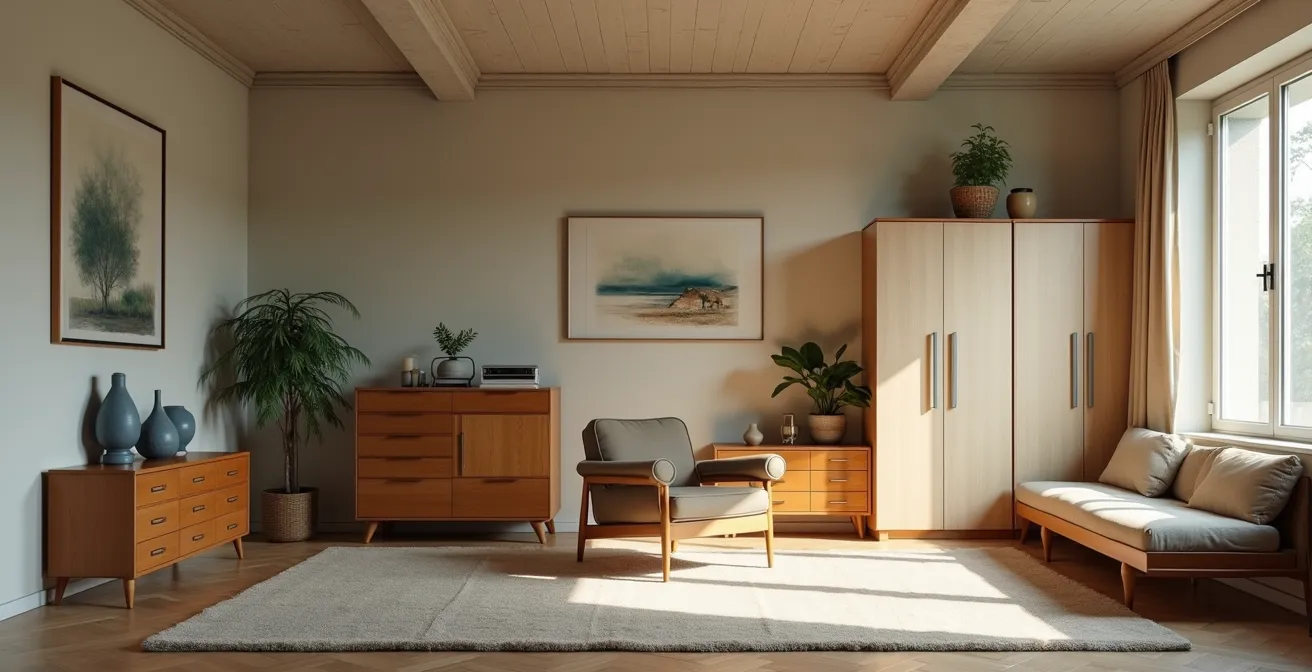
This adaptability is the hallmark of superior design. Instead of being discarded when needs change, the furniture evolves with the user. This approach respects both the user’s investment and the planet’s resources, proving that the most valuable designs are those where function and longevity are the driving forces behind the form.
The Risk of Skipping User Testing in Product Development
Why does dysfunctional minimalist design continue to be so prevalent? The answer often lies in a critical, and surprisingly common, process failure: skipping or marginalizing user testing. When design decisions are made in a vacuum, based on a team’s internal aesthetic preferences or assumptions about what is “clean” or “intuitive,” the end user is inevitably left behind. This is the birthplace of products that are beautiful but broken.
Shockingly, a report highlighted on Medium suggests that only 55% of businesses conduct any UX testing. This means nearly half of all businesses are flying blind, launching products without validating whether real people can actually use them. This isn’t just a risk; it’s a recipe for failure. As usability expert Steve Krug famously stated, even minimal testing provides invaluable insight.
Testing one user is 100 percent better than testing none.
– Steve Krug, Usability expert
The cost of ignoring users is far greater than the cost of testing. When users can’t find what they need, they don’t blame themselves—they abandon the product. The ROI of investing in usability testing is clear and direct, preventing costly redesigns and building customer loyalty from the ground up.
Case Study: Bear Mattress’s Mobile Optimization
The mattress brand Bear Mattress discovered that user interaction with its cross-sell items on mobile was extremely low. By partnering with VWO for usability testing, they identified key functional failures: the copy was weak, and the cross-sell products were missing images. They ran a test with a variation that added thumbnail images and more customer-centric copy. According to a VWO analysis, this simple, function-focused test ran for 19 days and resulted in a 16% increase in revenue. It’s a powerful demonstration that fixing small functional gaps delivers significant business results.
Integrating Nature: How Biophilic Design Reduces Office Stress?
At first glance, biophilic design—the practice of integrating nature into the built environment—might seem at odds with minimalism. It involves complex patterns, rich textures, and sensory variety. However, it offers a powerful model for functional minimalism, where complexity serves a clear human purpose. Instead of stripping an environment down to sterile emptiness, biophilic design uses natural elements to actively reduce stress, improve well-being, and boost productivity.
The “minimalism” in this context is cognitive, not purely visual. An office designed with biophilic principles might use the complex grain of a wooden desk, the rough texture of a stone wall, or the dappled light filtering through plants to create a calming atmosphere. These elements are not decorative clutter; they are functional components that fulfill a basic human need for connection to nature. The design works because it reduces the cognitive load associated with artificial, stressful environments.

This approach demonstrates that richness and simplicity are not mutually exclusive. An environment can be visually complex yet feel simple and restorative if its elements are coherent and serve a functional, psychological purpose. It’s a sophisticated form of minimalism that is measured by its positive impact on the user, not by how little is in the room.
Action Plan: Key Elements for Biophilic Integration
- Natural Light: Design spaces to maximize the use of natural light patterns rather than relying solely on artificial sources.
- Natural Textures: Use complex, authentic textures like wood grain, stone, and living plants as functional design surfaces.
- Visual Connections: Ensure window views are unobstructed to provide a direct visual connection to the natural world outside.
- Organic Patterns: Implement organic forms and fractal geometries in space planning and decor to mimic natural patterns.
- Sensory Balance: Find a balance between minimalist decluttering and the sensory richness provided by biophilic elements.
Why Living in a Walkable Area Increases Your Life Expectancy
An unconventional but powerful way to understand the failure of aesthetic minimalism in UI/UX is to look at urban design. A car-dependent suburb can be seen as a “minimalist” environment: vast, clean, with functions hidden away in separate zones. To navigate it, you need a specific tool (a car) and prior knowledge (a map or GPS). In contrast, a walkable city is functionally dense. Its storefronts, signs, and public spaces provide constant visual cues—or affordances—that make navigation intuitive. You can discover a bakery, a library, or a park simply by walking around.
This analogy directly maps to digital interface design. An aesthetically minimalist UI that hides its navigation behind an unlabelled icon is like a suburban shopping mall hidden from the main road. It forces the user to know where to look and what to do, increasing cognitive load. An interface with clear, visible labels and navigation is like a bustling city street; its functions are discoverable and accessible to everyone, without needing a manual.
The following table draws a parallel between urban design principles and their UI/UX counterparts, highlighting how ignoring natural user behavior leads to friction in both worlds.
| Urban Design | UI/UX Parallel | User Impact |
|---|---|---|
| Visible storefronts | Clear navigation labels | Easy discovery |
| Hidden suburban shops | Icon-only navigation | Requires tools/knowledge |
| Desire paths | User workarounds | Natural behavior ignored |
| Walkable streets | Intuitive interface | Immediate accessibility |
The connection to life expectancy in walkable areas is tied to this very principle of functional design. By making healthy activity (walking) the easiest and most integrated option, these environments promote well-being. Similarly, a well-designed product makes the user’s desired task as seamless as possible, respecting their time and mental energy. True minimalism should make life easier, not more complicated.
How to Write Prompts That Get Usable Results from ChatGPT?
The principles of form versus function extend even into the abstract world of artificial intelligence. Crafting a prompt for a large language model like ChatGPT is, in itself, an act of design. A “minimalist” prompt—one that is short, vague, and lacks context—will almost always yield a generic and unusable result. It’s the equivalent of giving a designer a one-word brief like “make it look nice.” The output will be a guess, an interpretation of form without a solid foundation of function.
To get usable results, a prompt must be functionally detailed. It requires providing clear context (“Act as a UX researcher”), specifying constraints (“Use a table format”), defining the audience and tone (“Write for a product manager in an analytical style”), and even giving negative constraints (“Avoid marketing jargon”). This level of detail isn’t clutter; it’s essential functional information that guides the AI toward a useful outcome. The more precise the functional requirements, the better the final form of the response.
This process mirrors product design perfectly. A detailed product brief rooted in user needs and business goals (function) is what enables a design team to create a truly effective and elegant interface (form). As designer Atmina Jovanka Azzahra states, the need for clarity is paramount. The focus must remain on usability. This principle holds true whether designing a physical product, a digital interface, or an AI prompt. Clarity is not the enemy of minimalism; it is its prerequisite.
Key Takeaways
- True minimalism is cognitive, not aesthetic; its goal is to reduce mental effort, not just visual elements.
- Prioritizing function through rigorous user testing is the only way to prevent design failures and ensure a product is genuinely useful.
- Real value stems from designs that are inclusive, adaptable, and timeless, rather than those that simply follow fleeting aesthetic trends.
Minimum Viable Product: How to Launch Without Perfection?
The concept of a Minimum Viable Product (MVP) is often misunderstood as an excuse to launch an unfinished or “minimalist” product. In reality, the MVP philosophy is the ultimate expression of function over form. The goal of an MVP is not to be a stripped-down version of a final design, but to be the smallest possible experiment that validates a core functional hypothesis: “Does this product solve a real problem for a specific user?” The “viable” part of MVP is crucial—it must work.
Aesthetic perfection is irrelevant at this stage. In fact, over-investing in a polished UI before validating the core function is a classic startup mistake. It wastes time and resources on a form that may be entirely wrong for the function users actually need. The focus must be squarely on usability. Research from Forrester, highlighted in a Voltage Control report on user testing, emphasizes this, stating that a well-crafted user interface can increase a website’s conversion rate by 200%. This demonstrates the immense business impact of getting the usability right from the start.
The consequences of ignoring this are severe. According to UX statistics compiled by Truelist, a staggering 70% of online businesses that fail do so because of bad usability. This isn’t a failure of aesthetics; it’s a fundamental failure of function. Launching without perfection means launching with a functional, testable core, not a beautiful but empty shell. It’s about being smart with resources to ensure you’re building something people can, and want to, use.
To put these principles into action, the next logical step is to integrate a human-centered design process from day one. Prioritize user testing, listen to feedback, and build a culture where functional elegance is valued more than superficial aesthetics. Start by evaluating your next project not on how “clean” it looks, but on how effortlessly a new user can achieve their goal.