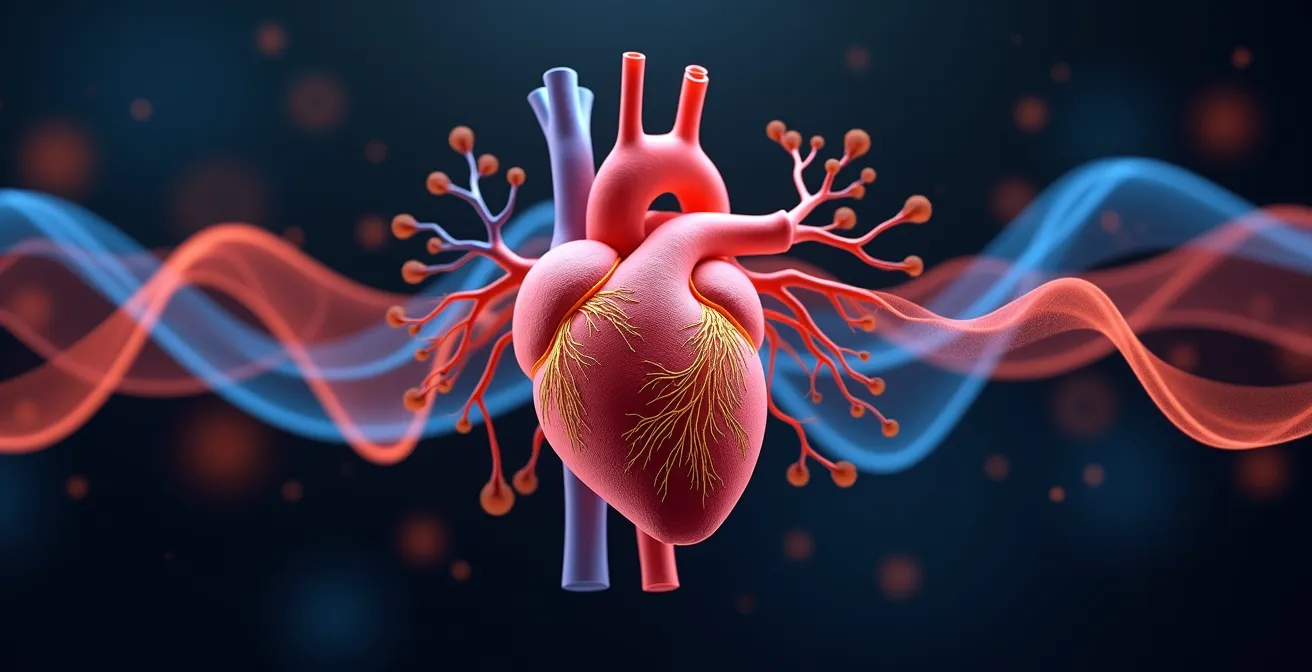
The key to improving Heart Rate Variability isn’t just applying generic ‘stress-reduction’ tactics; it’s about accurately diagnosing your autonomic nervous system’s current state and applying a specific, sequenced protocol to guide it back to balance.
- A low HRV is a quantifiable signal of systemic inflammation and impending illness, often preceding symptoms by up to 72 hours.
- Different stress states, like “tired and wired” versus “functional freeze,” require opposing interventions (e.g., calming adaptogens vs. gentle mobilization).
Recommendation: Stop reacting to your HRV score and start directing it. Use the state-dependent protocols in this guide to shift from a passive tracker to an active regulator of your own physiology.
As a biohacker or data-driven athlete, you’re no stranger to Heart Rate Variability (HRV). You see the number on your wearable every morning, a single metric that promises to tell you if you’re recovered, stressed, or ready to perform. The common advice is predictable: get more sleep, meditate, and reduce stress. While true, this approach is fundamentally passive. It’s like looking at the engine warning light without knowing how to open the hood and check the specific fluid levels.
The conventional wisdom treats all stress as a monolith, offering one-size-fits-all solutions. But what if the data your body is giving you is far more nuanced? What if a low HRV score isn’t just a sign of “stress,” but a specific signal indicating an inflammatory response or, more alarmingly, a “functional freeze” state where typical relaxation techniques could make things worse? The real breakthrough comes not from just tracking HRV, but from learning to speak its language. The key isn’t simply to “raise” your HRV, but to understand what your current autonomic state is and apply the precise protocol to restore its dynamic flexibility.
This guide moves beyond the basics. We will explore how to interpret the patterns in your HRV data to take targeted action. We will dissect specific, state-dependent interventions—from advanced breathing techniques and tailored adaptogens to nervous system resets—that allow you to actively dialogue with your physiology. It’s time to shift from being a data-logger to a nervous system regulator.
This article provides a complete framework for interpreting and acting on your HRV data. Discover how to identify early warning signs of illness, apply specific techniques to manage different stress states, and structure your training and recovery for optimal physiological resilience.
Summary: A Biohacker’s Protocol for HRV Optimization
- Why a Low HRV Score Indicates You Are Close to Illness
- How to Practice Resonance Breathing to synchronize Heart and Brain?
- Ashwagandha or Rhodiola: Which Adaptogen Suits Your Stress Type?
- The Risk of Ignoring “Functional Freeze” State in Your Body
- Sequencing Your Evening: From Blue Light Blocking to Bedtime
- How to Stimulate Your Vagus Nerve to Calm Anxiety Instantly?
- Sequencing Your Training: Why Every 4th Week Should Be Easy
- How to Reset Your Nervous System After a Period of Chronic Stress?
Why a Low HRV Score Indicates You Are Close to Illness
A downward trend in your HRV is more than just a sign of a bad night’s sleep or a stressful day; it’s a direct, quantifiable signal from your autonomic nervous system (ANS) that your body is shifting resources to fight a threat. This is not a subjective feeling—it’s a physiological reality rooted in inflammation. When your body detects a pathogen or is under significant systemic stress, the sympathetic (“fight-or-flight”) branch of your ANS becomes dominant. This reduces the variability between heartbeats as your system prepares for a sustained battle, causing your HRV to drop. It’s crucial to understand that HRV scores are highly individual; rather than comparing your number to others, you should focus on your own baseline and any significant deviations from it.
The link between low HRV and inflammation is well-documented. A comprehensive meta-analysis of 51 studies involving over 2,200 patients established a clear negative association between HRV and key inflammatory markers like C-reactive protein (CRP), IL-6, and TNF-α. This means as inflammation rises, HRV reliably falls. For a biohacker, this is a powerful early-warning system. The data from your wearable can function as a pre-symptomatic alert, giving you a critical window to prioritize recovery and potentially head off illness before it fully manifests.
Your HRV data provides specific, actionable patterns that can predict illness with surprising accuracy. Monitoring these trends is a key part of proactive health management:
- Predictive Drops: Research indicates that substantial decreases in HRV can precede elevations in CRP by 72 hours with a 90.9% positive predictive value. This is your body’s earliest warning signal.
- Timing is Key: In both athletes and the general population, these meaningful HRV changes typically occur 24-48 hours before the onset of symptoms, giving you a clear window to adjust your training and lifestyle.
- Pattern Differentiation: It’s important to distinguish a temporary dip (1-2 days of low scores before an acute illness) from a chronically suppressed baseline (weeks of low scores), which may indicate a more serious systemic issue or overtraining.
How to Practice Resonance Breathing to synchronize Heart and Brain?
While “deep breathing” is common advice, resonance breathing is a precise technique designed to maximize your vagal tone and synchronize your cardiovascular and respiratory systems. The goal is to find your personal resonance frequency—the specific breathing rate at which your HRV is highest. For most adults, this rate falls between 4.5 and 7 breaths per minute, with a common starting point being a balanced cadence of 5.5 seconds on the inhale and 5.5 seconds on the exhale (approximately 5.5 breaths per minute). When you breathe at this frequency, you create a state of “cardiac coherence,” where your heart rate, blood pressure, and brainwave patterns fall into a harmonious rhythm.
This synchronization is not just a feeling of calm; it’s a powerful signal to your brain that you are safe, directly stimulating the vagus nerve and shifting the ANS towards a parasympathetic (rest-and-digest) state. The key to effective practice is diaphragmatic breathing. Instead of shallow chest breaths, the focus is on a deep, belly-driven inhale that fully engages the diaphragm, the large muscle at the base of the lungs that is intrinsically linked to the vagus nerve.

As shown in the visualization, this deep abdominal movement mechanically stimulates the vagal pathways. To practice, place one hand on your chest and the other on your belly. As you inhale slowly through your nose, focus on making your belly rise while your chest remains relatively still. Exhale slowly through your mouth or nose, feeling your belly fall. Using a pacer app or simply timing your breaths for 5-6 seconds in and 5-6 seconds out for 5-10 minutes daily can produce measurable improvements in your baseline HRV.
Ashwagandha or Rhodiola: Which Adaptogen Suits Your Stress Type?
Adaptogens are not a one-size-fits-all solution for raising HRV. Their effectiveness depends on matching the herb’s specific action to your current autonomic state. As a data-driven individual, you can use your subjective feelings alongside your HRV data to diagnose your “stress type” and choose the right tool. The two most common, yet distinct, states of chronic stress are being “tired and wired” or “fatigued and foggy.” Each state reflects a different pattern of cortisol dysregulation and requires a different adaptogenic strategy.
The “tired and wired” state is characterized by sympathetic overdrive. You feel agitated, anxious, and unable to switch off, yet you’re also exhausted. Your HRV might be consistently low, and your cortisol is likely elevated, especially in the evening, disrupting sleep. Conversely, the “fatigued and foggy” state often points towards adrenal exhaustion or a “functional freeze” response. You feel depleted, unmotivated, and have trouble with focus. Your cortisol awakening response may be blunted, making it hard to get going in the morning. A consistently low and flat (non-reactive) HRV pattern can be a hallmark of this state.
Choosing between Ashwagandha and Rhodiola Rosea depends entirely on which of these profiles you fit. This decision matrix, supported by emerging research on adaptogens for different autonomic states, can guide your choice.
| Adaptogen | Best For | Autonomic State | Optimal Timing | Cycling Protocol |
|---|---|---|---|---|
| Ashwagandha | Tired and Wired | Sympathetic overdrive with high cortisol | Evening (lowers cortisol before sleep) | 5 days on, 2 days off |
| Rhodiola | Fatigued and Foggy | Adrenal exhaustion or freeze state | Morning (supports cortisol awakening response) | 3 weeks on, 1 week off |
The Risk of Ignoring “Functional Freeze” State in Your Body
One of the most critical and misunderstood patterns in HRV data is the “functional freeze.” This isn’t the classic “fight-or-flight” stress response characterized by high heart rate and anxiety. Instead, it’s a more primitive shutdown response from the dorsal vagal part of our nervous system. On your wearable, it may manifest as a low and flat HRV, a pattern that barely reacts to daily stressors or recovery efforts. Subjectively, it feels like numbness, dissociation, profound fatigue, and a sense of being “stuck.” Ignoring this state is risky because applying standard relaxation techniques like passive meditation can actually deepen the dissociation and worsen the condition.
This state represents a profound conservation of energy, a biological shutdown when the nervous system perceives a threat as inescapable. As the founder of Polyvagal Theory, Dr. Stephen Porges, explains, this state requires a completely different approach than managing sympathetic arousal. His work highlights the need for gentle mobilization over passive rest.
Low HRV with a flat, non-reactive pattern distinct from fight-or-flight indicates a functional freeze state characterized by dissociation, numbness, and profound fatigue requiring gentle mobilization rather than standard relaxation techniques.
– Dr. Stephen Porges, Polyvagal Theory in Clinical Practice
The goal when in a freeze state is not to force relaxation but to gently re-introduce a sense of safety and mobilization to the nervous system. This involves techniques that are titrated and carefully dosed, allowing the system to slowly come back “online” without becoming overwhelmed. The following protocol uses principles of pendulation and titration to build nervous system resilience.
Action Plan: Re-engaging From a Functional Freeze State
- Pendulation Practice: Begin by gently shifting your focus. Spend 30 seconds noticing a neutral or pleasant sensation in your body (e.g., the warmth of your hands), then briefly (10-15 seconds) shift your attention to a small area of tension or discomfort before returning to the safe anchor point.
- Titration of Sensation: Intentionally experience the physical sensations of stress or shutdown in very small, manageable doses. Allow yourself to feel the numbness or fatigue for only 10-15 seconds at a time, then actively shift your focus to an external sight or sound to ground yourself.
- Gentle Mobilization: Replace passive lying-down meditation with micro-movements. While seated, slowly wiggle your fingers and toes, rotate your ankles and wrists, or gently turn your head from side to side. The goal is movement, not exercise.
- Active vs. Passive Techniques: Prioritize gentle, rhythmic activities like a slow walk, tai chi, or swaying to music over passive states. This helps prevent an increase in dissociation that can occur when one is too still.
- Gradual Capacity Building: Systematically increase your nervous system’s tolerance. After a week of micro-movements, you might progress to a 5-minute slow walk, gradually building duration and intensity as your HRV begins to show more variability and a healthier response.
Sequencing Your Evening: From Blue Light Blocking to Bedtime
Your HRV score is profoundly influenced by your sleep quality, which in turn is dictated by the signals you send your brain in the hours leading up to bed. A properly sequenced evening routine is not about a single hack, but about creating a cascade of physiological cues that promote a robust parasympathetic response. The three primary levers for this are light, food, and temperature. By managing these inputs in the correct order, you can optimize your body’s natural melatonin production and core body temperature drop, two critical drivers of deep, restorative sleep and a high overnight HRV.
The process begins about three to four hours before your desired bedtime. This is when you should have your last meal, signaling to your metabolic system that its work for the day is winding down. Soon after, light management becomes critical. Modern lighting, especially the blue spectrum from screens and overhead lights, actively suppresses melatonin. Dimming lights and using blue-light-blocking software or glasses is non-negotiable. The final major cue is temperature. A warm shower or bath about 90 minutes before bed doesn’t just relax you; it raises your peripheral body temperature, which then triggers a compensatory drop in your core body temperature—a key signal for your brain to initiate sleep.

Creating an environment conducive to this wind-down is essential. A cool, dark, and quiet bedroom reinforces the signals you’ve been sending your body. The final step is a cognitive offload—a “brain dump” to get worries and to-do lists out of your head and onto paper, preventing them from activating your sympathetic nervous system just as you’re trying to power down.
- Light Management (3 hours before bed): Dim all house lights to below 40% intensity. Activate blue light filters on all digital devices or wear blue-light-blocking glasses.
- Food Timing (3-4 hours before bed): Finish your last meal. This allows digestion to complete, reducing metabolic activity and preventing it from interfering with sleep onset.
- Temperature Trigger (90 minutes before bed): Take a warm shower or bath. This initiates the crucial core body temperature drop that signals your brain it’s time to sleep.
- Cognitive Offload (30 minutes before bed): Spend 5-10 minutes writing down any lingering thoughts, worries, or tasks for the next day to clear your mind.
- Chronotype Adjustment: Personalize this sequence. Natural “larks” (early birds) might start this wind-down at 8 PM, while “owls” (night owls) might begin at 10 PM for maximum effectiveness.
How to Stimulate Your Vagus Nerve to Calm Anxiety Instantly?
While resonance breathing provides a systemic, long-term way to improve vagal tone, there are moments of acute anxiety or sympathetic arousal where you need a more immediate “reset” button. The vagus nerve, the main highway of the parasympathetic nervous system, has multiple branches throughout the body that can be directly stimulated to induce a rapid state of calm. These techniques go beyond simple breathing and leverage specific physiological reflexes to quickly shift your autonomic state and increase HRV in the moment.
These methods work by creating physical vibrations or activating reflexes that send a powerful “all clear” signal up the vagus nerve to the brain. For instance, creating a low-frequency hum vibrates the thoracic cavity, directly stimulating the vagal branches around the heart and lungs. Similarly, activating the dive reflex with cold water or gently stimulating the gag reflex triggers an immediate parasympathetic response. These are not everyday practices but are powerful tools for your biohacking toolkit, designed for moments when you need to manually override a fight-or-flight response.
Here are several advanced techniques to have in your arsenal for acute stress and anxiety. Approach them with awareness, especially those involving pressure or reflexes, and start gently.
- Voo Chant Technique: Inhale deeply, and on the exhale, create a low, vibrating “Voo” sound, similar to the start of the word “Voodoo.” Feel the vibration in your chest and throat. Repeat for 10-15 cycles.
- Oculocardiac Reflex: Close your eyes and apply very gentle pressure with your fingertips to your eyelids for 10-20 seconds. This can slow the heart rate. Use minimal pressure only and cease if you feel any discomfort.
- Modified Dive Reflex: Hold your breath (without straining) and splash cold water on your face, focusing on the area under your eyes and nose, for 15-30 seconds. This is a potent and rapid way to activate the vagus nerve.
- Deep Gargling: Vigorously gargle with water for 30 seconds, enough to be on the verge of tearing up. This activates the vagal branches in the back of your throat.
- Controlled Gagging: For a more intense stimulus, you can gently use a tongue depressor or your toothbrush to touch the back of your tongue and trigger the gag reflex 2-3 times. This provides a powerful activation of the pharyngeal branch.
Sequencing Your Training: Why Every 4th Week Should Be Easy
For any serious athlete, the principle of progressive overload is sacred. However, relentless intensity without planned recovery is the fastest path to a chronically suppressed HRV, burnout, and injury. The “deload” week, strategically placed typically every fourth week, is not a sign of weakness but a cornerstone of intelligent training design. It is the period where supercompensation—the process of your body adapting and becoming stronger than before—actually occurs. Ignoring this phase means you are leaving performance gains on the table and accumulating systemic fatigue that your HRV data will reflect.
An HRV-guided approach makes this process even more precise. Instead of blindly taking a week easy, you can use your data to determine the *type* of deload required. For instance, if your HRV has been trending slightly downwards but remains within your normal range, an active recovery week (reducing training volume and intensity by 40-50%) is likely sufficient. However, if your HRV has tanked or is consistently in your wearable’s “red zone,” this is a signal of significant accumulated stress, and a passive recovery week (no structured training, only light walking and stretching) is necessary to allow your nervous system to truly rebound.
Case Study: HRV-Guided Deload Implementation
Athletes using wearables to monitor HRV trends found that this individualized approach to deloading was superior to a fixed schedule. When scores trended downward but remained stable, an active recovery week optimized recovery without losing fitness. However, for those with consistently low HRV or multiple readings in the ‘red zone,’ a switch to complete passive recovery (only light activity like walking and stretching) was required. This state-dependent method consistently leads to a powerful supercompensation effect, where post-deload metrics for HRV, glycogen stores, and hormonal balance all overshoot previous baseline levels, setting the stage for a new level of performance.
The quantifiable benefits are clear. Well-managed training periodization directly enhances autonomic function, and research on periodization demonstrates that athletes show 15-25% higher HRV after properly timed deload weeks. This isn’t just a break; it’s a strategic investment in long-term resilience and performance. It’s also worth noting for advanced athletes that an abnormally high HRV can sometimes indicate parasympathetic saturation, a state of under-arousal suggesting the training stimulus is insufficient, reinforcing the need for data-driven periodization.
Key Takeaways
- HRV is a direct measure of your autonomic nervous system’s flexibility; a higher, more variable score signals a state of recovery and resilience.
- Your HRV data provides early warnings of illness and different “stress types” (e.g., sympathetic overdrive vs. functional freeze) that require unique interventions.
- Targeted protocols—like resonance breathing, state-specific adaptogens, and sequenced evening routines—are more effective than generic stress management for improving HRV.
How to Reset Your Nervous System After a Period of Chronic Stress?
Resetting your nervous system after a period of chronic stress isn’t a single event but a systematic process of re-establishing safety and building back autonomic flexibility. Chronic stress locks the body into a defensive posture—either a state of high alert (sympathetic dominance) or a state of shutdown (dorsal vagal freeze). The goal of a “reset” is to coax your system out of this rigid pattern and restore its ability to dynamically shift between states, which will be reflected in a higher and more variable HRV baseline. This requires a multi-layered approach that integrates all the principles we’ve discussed.
The foundation of the reset is consistency. While acute techniques can provide immediate relief, lasting change in your HRV baseline comes from the steady accumulation of positive inputs over weeks and months. The process starts with creating a predictable and safe environment. This means committing to a non-negotiable evening wind-down sequence (light, food, temperature) to restore circadian rhythm and optimize sleep, which is when your nervous system does its most critical repair work. During the day, the focus shifts to actively punctuating your schedule with moments of parasympathetic activity. This could be two 5-minute sessions of resonance breathing, a short walk outside without your phone, or using a quick vagal stimulation technique before a stressful meeting.
Finally, a true reset involves intelligently managing your physiological load. This means honoring the training/recovery cycle with planned deload weeks and using your HRV data as a guide to know when to push and when to rest. It also means providing your body with the right biochemical support, such as a targeted adaptogen like Rhodiola for morning energy or Ashwagandha for evening calm, based on your specific stress signature. By layering these behavioral, physiological, and biochemical strategies, you create a powerful, holistic protocol that doesn’t just manage stress but fundamentally rebuilds your nervous system’s capacity for resilience.
To put these strategies into practice, your next step is to begin consistently tracking your HRV while implementing one new protocol at a time, observing its specific impact on your data and subjective feelings over a two-week period.