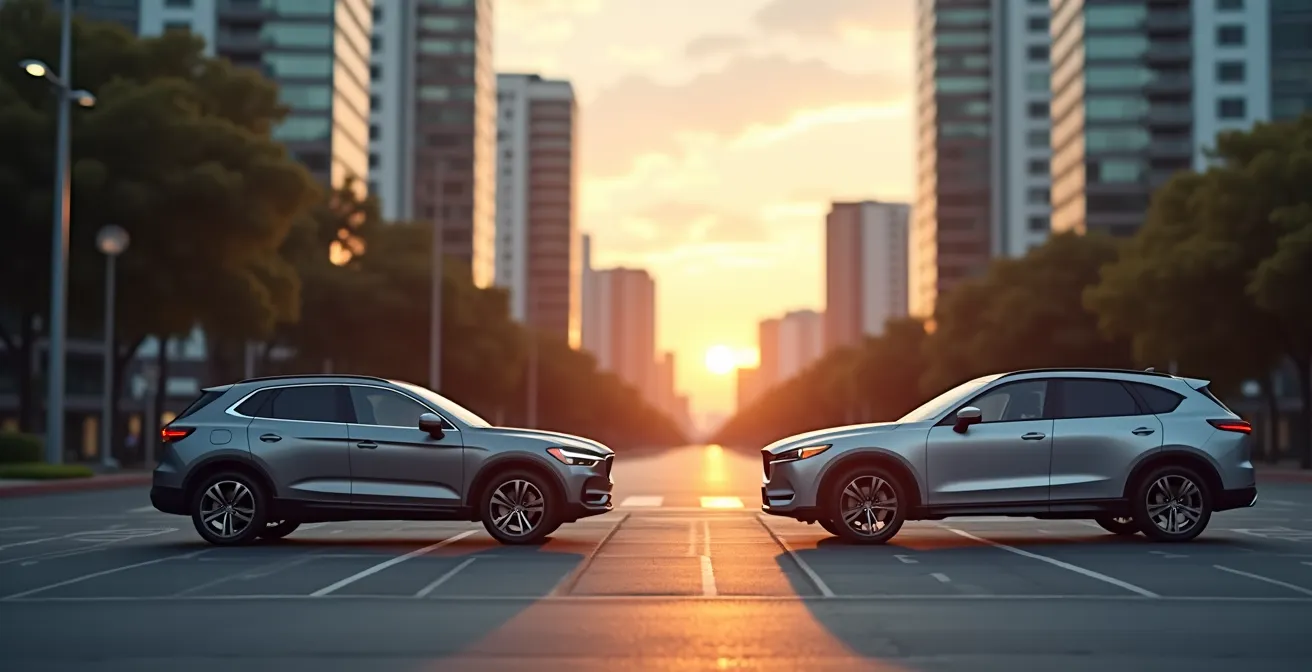
The popular shift to SUVs is based more on perception than practicality, often leading to compromises in safety, cost, and daily convenience.
- Despite a commanding view, SUVs present a greater statistical risk to pedestrians and can be less maneuverable in cities.
- The total cost of ownership—including higher fuel consumption, potential maintenance, and a diminishing resale advantage—often outweighs the perceived benefits of extra space.
Recommendation: Critically evaluate your daily driving needs before deciding; a modern sedan or a front-wheel-drive crossover with proper tires may be the smarter, safer, and more economical choice.
It’s impossible to ignore: the roads are dominated by crossovers and SUVs. For decades, the sedan was the default family car, but a massive market shift has crowned the sport utility vehicle as the new king. The appeal is understandable, driven by promises of more space, a commanding driving position, and the go-anywhere capability suggested by all-wheel drive. Many traditional sedan drivers now find themselves asking if it’s finally time to join the trend.
The common wisdom suggests the switch is a clear upgrade in safety and practicality. However, a closer look at the data reveals a more complicated picture. The perceived benefits that fuel this automotive migration often come with hidden trade-offs in real-world safety, urban usability, and long-term running costs. The feeling of safety from a higher seating position, for instance, doesn’t always translate to better outcomes in accident scenarios, especially for those outside the vehicle.
This article moves beyond the marketing hype to provide a critical analysis for the discerning driver. We will dissect the most common assumptions about SUVs, using data and expert analysis to compare them directly with their sedan counterparts. Is the extra space truly more practical for your family? Does all-wheel drive offer the safety net you think it does? And what is the real financial penalty for that higher ride height? By challenging these popular beliefs, you can make a decision based not on trends, but on a clear understanding of what you gain and what you give up.
To help you navigate this complex decision, this guide breaks down the key comparisons between crossovers and sedans, from safety implications to the practical realities of daily use and long-term costs.
Summary: The Sedan vs. Crossover Showdown
- Why Sitting Higher Doesn’t Necessarily Make You Safer
- How Much More Gas Does a Crossover Really Consume?
- Hatchback vs. Trunk: Which Is More Practical for Families?
- The Risk of Upsizing Your Car in a Congested City
- FWD with Winter Tires or AWD: Which Crossover Spec Do You Need?
- Why Your Car Loses 20% of Value the Moment You Buy It
- How to Judge if Your Crossover Can Handle a Forest Road?
- Plug-In Hybrid (PHEV) or Full Hybrid (HEV): Which Saves More Money for You?
Why Sitting Higher Doesn’t Necessarily Make You Safer
One of the most frequently cited reasons for choosing an SUV is the feeling of security that comes from a high driving position. This “command view” of the road can certainly boost driver confidence, but the belief that it equates to superior overall safety is a dangerous oversimplification. The very design that provides this high perch—a taller, blunter front end—creates significant blind spots and changes the dynamics of a collision, particularly with pedestrians. The perceived safety inside the cabin comes at the cost of increased external risk.
Research from the Insurance Institute for Highway Safety (IIHS) paints a sobering picture. While vehicle occupants may feel secure, the danger to pedestrians is magnified. An IIHS study found that at speeds of 40 mph and higher, SUVs were associated with a 100% pedestrian fatality rate in crashes, compared to 54% for sedans. The higher bumper and hood height of an SUV tend to strike a pedestrian in the torso and head, rather than the legs, leading to far more severe injuries.
As IIHS Vice President of Research, Jessica Cicchino, explains, the problem is systemic. In a statement on the findings, she noted:
We already know that larger vehicles cause more severe injuries when they strike pedestrians. The link between these vehicle types and certain common pedestrian crashes points to another way that the increase in SUVs on the roads might be changing the crash picture.
– Jessica Cicchino, IIHS Vice President of Research
This risk is further compounded in common urban situations like turning at intersections, where A-pillar blind spots on larger vehicles are more pronounced. The following data from IIHS highlights these disparities.
| Vehicle Type | 20-39 mph Fatality Rate | Turning Crash Risk | Visibility Issue |
|---|---|---|---|
| SUVs | 30% | 2x more likely during left turns | A-pillar blind spots |
| Sedans | 23% | Baseline risk | Better visibility |
Ultimately, the commanding view from an SUV cockpit offers a psychological comfort that is not fully supported by safety statistics. The trade-off is a demonstrable increase in danger to the most vulnerable road users.
How Much More Gas Does a Crossover Really Consume?
A larger size and heavier build inevitably come with a fuel economy penalty. While modern crossovers have made significant strides in efficiency, they rarely match their sedan counterparts built on the same platform. This difference might seem small on a per-gallon basis, but it represents a significant, recurring expense over the lifetime of the vehicle—a key part of the total cost of compromise when choosing an SUV.
To put this in perspective, let’s compare two of America’s best-selling vehicles from the same manufacturer: the Toyota RAV4 crossover and the Toyota Camry sedan. While the 2024 RAV4 is impressively efficient for its class, its non-hybrid version achieves up to 35 MPG on the highway. In contrast, the equivalent gasoline-powered Camry can reach up to 39 MPG highway. This gap widens further when comparing hybrid models, where the Camry can achieve over 50 MPG. This isn’t a small discrepancy; it’s a persistent drain on your wallet every time you visit the pump.

This visual representation underscores a simple truth: a heavier, less aerodynamic vehicle requires more energy to move. Over a year of driving 15,000 miles, the difference of even 5 MPG can translate to hundreds of dollars in extra fuel costs. For a sedan driver accustomed to excellent fuel economy, the frequent stops for gas can become a noticeable and frustrating new reality of SUV ownership. This recurring cost must be factored into any decision, as it directly impacts the long-term affordability of the vehicle far beyond the initial sticker price.
Therefore, while the utility of a crossover is appealing, it’s essential to honestly assess if that utility is worth a permanent increase in your annual fuel budget.
Hatchback vs. Trunk: Which Is More Practical for Families?
On paper, an SUV’s large, open cargo area and hatchback design seem like an obvious win over a sedan’s enclosed trunk. The ability to fold down seats and create a cavernous space for bulky items is a key selling point. However, this “practicality paradox” means that for everyday family life, the sedan’s trunk often provides a more secure, quiet, and user-friendly solution. The question isn’t just about maximum cubic feet, but about how the space is used day-to-day.
An SUV’s hatchback is unmatched for hauling a new flat-screen TV or a large piece of furniture. But for the daily grind of grocery runs, school bags, and sports gear, a trunk has distinct advantages. It naturally contains smaller items, preventing them from rolling around the cabin. It also offers complete security, hiding valuables from view in a way a cargo area with windows cannot. Furthermore, the lower lift-over height of a sedan’s trunk can be a significant ergonomic benefit, reducing strain when loading heavy groceries or luggage.
Data from an iSeeCars.com comparison of the RAV4 and Camry reveals this nuance: while the RAV4 offers substantially more cargo volume and shoulder room, the Camry provides superior front and rear legroom. For families with tall teenagers, the added legroom in a sedan might be more valuable than the vertical cargo space of a crossover. It highlights that “space” is not a single metric.
Your Checklist for Real-World Cargo Usability
- Vertical Space vs. Containment: Do you frequently carry tall, bulky items like strollers and large sports equipment (favoring an SUV), or do you need to keep groceries and loose bags contained (favoring a sedan trunk)?
- Security Needs: Do you often leave valuable items like laptops or shopping bags in your car? A sedan’s fully enclosed and hidden trunk offers superior security over an SUV’s visible cargo area.
- Loading Ergonomics: Consider the physical effort of loading. A sedan’s lower lift-over height is easier on your back and makes it simpler for shorter individuals or even older children to load their own gear.
- Cabin Isolation: Do you value a quiet ride? A sedan’s separate trunk compartment isolates the cabin from road noise and any sounds or odors coming from the cargo area.
- Flexibility vs. Consistency: Is your primary need the occasional massive haul that requires folding seats (SUV), or the consistent, everyday availability of enclosed storage space that doesn’t compete with passengers (sedan)?
The most practical choice depends entirely on your lifestyle. Don’t assume more space is always better space; consider how you’ll use it 95% of the time, not the 5% of the time you’re moving furniture.
The Risk of Upsizing Your Car in a Congested City
The freedom and capability an SUV projects can quickly turn into frustration in a dense urban environment. The very attributes that make it feel substantial on the open road—its width, length, and turning radius—become liabilities in tight city streets, crowded parking garages, and narrow parallel parking spots. This is the urban penalty: the daily stress and inconvenience of navigating a large vehicle through a space designed for smaller ones. For a driver transitioning from a nimble sedan, this can be a jarring and constant source of anxiety.
Maneuverability is the first and most obvious challenge. A sedan’s smaller footprint and tighter turning circle make U-turns, three-point turns, and navigating narrow alleys significantly easier. Conversely, an SUV requires more space and planning for the same maneuvers. This is not just an inconvenience; it has safety implications. IIHS research reveals that SUVs are twice as likely as cars to strike pedestrians during left turns, partly due to wider turning arcs and larger blind spots.

Parking is where the urban penalty is felt most acutely. The stress of circling a block looking for a spot large enough, or cautiously navigating the tight ramps and pillars of a multi-story garage, is a daily reality for many SUV drivers in the city.
Case Study: The Urban Parking Challenge
An analysis of city driving patterns consistently shows that sedans offer superior real-world maneuverability. Their smaller footprints are ideal for fitting into tight parking spaces and navigating narrow historic streets. Drivers frequently report increased stress and anxiety when navigating multi-story parking garages with larger crossovers, citing concerns about scraping pillars or other vehicles. In contrast, the sedan’s lower height and tighter turning radius make this daily urban navigation significantly less taxing, especially in dense metropolitan areas where parking infrastructure is often decades old and not designed for today’s larger vehicles.
While an SUV might be perfect for a suburban lifestyle with wide-open parking lots, it can feel like trying to fit a square peg in a round hole in the heart of a city.
FWD with Winter Tires or AWD: Which Crossover Spec Do You Need?
For many buyers, especially those in regions with inclement weather, the availability of All-Wheel Drive (AWD) is a primary reason to choose a crossover over a sedan. The belief is that AWD is a magic bullet for snow and ice, providing an non-negotiable layer of safety. However, this represents the “all-weather illusion”. While AWD is excellent at one thing—improving acceleration on slippery surfaces—it does nothing to improve braking or cornering. True winter safety comes from tires, not the number of driven wheels.
An automotive engineering analysis often highlights a critical distinction: AWD helps you ‘Go,’ but winter tires help you ‘Stop’ and ‘Turn.’ In a panic situation, braking and steering control are far more important than getting a quick start from a snowy intersection. A Front-Wheel Drive (FWD) vehicle equipped with a quality set of winter tires will consistently outperform an AWD vehicle on all-season tires in braking distance and cornering grip on snow and ice. The false sense of security provided by AWD can be dangerous, encouraging drivers to enter corners or approach intersections at speeds their tires cannot handle.
The cost-benefit analysis also heavily favors the FWD-plus-winter-tires approach. An AWD system is a costly option (often $2,000-$3,000 upfront) that also carries a year-round fuel economy penalty and adds long-term maintenance complexity. A set of winter tires is a smaller initial investment and only impacts fuel economy during the months they are used.
This table breaks down the true costs and benefits, challenging the assumption that AWD is the default best choice for winter.
| Factor | AWD System | FWD + Winter Tires |
|---|---|---|
| Initial Cost | +$2,000-3,000 | +$800-1,200 (tires) |
| Fuel Economy Penalty | 2-3 MPG year-round | ~1 MPG (winter only) |
| Maintenance | Higher (differentials, transfer case) | Seasonal tire changes |
| Acceleration (snow) | Excellent | Good |
| Braking (snow/ice) | Same as FWD on same tires | Superior with winter tires |
| Cornering (winter) | Good | Superior with winter tires |
Unless you regularly face deep, unplowed snow or steep, icy driveways where getting moving is the primary challenge, a FWD vehicle with dedicated winter tires offers a safer and more economical solution for the vast majority of winter driving.
Why Your Car Loses 20% of Value the Moment You Buy It
The old adage about a new car losing a huge chunk of its value the second it leaves the lot is well-known. However, in the Crossover vs. Sedan debate, depreciation has long been a point in the SUV’s favor. Historically, strong demand for used SUVs meant they held their value better than sedans. While this is still true to an extent, the market dynamics are shifting, and the depreciation advantage that crossovers once held is beginning to shrink.
Recent data still shows popular crossovers have an edge. For instance, an iSeeCars.com analysis shows the Toyota RAV4 loses only 30.3% of its value over 5 years, compared to 37.7% for the Camry. On a $35,000 vehicle, that difference is over $2,500, a significant factor in the total cost of ownership. This has been a powerful financial argument for choosing the crossover.
However, this advantage is not guaranteed to last. The same market forces that propelled SUV sales are now leading to a potential saturation of the used market. With SUVs now accounting for the vast majority of new vehicle sales, the supply of 3-to-5-year-old crossovers is increasing dramatically. Basic economics dictates that as supply rises to meet demand, prices—and therefore resale values—will begin to normalize. At the same time, the relative scarcity of late-model used sedans could help prop up their values.
The Market Saturation Effect on Resale Value
The used car market is undergoing a fundamental shift. As the wave of crossovers sold over the past five years enters the secondary market, the historical supply-demand imbalance is evening out. While popular models like the Honda CR-V and Toyota RAV4 continue to command strong resale values due to their reputation for reliability, the broad depreciation gap between the average crossover and the average sedan is narrowing. Experts predict this trend will continue as fuel-efficient and reliable sedans become harder to find on used car lots, increasing their appeal to budget-conscious buyers.
Relying on past depreciation performance as a primary reason to buy a crossover today may be a risky bet. The smart buyer will consider the possibility that the resale value gap could be significantly smaller by the time they are ready to sell.
How to Judge if Your Crossover Can Handle a Forest Road?
The rugged styling and available AWD on many crossovers project an image of off-road readiness. It’s easy to imagine venturing down a scenic forest road or a dirt path to a remote trailhead. However, the reality is that most crossovers are designed for “on-road slip management,” not the sustained challenges of unpaved terrain. Judging a crossover’s true capability requires looking past the marketing and inspecting a few key mechanical specifications.
The single most important factor for light trail use is ground clearance. This is the distance from the lowest point of the vehicle’s undercarriage to the ground. A typical sedan has 5-6 inches of clearance, while a standard crossover might have 7-8 inches. For handling a rutted forest road without scraping the oil pan or exhaust, a minimum of 8.5 inches is a widely accepted benchmark. Anything less, and you risk expensive damage from rocks or deep ruts.
Beyond clearance, the type of AWD system and, most importantly, the tires, determine true capability. As an off-road engineering expert from Subaru’s information center notes, “The single most effective upgrade for light off-road capability is switching from highway-focused tires to quality all-terrain tires.” The standard all-season tires on most crossovers are designed for quietness and fuel economy on pavement, and they quickly clog with mud or fail to grip loose gravel. A crossover’s AWD system is primarily designed to correct momentary slips on a wet or icy road, not to provide the continuous, low-speed traction needed to climb a steep, loose-surface hill.
Before you venture off the pavement, you need to perform a quick audit of your vehicle. Here are the key points to assess:
- Ground Clearance: Is it at least 8.5 inches? Measure from the lowest point, which might be the exhaust or a suspension component.
- Tires: Are they standard highway/all-season tires or more aggressive all-terrain (A/T) tires with deeper tread?
- Drivetrain: Does your vehicle have off-road modes in its traction control system that allow for more wheel spin in sand or mud?
- Underbody Protection: Look underneath for factory-installed skid plates protecting the engine, oil pan, and transmission. Their absence indicates a vehicle not intended for rough surfaces.
In most cases, a crossover is a “soft-roader” at best. Its capabilities are suitable for a well-maintained gravel road, but it lacks the fundamental hardware for anything that could be considered true off-roading.
Key Takeaways
- The perceived safety of a higher driving position in an SUV is offset by a statistically higher risk to pedestrians and reduced maneuverability in cities.
- The total cost of SUV ownership is consistently higher due to poorer fuel economy and potentially higher maintenance, and its historical resale value advantage is shrinking.
- True all-weather safety is dictated by tires, not drivetrain; a FWD vehicle with winter tires is often a safer and more economical choice than an AWD vehicle on all-seasons.
Plug-In Hybrid (PHEV) or Full Hybrid (HEV): Which Saves More Money for You?
After weighing the pros and cons of vehicle type, the final layer of financial complexity often comes down to the powertrain. For buyers set on a popular crossover like the RAV4, the choice between a standard full hybrid (HEV) and a plug-in hybrid (PHEV) presents another puzzle. Both promise significant fuel savings, but the right choice—and the one that actually saves more money—depends entirely on your personal driving habits, your housing situation, and your access to charging.
A full hybrid (HEV), like the standard RAV4 Hybrid, operates seamlessly. It uses its electric motor to assist the gasoline engine, capturing energy during braking and never needing to be plugged in. It delivers excellent fuel economy in all situations, with owner reports showing the RAV4 Hybrid consistently achieves 40-42 MPG in real-world mixed driving. It’s a simple, effective way to reduce fuel consumption with no change in behavior.
A plug-in hybrid (PHEV), like the RAV4 Prime, adds a much larger battery that can be charged from an external power source. This allows it to travel a significant distance (around 40 miles) on electricity alone. For a driver with a short daily commute and home charging, a PHEV can nearly eliminate gasoline use for everyday driving, resulting in massive fuel savings. However, this advantage evaporates on long-distance trips once the initial charge is depleted, and the benefit is minimal for an apartment dweller with no place to plug in. The PHEV’s higher purchase price can only be recouped if you can maximize its all-electric range.
Your driver profile is the ultimate deciding factor. A homeowner with a 20-mile round-trip commute is the ideal candidate for a PHEV. A traveling salesperson or an apartment dweller will almost certainly save more money over the long term with the lower purchase price and consistently excellent efficiency of a standard HEV. The choice is not about which technology is superior, but which one is superior *for you*.
Before committing to a specific model, the next logical step is to map out your typical week of driving. By calculating your daily mileage and assessing your access to charging, you can clearly determine which hybrid technology offers the best return on your investment.